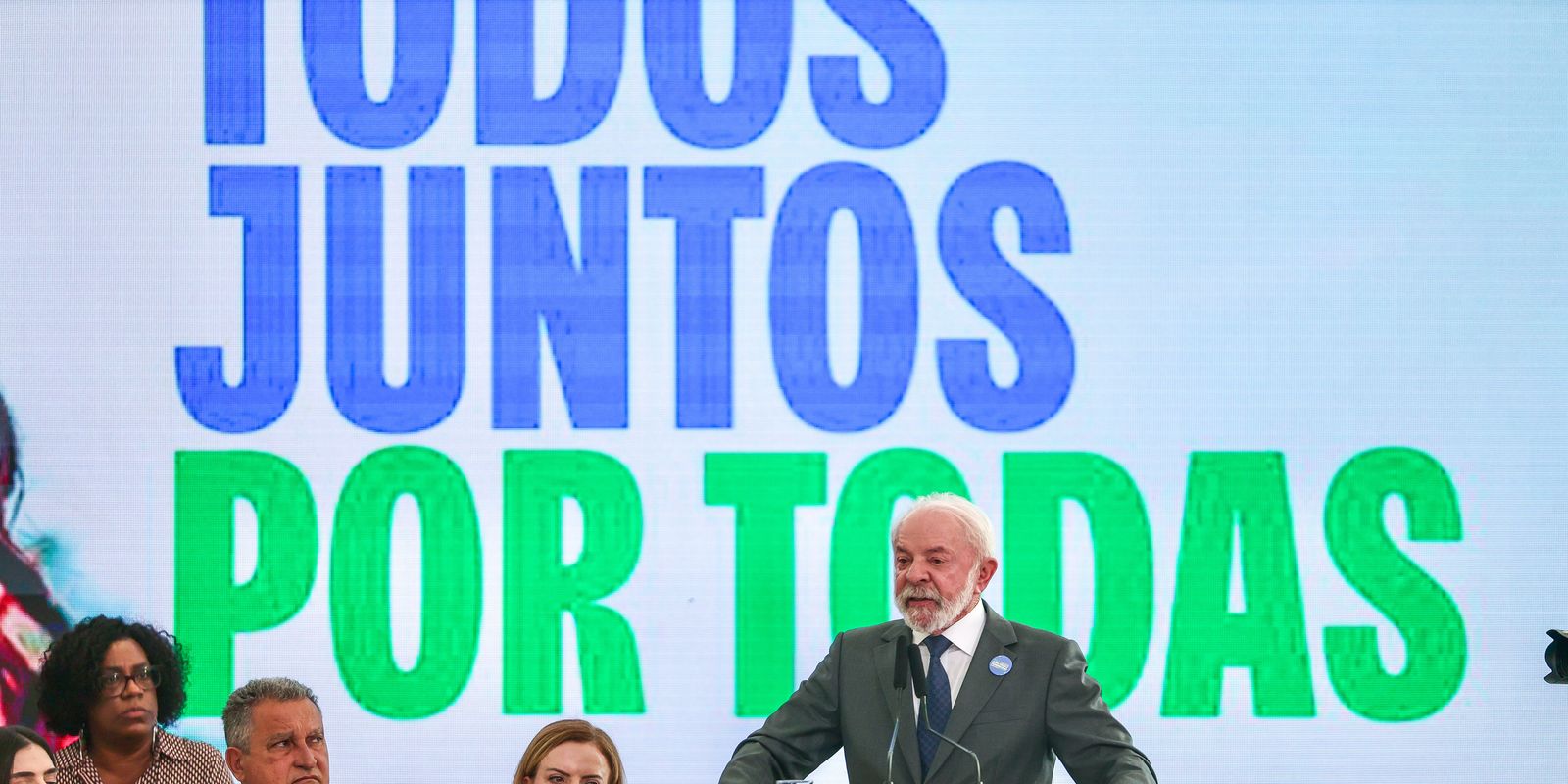
By signing the decree establishing the Brazil National Pact against FeminicidePresident Luiz Inácio Lula da Silva defended this Wednesday (4) that combating feminicide and all forms of violence against women must be the responsibility of society, but above all of men.
“It is not enough to not be an aggressor. It is also necessary to fight so that there are no more attacks. Every man in this country has a mission to fulfill”, he said, during a ceremony at Palácio do Planalto.
The pact provides for coordinated and permanent actions between the Three Powers, with the aim of preventing violence against girls and women in Brazil. The new thing, according to Lula, is that, for the first time, they are assuming that the responsibility in the fight to defend women does not lie solely with women.
“For the Brazilian trade union movement, we are saying that this is a theme for the factory gates and workers’ assembly. What we are saying for deputies is that this is a theme for all their speeches.”
“We are trying to raise awareness among children, because it is the duty of our teachers because it is a topic that goes from nursery school to university. This is the possibility of creating a new civilization. A civilization in which it is not sex that makes the difference, but behavior, respect”, he added.
In his speech, the president recalled that the domestic environment is a constant scene of violence against women and feminicide. “[Elas] They die at the hands of current or ex-husbands and ex-boyfriends, but also at the hands of strangers who cross their path.”
“They die because of men who do not accept being led by women. For these, it is necessary to say loud and clear: women are conquering more and more leadership spaces in the job market and will achieve even more. For justice and for merit. A woman’s place is wherever she wants to be”, he concluded.
The ceremony was opened by First Lady Janja da Silva. She read a story narrated by a woman who was the victim of an attack by a boyfriend, beaten in public, but who was unable to get help from people who witnessed the attack.
“This story could be mine or any woman present here,” said the first lady when asking men to also stand by women who are victims of aggression when they encounter this type of situation.
“We are all committed to creating a society in which women can live in peace. We want you, men, in this fight, by our side,” she added.
Afterwards, the Minister of the Institutional Relations Secretariat, Gleisi Hoffmann, highlighted that this is a priority agenda for the government, in different areas. She also highlighted the strategic campaign launched during the event which, according to her, will be of public benefit to society, and that the Federation Council will serve to “engage and have the support of states and municipalities in this cause”. Created in 2023, the board is made up of representatives from the federal, state, district and municipal governments, with the aim of promoting federative cooperation in the management of public policies.
>> Follow the channel Brazil Agency on WhatsApp
Judiciary and Legislature
The president of the Federal Supreme Court (STF), Edson Fachin, defended that the changes should not be limited to the cold letter of the law. “It is necessary to act on several fronts to prevent, hold accountable and protect [as mulheres]”, he said.
“The change in the law is important, but it is not enough. The change in the law must be accompanied by a change of minds and hearts in the State, in society, and most importantly: in families. This change begins when we start to act”, he added.
According to Fachin, the Judiciary signed this pact “with a sense of urgency and a feeling of hope, fully committing to the initiative”. “True peace is not born from fear and silence, but flourishes when there is protection, freedom and dignity”, he concluded.
The president of the Chamber of Deputies, Hugo Mota, recalled that Brazil ended the year 2025 with an average of four women murdered per day.
“It is inconceivable that we would allow these numbers to continue to occur. This action [prevista pelo pacto] it cannot be postponed”, he said, stating that the Legislature will act to tighten the laws, in order to punish “those who act in this way, be it violence against women”.
“Count on our priority in this agenda, to change this reality, he concluded.
The president of the Senate, Davi Alcolumbre, stated that Brazilian institutions are united in purposes like this. “Femicide is not just a statistic, but an open wound in Brazilian society”, which needs to be treated as a State problem, not a government problem.
“[O feminicídio] It is the cruelest side of violence that permeates the lives of thousands every day. And the pact is, first and foremost, a commitment between institutions; and a declaration of responsibility from the Brazilian State, which reaffirms one of its fundamental duties, by combating femicide with the utmost rigor; with absolute priority; and with permanent action”, he said.
Cases
Data from the judicial system show that, in 2025, Brazilian justice judged an average of 42 cases of femicide per day, totaling 15,453 trials – an increase of 17% compared to the previous year.
In the same period, 621,202 protective measures were granted, the equivalent of 70 measures per hour, according to the National Council of Justice.
Ligue 180, the Women’s Service Center, recorded an average of 425 complaints per day in 2025.
Check out information about the launch on Repórter Brasil Tarde, on TV Brasil
Understand the Pact
Among the objectives of the Brazilian National Pact against Feminicide are:
- accelerate compliance with protective measures,
- strengthen networks to combat violence throughout the national territory,
- expand educational actions and hold aggressors accountable, combating impunity.
The agreement involving the Executive, Legislative and Judiciary recognizes that violence against women in the country appears as a structural crisis that cannot be addressed by isolated actions.
The pact also provides for the creation of the Interinstitutional Management Committee, coordinated by the Presidency of the Republic. The collegiate will bring together representatives of the Three Powers, with permanent participation of public ministries and public defender offices, ensuring continuous monitoring, federative coordination and transparency.