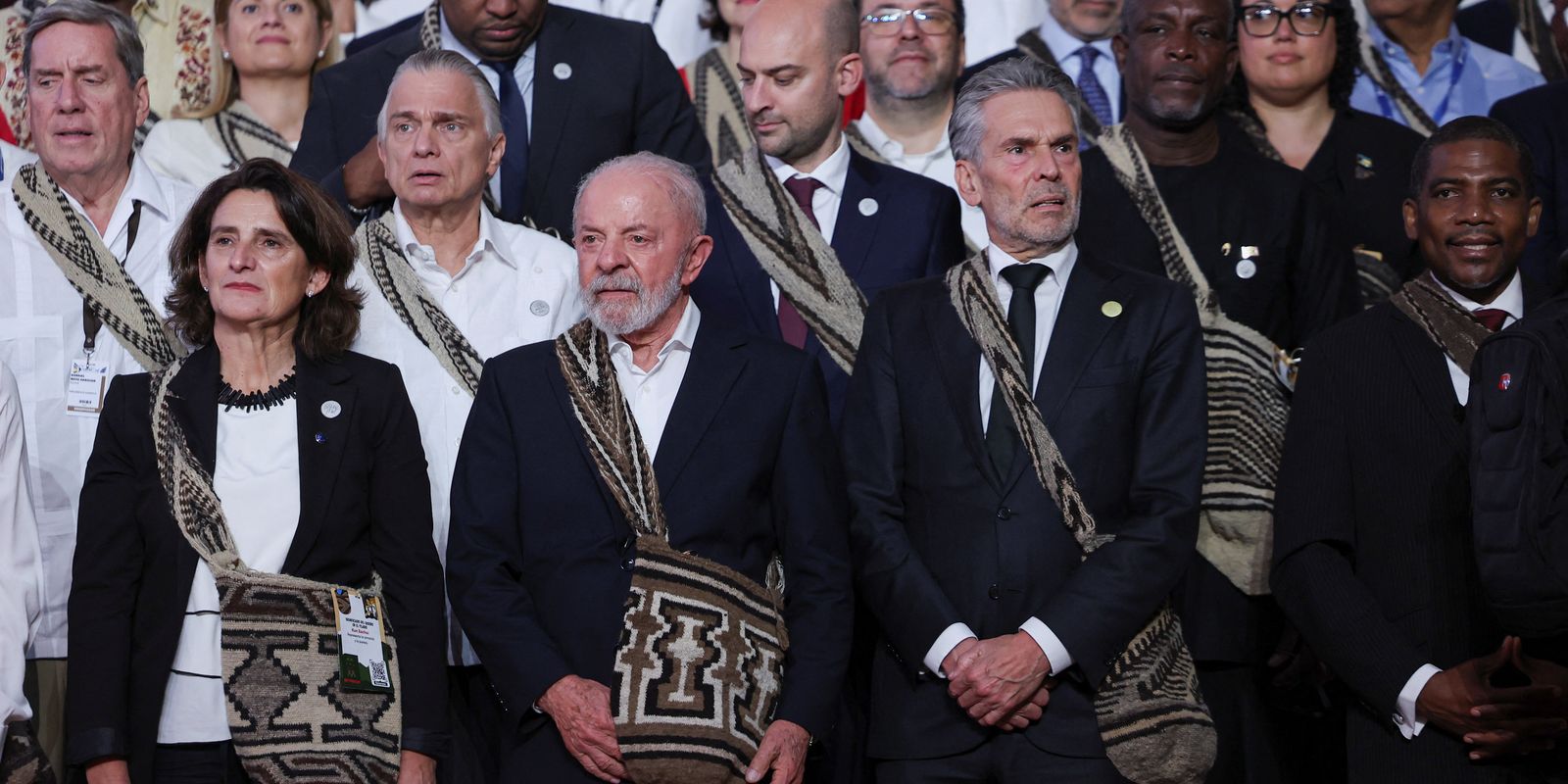
President Luiz Inácio Lula da Silva reinforced, this Sunday (9), in Santa Marta, Colombia, the defense of multilateralism between countries and criticized articulations that seek to justify the use of force and illegal intervention in countries.
“The threat of using military force is once again part of everyday life in Latin America and the Caribbean. Old rhetorical maneuvers are recycled to justify illegal interventions,” said the president, who did not name the countries involved.
“We are a region of peace and we want to remain at peace. Democracies do not fight crime by violating international law”, he added.
The statements were made during the plenary session on the first day of the 4th Summit meeting of the Community of Latin American and Caribbean States (Celac) and the European Union (EU).
American pressure
The meeting takes place against a backdrop of concern among Latin American governments about the United States offensive against alleged drug traffickers in international waters in the Caribbean Sea and the Pacific Ocean.
By order of American President Donald Trump, since September, military personnel have been targeting boats in the region, alleging that they were transporting drugs from countries such as Venezuela to the United States.
Last Friday (7), an attack left three dead. The announcement of the offensive was made by the American Secretary of Defense (equivalent to our Minister of Defense), Pete Hegseth. Operations like this have already left at least 70 people dead.
Trump has presented an intimidating speech against Venezuela, including insinuating offensive actions on land. Venezuelan President Nicolás Maduro denies the country’s involvement with drug traffickers and says that the American seeks to create reasons to invade the country, which has the largest oil reserves in the world.
Split region
The meeting in the city bathed by the Caribbean Sea brings together leaders from 27 EU countries and 33 from CELAC. Lula stated that the two groups of countries are central to the construction of a world order based on peace, multilateralism and multipolarity.
However, the president recognized that Latin America and the Caribbean had once again become a divided region, “more outward-looking than inward-looking.” He cited threats such as political extremism, information manipulation and organized crime.
“We live in meetings full of ideas and initiatives that often don’t get off the ground,” he said.
Fighting crime
Less than two weeks after government operation of the state of Rio de Janeiro against the Red Command faction, which left 121 dead – including four police officers – Lula, stated that security is a duty of the State and a fundamental right.
“There is no magic solution to end crime. It is necessary to repress organized crime and its leaders, strangling its financing and tracking and eliminating arms trafficking”, he argued. The president did not specifically mention the case in Rio de Janeiro.
Lula stated that no country can face the challenge in isolation. He recalled two actions that he classifies as permanent cooperation platforms to combat financial crimes and drug trafficking of weapons and people: the tripartite command of the triple border with Argentina and Paraguay, and the Center for International Police Cooperation in the Amazon, bringing together nine South American countries.
COP30
The president took advantage of the speech to draw countries’ attention to the progress and efforts of the 30th United Nations Conference on Climate Change (COP30), which will begin this Monday (10), in Belém.
“COP30, which is taking place in the heart of the Amazon, is an opportunity for Latin America and the Caribbean to show the world that conserving forests means taking care of the future of the planet”, he pointed out.
He exalted the Tropical Forests Forever Fund (TFFF, its acronym in English), one of Brazil’s main flags at COP30.
“Innovative solution so that our forests are worth more standing than being cut down.”
The president also called for efforts towards the energy transition, that is, the predominance of clean energy over fossil fuels, which emit greenhouse gases and cause global warming.
“Our region is a safe and reliable source of clean energy and can accelerate the reduction of dependence on fossil fuels.”
Woman in command of the UN
When defending policies for gender equality, Lula called for the presence of a Latin American woman in the highest position at the United Nations.
“Despite representing more than half of the world’s population, they have never held the highest function of the United Nations. The time has come to have a Latin American woman in the position of Secretary General of the UN”, he said.
The current secretary general, Portuguese António Guterres, has a mandate until 2026. Brazil had already defended a female presence in the institution’s top position. Names such as the former president of Chile, Michelle Bachelet, and the prime minister of Barbados, Mia Mottley, are mentioned.
Still this Sunday, President Lula leaves Santa Marta and heads directly to Belém, which will host, starting this Monday (10), the 30th United Nations Conference on Climate Change (COP30).