President Luiz Inácio Lula da Silva sanctioned this Tuesday (13), with vetoes, the second and final bill that regulates central points of the tax reformsuch as the management and supervision of the Goods and Services Tax (IBS). This new tax will gradually replace the Tax on the Circulation of Goods and Services (ICMS), charged by states, and the Service Tax (ISS), charged by municipalities. 
Collection, inspection and distribution of the new tax will be the responsibility of the IBS Management Committee (CG-IBS), formed by representatives of the Union, states and municipalities. The event that marked the sanction of Complementary Law Project (PLC) 108/2024 was held at the headquarters of the Federal Data Processing Service (Serpro), a public technology company, in Brasília. On that occasion, it was also launched Tax Reform Digital Platform.
Developed by the Federal Revenue Service in partnership with Serpro, the Tax Reform portal can be accessed through Gov.br and contains features such as a tax calculator, assisted calculation and real-time monitoring of amounts payable and credits receivable by companies. Considered the largest digital infrastructure ever developed for the Brazilian tax system, the platform has an estimated capacity to process around 200 million transactions per day and move approximately 5 petabytes of data per year. The portal has been tested by more than 400 companies in the last six months, according to the government.
“Just as people from other countries are amazed by our pre-filled Income Tax declaration, which is a source of pride for the Federal Revenue and for Brazil, everyone will be even more impressed with this new consumption taxation system”, highlighted the Secretary of the Federal Revenue, Robinson Barreirinhas.
The new technological platform, according to the secretary, takes Brazil to a level of ease, transparency and security in tax information that “does not exist anywhere else in the world”.
Among the best
In the assessment of the Minister of Finance, Fernando Haddad, the completion of another stage of the tax reform, which enters the third year since approval of a constitutional amendmentwill place Brazil among the countries with the best tax management and collection system on the planet.
“It is one of the first tax reforms on consumption that aims to be progressive because the poor receive cashback [devolução do imposto] on a significant set of taxed goods, but he will not pay tax. In addition to a much more generous basic food basket, with animal protein, and a basket of essential medicines that will also not be taxed. It greatly changes the lives of Brazilians, in general, and those who undertake, in particular”, observed the minister.
According to Haddad, the new system’s facilities will free many workers from the bureaucratic tasks of dealing with complex tax issues, which will be completely simplified.
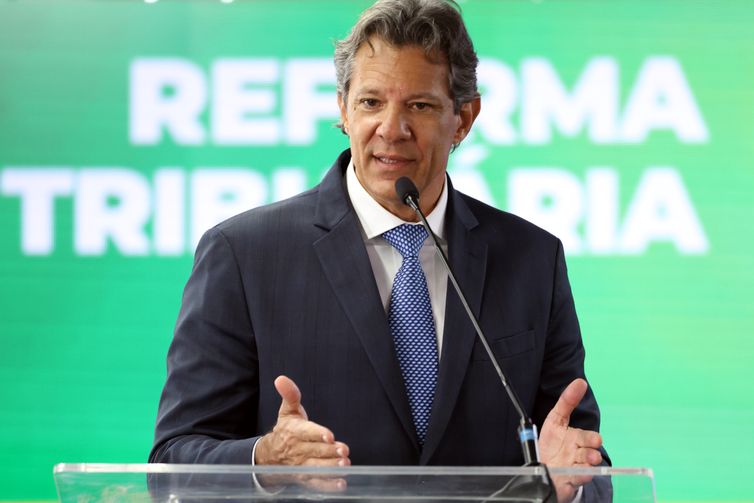
Fernando Haddad says the system will take many workers away from bureaucratic tasks – Valter Campanato/Agência Brasil
Transition
The year 2026 will be dedicated to testing the adaptation of tax reform. Companies will have until the fourth month after the law is enacted to test the new systems, adjust their tax documents, identifying the new taxes (CBS and IBS), although without actual payment. There will be no penalties.
The effective collection of CBS and the Selective Tax — which is levied on products harmful to health and the environment — begins in January 2027. CBS is the Contribution on Goods and Services (CBS) and will replace PIS, Cofins and IPI, which are federal taxes.
IBS will enter a transition phase from 2029 onwards, with the total extinction of ICMS and ISS scheduled for 2033.
Other changes
The new law sanctioned by Lula also establishes that the state tax on inheritances must be progressive, which is a victory in the trajectory of building a progressive tax system in which those who have less pay less. The Tax rates on Causa Mortis Transmission and Donation of Any Goods or Rights (ITCMD) will be defined by each state, respecting the rate ceiling defined by the Federal Senate.
The details of the presidential vetoes on the new law were not provided by the government until the article was written.