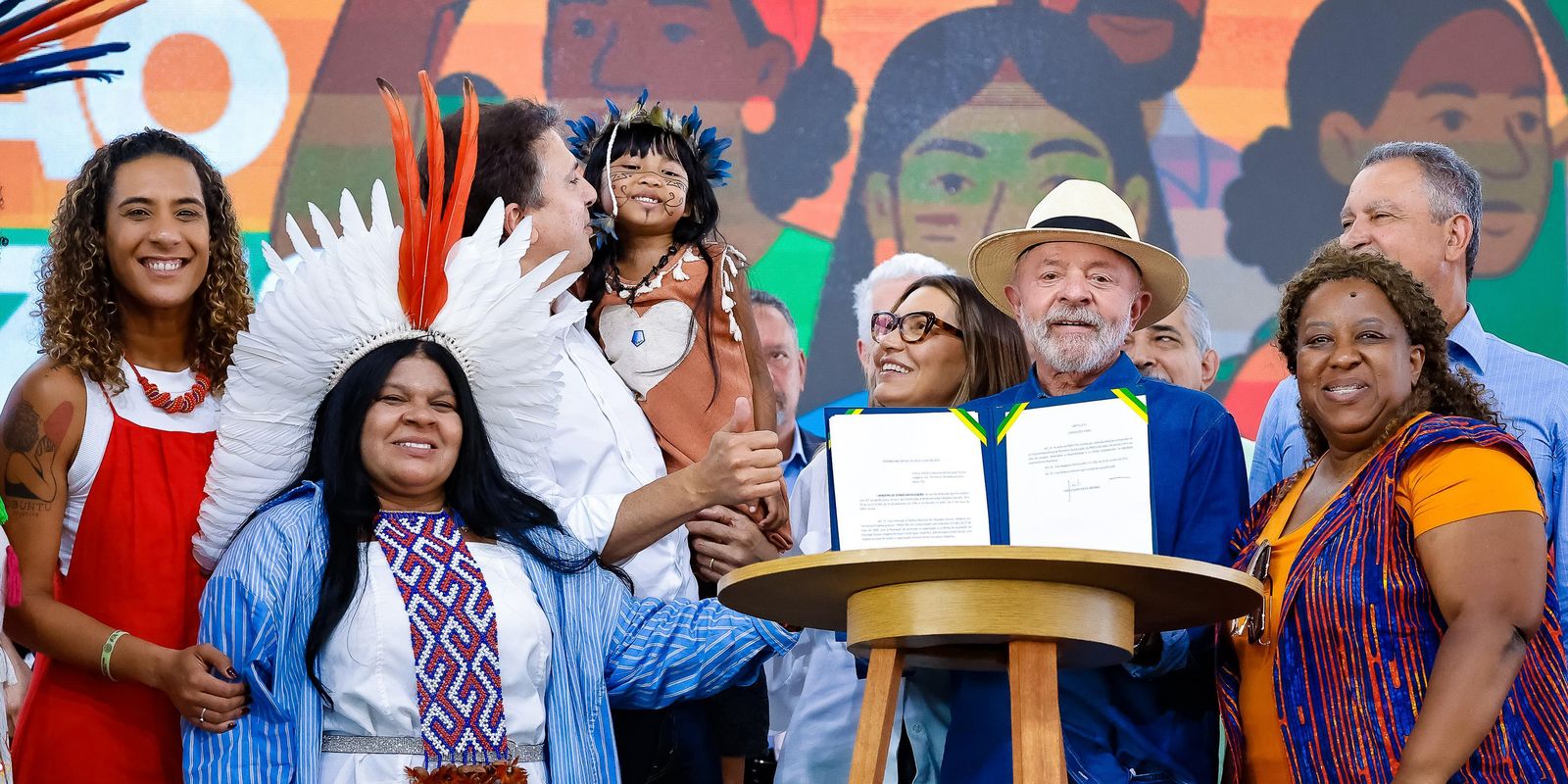
President Luiz Inacio Lula da Silva defended, on Thursday (24), educational public policies for traditional populations, such as quilombolas and indigenous people, for the socioeconomic inclusion of these peoples. Lula participated in a federal government announcements ceremony in the area of education and racial equality in Minas Novas (MG), in the Jequitinhonha Valley.
“Today I come here to recognize the knowledge of the people of this region, recognize the value of the indigenous people, recognize the value of quilombolas, recognize the values of women, recognize the values of those people who work from sun to sun to build their own lives, the city and the region,” he said.
The president cited a young quilombola present at the event, a doctoral student in Brasilia. “Many of you are wondering why she managed to win in life. She will be more new, she is very young. And she only won in her life because she had a public policy that allowed a poor person to study in this country, that a quilombola can be a doctor, can do postgraduate and whatever he wants,” he said.
One of the highlights presented today is the investment of R $ 1.17 billion in the construction of 249 schools aimed at indigenous and quilombola communities, under the new Growth Acceleration Program (PAC). The works have been delivered since 2024 and continue until next year. The government also works in 22 emergency works in the Yanomami and Ye’kwana territories, including schools and a teacher training center.
The president also signed an implementation of the National Policy of Indigenous School Education and aims to realize the organization of indigenous school education in ethno -educational territories that respect the social, historical, cultural, environmental and linguistic needs and specificities of each people.
>> Follow the channel of Brazil agency on WhatsApp
The Minister of Indigenous Peoples, Sonia Guajajara, recalled that the illiteracy rate among the indigenous population is twice the national rate. While illiteracy reaches 7% of the Brazilian population, among indigenous people the percentage is 15%.
Guajajara also spoke about the structural problems of indigenous schools: 26% have no sanitary exhaustion, 27% do not have drinking water, 55 do not have internet, 90% have no library, 94% do not have sports court. In addition, 78% of teachers are temporary.
“The path is still somewhat long for us to reach the equitable model, which offers equality of opportunity for indigenous people and, even more so, to reach the culturally appropriate model. The indigenous person has the right to be literate and competitive in the labor market. But above all, he has the right to become a citizen within their indigenous land, with their own learning and their people in harmony with their people and in their people and in harmony in harmony with their people and in harmony with harmony with harmony with harmony with harmony with harmony with harmony with harmony with harmony with harmony with harmony with harmony with harmony Earth, ”said the minister.
This Thursday’s ceremony is part of the 1st Regional Meeting of Southeast Quilombola School Education, which brings together interministerial initiatives in direct dialogue with local communities, especially from Jequitinhonha Valley.
New policies
The government also establishes the Nego Bispo National School Program that will integrate traditional knowledge on Afro -Brazilian and Indigenous History and culture in the formation of teachers of public higher education institutions. The appreciation and integration of these knowledge is also provided for in the continuing education of basic education professionals, according to the National Equity Policy, Ethnic-Racial Relations Education and Quilombola School Education.
“With this, it is intended to guarantee the pluralism of ideas, pedagogical and epistemological conceptions and the protagonism of the subjects, trajectories and epistemological conceptions of the territories, aiming to alter the historical processes of invisibilization and face racism within the educational institutions,” explained the government, in a statement.
Also, the National Policy of Field, Waters and Forests (New Pronamocamp) is officialized that aims to expand, qualify and guarantee the offer, access and permanence in the field of field education, in all stages and levels of education. Among the goals are the structuring of a system of evaluation and monitoring of the education of the peoples of the countryside, waters and forests and consolidation of the sport with the implementation of the national curriculum guidelines for the school’s school education.
Also among the announcements is the creation of the student housing of the Quilombo Minas Novas Campus, of the Federal Institute of Northern Minas Gerais (IFNMG). The new campus integrates the expansion plan of the 102 new federal institutes across the country and will primarily serve quilombola communities and other traditional peoples of the region, from a perspective of articulated education between the local context, traditional knowledge and their productive, social and cultural arrangements.
The Ministry of Racial Equality and the City of Minas Novas have signed a municipality’s adhesion term to the National Quilombola Territorial Management Policy, which seeks to strengthen the autonomy, self -management and ethnodes of these communities, reconciling socioeconomic development with environmental protection.
Cultural heritage
Also during the event, Lula gave the title of Brazil Cultural Heritage Knowledge of the Rosary: Reign, Congado and Congadas. They are Afro -Brazilian ancestral traditions with over 300 years of history, updated through devotion to Our Lady of the Rosary, but maintaining her fundamental identity, which is the ancestry of African matrix, with singing, rhythm and dance.
The title is the official act designed to recognize that an intangible cultural good is part of the set of knowledge and expressions that make up the Brazilian cultural heritage. The recognition is made by the Institute of National Historical and Artistic Heritage (IPHAN).