Santo Domingo.-A flock of motorcyclists surrounded his vehicle like a rushing river of stone that refuses to give way. One hit hard on the side, reversing the direction of the rearview mirror, while five or six of them crossed the red light before the indifferent gaze of several Digesset agents, while the rest stopped on the white line that corresponds to pedestrians.
The scene is common to any driver in the Dominican Republic and according to the results of the study “Marketing of motorcycles: realities that impact”, carried out by the Association of Motorcycle Manufacturers Dealers (Afamoto), the lack of schooling is the main reason for the behavior of motorcyclists.
The research showed that 83% of motorcyclists have a primary education or less and only 17% reach technical high school. The figure is worth considering, taking into account that obtaining a degree level in the country is increasingly irrelevant, which has led thousands of professionals to resort to specializations and even doctorates.
This would be one of the main reasons for the misconduct of motorcyclists on the streets, who are unaware of traffic laws, which reinforces the idea that the problem is not the motorcycle itself, but the way in which it is used in the opinion of the entity.
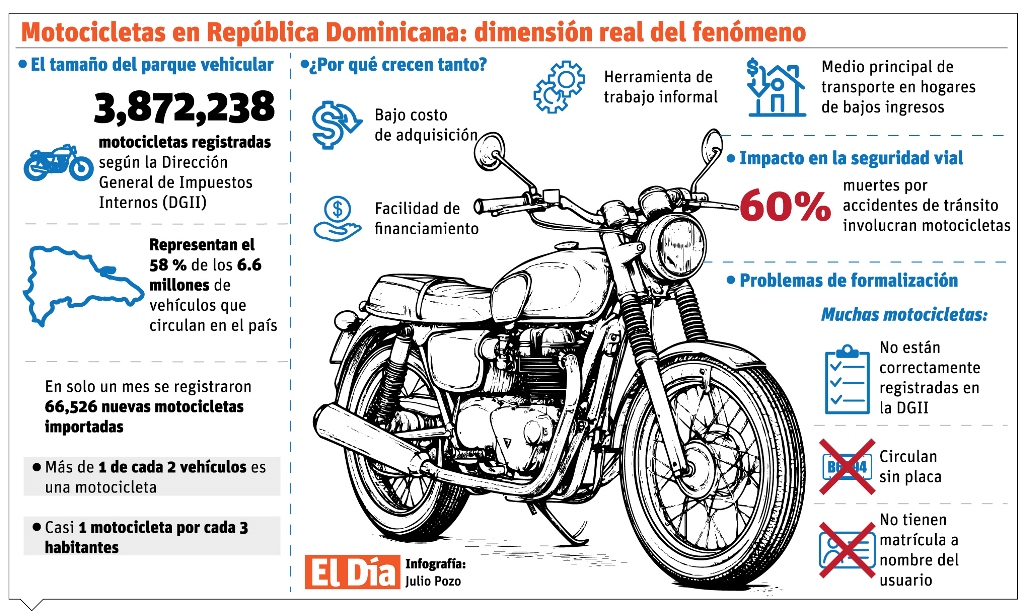
However, the motorcyclist is an essential part of mobility in the country. The Afamoto study highlighted that daily 2.66 million people travel nationwide on motorcycles and that in the metropolitan area the figure rises to 1.6 million users. According to their figures, the use of motorcycles generates more than 185 thousand direct and indirect jobs throughout the national territory, becoming an important source of economic support for thousands of families.
That is, the solution to the problem must include the problem itself.
Proposals
Given this scenario, Afamoto urged that every motorcycle have its license plate and license plate in the user’s name, since – as he explained – a significant part is not duly registered in the General Directorate of Internal Taxes (DGII) and circulates without a license plate or with a license plate that does not correspond to the current driver.
Another proposal is that the issuance of motorcycle plates be resumed at the time of importation or, failing that, that provisional plates be implemented. They also urged to consider creating an agile mechanism to manage oppositions to license plates, since 85% of motorcycles are acquired via credit and around 50% must be recovered for non-compliance.
Study reveals that only 17% graduated from a technical high school. Position. Entity suggests measures such as the implementation of plates and the annual tag collection. As a complement to the above, renew the tag annually, and regularly download the vehicle registry from the DGII to eliminate inconsistencies in the real number of units in circulation and convert those that do not have a registered chassis into scrap metal. Regarding driver’s licenses, they suggest applying stricter controls.
Helmet for both
—The passenger
One of the absurdities of motorcycle traffic is that it is only required of the driver, not the passenger. In other countries, it is normal and mandatory for both to use a protective helmet, which, moreover, must be approved.