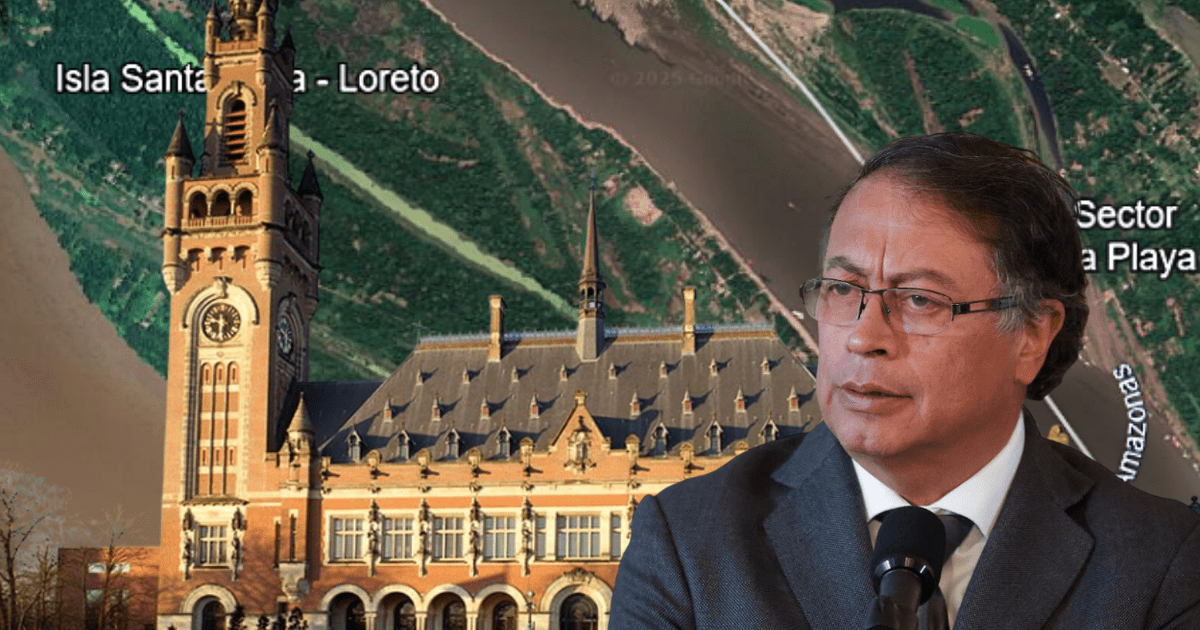
In the middle of the border tension, the Minister of the Interior of Colombia, Armando Benedettideclared that the government of his country, led by Gustavo PetroI could go to the Hague cut to resolve the alleged conflict over the Santa Rosa Island. This occurs after Petro accused the Peru of, allegedly, take part in its territory and violate the Rio de Janeiro protocol. In that context, during an interview for W Radio, Benedetti said that the possibility of going to an international instance is established in the aforementioned treaty.
“If they do it for a law, it is something quite aggressive, the statement is quite aggressive, they did not convene a binational assembly to see the agreements. As this is going wrong and the thing gets ugly, we could go to Haguewhich is what contemplates the Agreement of the Treaty of 1934, “he emphasized.
However, Benedetti acknowledged that the problem with Leticia and the island of Santa Rosa arises as a result of the change of the Amazon flow and not for Peru’s responsibility. “Yes, it is a geomorphological issue, in which it was very clear that the deepest side would be for Colombia,” he said.
Although various authorities do not support the management of the Colombian President, the head of the Interior portfolio said that “Peru has taken a law to” appropriate “the Santa Rosa Islandthus supporting Petro’s sayings. However, the Government He replied that the creation of the district was made according to the established statutes. Likewise, specialists agreed that the Loreto district belongs to Peru and that the president uses accusations to divert attention from Colombia for the crisis he faces in his country.
“I worry a lot because Peru took a law and appropriates from Santa Rosa Island and we had been that since 1929 the islands, that there are 4, those issues had to be settled in a binational commission that is for the delimitation of borders. And it turns out that, oh surprise, they come and, through a law, dictate sovereignty and limit on that island,” he said.
Meanwhile, although he threatened to go to international instances, Benedetti did not rule out the possibility of Peru not attending the court of Hague. “But how about Peru does not go to The Hague? How do we recover this sovereignty? (…) I am putting it in the form of a description, Peru has skipped several diplomatic instances to solve things friendly (…) things can get ugly. We do not get along with Peru, we have no ambassador,” he questioned.
You can see: Exalcalde of Santa Rosa Island demands the presence of Dina Boluarte in the area: “That you see the needs we have”
Colombia rejects accusations of Gustavo Petro
During his visit to Parliament to be part of a work table on Tuesday, August 5, the Colombian congressman, Juan Carlos Lozada, He described Petro’s statements as a “verbal excess”, after pointing out that Peru would have “copied” its territory in the Amazon.
“Well, if he says it that way, it seems to me that President EH commits, if he wants, a verbal excess. It seems to me that in the light of what the statement of the Colombian Foreign Ministry says, what corresponds is that the mixed table that establishes how the distribution of new territories is made (…) I do not think it is prudent to try to climb the language to invasions or occupations,” he said.
Also, through their social networks, the former vice president of Colombia, Marta Lucía Ramírezhe lashed out at Petro and denied that there is a dispute with Peru on the island of Santa Rosa. “It is not true that we have any border or historical dispute with the Government of Peru, we have a treaty of friendship cooperation and that has been very fluid, there is no problem. (…) What Petro does is nothing more than a pretext to move the celebration of Boyacá to the Amazon, because everything is out of control.”
Similarly, the Board of Directors of the Peru Congress He rejected the statements of the Colombian president and ratified the national sovereignty about the island of Santa Rosa. Along the same lines, the Legislative supported the pronouncement of the Foreign Ministry and the National Assembly of Regional Governments, which “have ratified the legitimacy of the acts of the Peruvian State.”
Former mayor denouncing the State in Santa Rosa
After the creation of the district of Santa Rosathe former mayor of the populated center, Iván YoveraHe denounced that there is no elected authority and state elections in the town. Similarly, he warned of the lack of presence by the State in the area. “The abandonment is total. Here we continue as always, forgotten.”
“We have always been Peruvians, but abandonment is total. They have never come to ask what we lack.” Along the same lines, he called on the president Dina Boluarte to know the needs of citizenship.
“I called the President of the Republic, Dina Boluarte, to visit Santa Rosa, who comes personally, even to give us our creation law, which she herself signed after the approval of the Congress. So far we have not had that response of the president,” she emphasized.
Peru Army arrives in Santa Rosa Island to place Peruvian flags in the middle of border tension
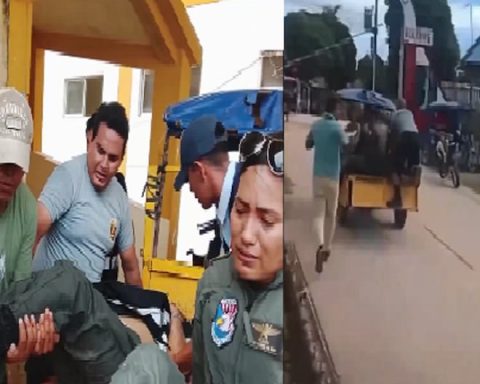
In the morning of Wednesday, August 6, correspondents of the island Santa Rosa reported the Presence of military from the Armed Forces of Peruwho arrived in the city to place Peruvian flags in order to strengthen the presence of the State in the town.
Therefore, the soldiers arrived in the company of various representatives of the State and went to the military barracks in Santa Rosa. The civic actions of the Armed forces It occurred in the midst of territorial tension between Peru and Colombia after the statements of Gustavo Petro Last Tuesday, August 5.
The opinion of a specialist about an eventual dispute in The Hague
In communication with The Republicthe researcher with specialization in international relationships and business, Juan Carlos LadinesHe pointed out that the decision to go to the Court of the Hague corresponds to the president and the chancellor of each country and that “both parties must recognize the jurisdiction of the Court to be presented with the claim.” He also recalled that, previously, both Peru and Colombia went to the international instance to solve border problems, against Chile and Nicaragua, respectively.
When asked if the Hague Court could take from Santa Rosa to Peru, he mentioned that “you have to put together a file and proposal of both parties to just be able to evaluate what possibilities and arguments present the parties”
“More than giving and removing is recognition of sovereignty. And of course limit definition. The formation of islets and other environmental impacts must be taken into consideration to define border criteria,” he said.
“Both must recognize the jurisdiction of the Court, since the decisions they pose are not appealable. It is a long process, yes, but that reaffirms institutionality in the border issues,” he said.
Finally, Ladines stressed that one country could not force another to attend The Hague and that “bilateral border agreements can be established, it is with external observers.” Finally, he stressed that it can take up to five years of time to resolve the conflict in an eventual dispute in The Hague, taking into account the last case between Chile and Peru.