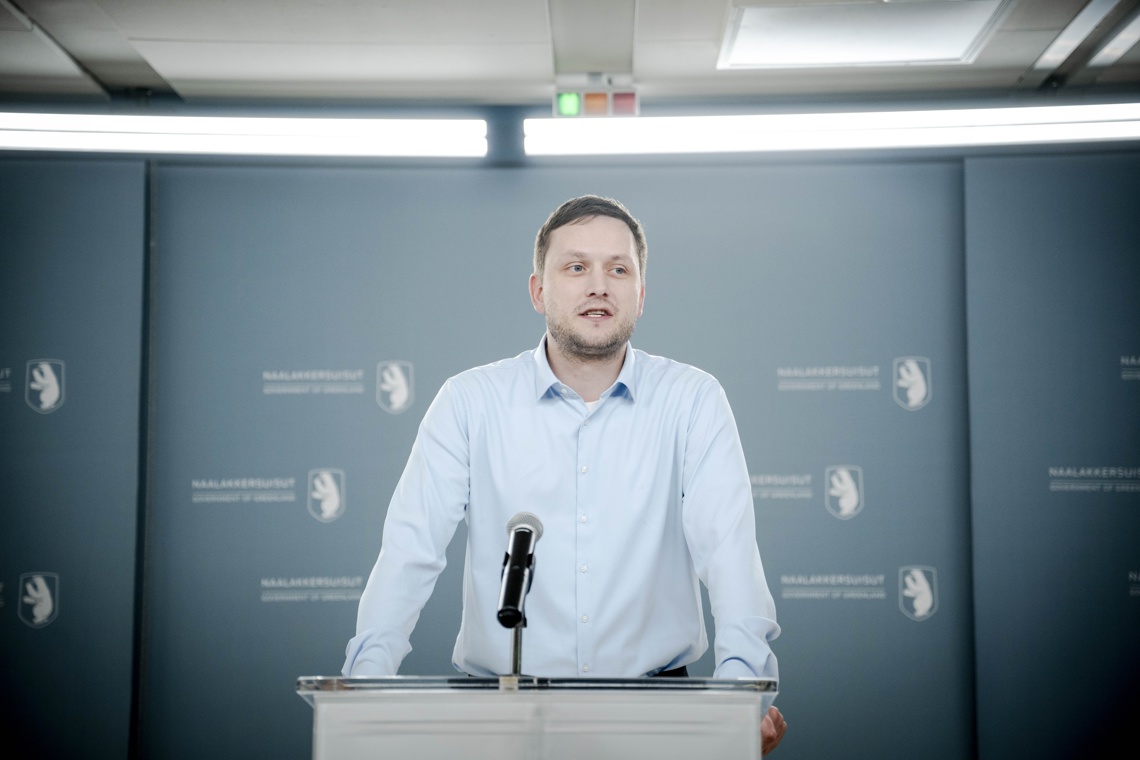
The president of the autonomous government of Greenland, Jens-Frederik Nielsen, asked this Monday to avoid “panic” in the face of the renewed interest of the United States in taking over the Arctic territory, although he recognized that pressure from Washington forces us to reflect on the future of the largest island in the world.
“We are not in a situation where the United States can conquer Greenland. That is not the situation, so there is no need to panic. We must restore the good collaboration we have had,” Nielsen said at a news conference in Nuuk, the capital.
The Greenlandic leader rejected comparisons with Venezuela, where just two days ago the United States carried out a military operation to capture President Nicolás Maduro.
“Our country is not the right one to compare with Venezuela. We have been a democratic country for many years,” he stressed.
European support and defense of sovereignty
Nielsen’s remarks came amid widespread European support for Denmark and Greenland. The European Commission reaffirmed that the European Union “will continue to defend the principles of national sovereignty, territorial integrity and the inviolability of borders.”
British Prime Minister Keir Starmer expressed support for Danish Prime Minister Mette Frederiksen, who had urged Washington to stop its threats.
From Madrid, the President of the Spanish Government, Pedro Sánchez, ratified “full solidarity” with Denmark and Greenland, and recalled that “from Ukraine to Gaza, passing through Venezuela”, respect for sovereignty is “non-negotiable.”
German Foreign Minister Johann Wadephul warned that Greenland, as part of Denmark, would have to be defended as NATO territory against any threat.
Trump insists on the strategic value of the island
President Donald Trump twice reiterated his interest in Greenland, citing national security reasons. “I don’t want to talk about Greenland. Let’s talk about Venezuela, Russia, Ukraine… We’ll worry about Greenland in two months,” he initially said aboard Air Force One this Sunday, before emphasizing its strategic value.
Trump assured that the island is “surrounded by Russian and Chinese ships on all sides” and that Denmark “will not be able” to guarantee its security.
On several occasions over the last year, the president has stated that the United States “needs” Greenland and has suggested that he could explore ways to bring it under US jurisdiction.
The appointment of Louisiana Governor Jeff Landry as US special envoy to Greenland sparked criticism in Copenhagen and Nuuk, which filed a formal protest with the US ambassador.
The Danish response: respect and caution
Danish Prime Minister Mette Frederiksen acknowledged that she takes Trump’s intentions seriously, but insisted that she will do everything possible to ensure that the situation is resolved peacefully. “I believe in democracy and a rules-based international order,” he said.
Frederiksen assured that she is not “nervous,” although she is not “naïve” about the possibility of Washington acting unilaterally. “If a NATO country attacks another NATO country, everything will be over. Including our NATO and, consequently, the security it has provided since the end of the Second World War,” he warned.
Greenland, with a population of about 57,000 inhabitants in a territory of 2.1 million square kilometers, depends on fishing and annual economic aid from Denmark, which covers about half of its budget.
Washington’s interest in Greenland is not new, but Trump’s insistence has set off alarms in Europe. Analysts point out that the island has become a key point in the strategic competition with Russia and China in the Arctic.
Nielsen, for his part, said he wants to “deepen” and “reinforce” the relationship with NATO and establish a “direct line” of communication with the United States, preventing tensions from being managed through the media.
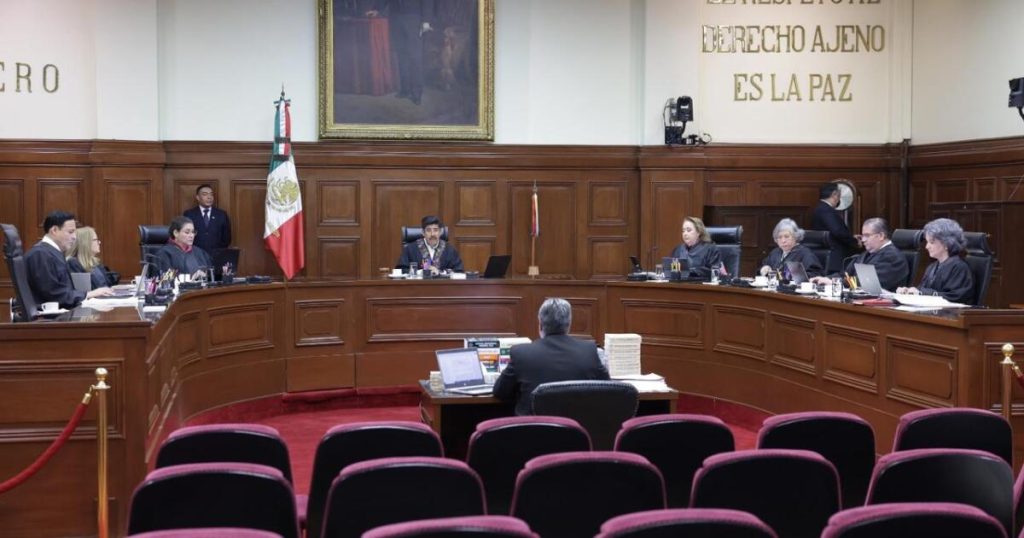
After the US attack on Venezuela, Trump once again insisted on the need to act against the cartels in Mexico.
Although the Mexican government and analysts rule out unilateral military action, they recognize that threats could intensify as a tool of pressure.
President Claudia Sheinbaum minimized the possibility of intervention. “I don’t see risks. There is coordination, there is collaboration with the United States government,” he said.
“Organized crime cannot be resolved with intervention,” he added, reaffirming his defense of sovereignty and international legality.
Mexico, experts point out, has a different situation than Venezuela or Cuba: it has democratic legitimacy, is the main trading partner of the United States and is home to some 40 million Mexicans residing in the northern neighbor. The Secretary of State himself, Marco Rubio, recognized that bilateral cooperation “is at a high level,” recalled a note from the agency. AP.
Trump and his collaborators have flirted with the idea of militarily attacking the cartels since the election campaign, although with increasingly restrained tones. Sheinbaum has even acknowledged that the US president has proposed to her in phone calls to “enter Mexico” to combat the cartels, initiatives that she always rejected.
A negotiation weapon with a view to the T-MEC
Analysts such as David Saucedo consider that threats function as a “negotiation weapon” to obtain commercial and political advantages. “Marco Rubio and Donald Trump play the good cop and the bad cop,” he estimated.
Mexico has intensified cooperation: more arrests and drug seizures, extraditions of drug traffickers and acceptance of deported migrants. “A military intervention would put this cooperation on hold,” warned Carlos Pérez Ricart, an academic at the Center for Economic Research and Teaching (CIDE).
With the review of the T-MEC trade agreement underway and the anti-narcotics cooperation agenda, Mexico will have to “tread fine lines” in its relationship with the United States, said Arturo Sarukhan, Mexican ambassador in Washington between 2007 and 2013. In his opinion, openly supporting Maduro or maintaining ties with Cuba could be costly for the Mexican administration.
For her part, diplomat Martha Bárcena stressed that Mexico must fight more strongly against political corruption linked to organized crime and continue defending international legality.
“The United States does not operate under the logic of rationality. At this moment all possibilities are open, even those unimaginable until a year ago,” Pérez Ricart concluded.