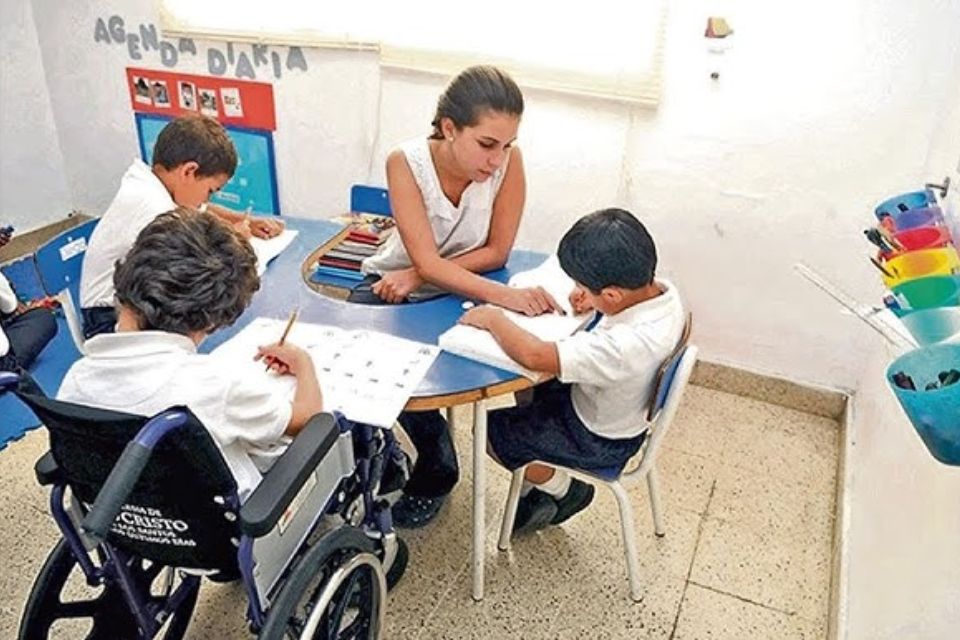
The presence of students with disabilities in schools in Latin America and the Caribbean is low in pre-primary ages, with a gradual increase until twelve years of age, when it reaches a maximum of 33 students with disabilities per thousand. From that age onwards, participation begins to fall, according to a new UNESCO study
Millions of students with disabilities in Latin America and the Caribbean continue to face insufficient access, unequal participation and gender and permanence gaps in the educational system, warned the United Nations Educational, Scientific and Cultural Organization (UNESCO) in its latest report.
The new regional report revealed that 2.3 million students with disabilities, spread across 16 countries that participated in the UNESCO survey, are in school.
The trajectory of these children and young people is marked by multiple obstacles. Its presence is low in pre-primary ages, with a gradual increase until age 12, when it reaches a maximum of 33 students with disabilities per thousand. From that age onwards, participation begins to fall and, at age 17, the figure drops to 24 per thousand.
UNESCO also highlighted significant gender gaps: male participation is greater at all levels, with especially marked differences in primary and secondary school, where the number of men almost doubles that of women with disabilities.
In terms of infrastructure, although 94% of countries have standards for ramps or stairs with handrails in educational centers, accessibility remains partial.
*Read also: Ministry of Education is getting ready to adopt regulations on homework
Only one in four countries includes textures on walls for blind people, and barely half contemplate visual signage for deaf students, evidencing barriers that are still present for the full participation of these students in school life.
Regular schools and special schools
The distribution between regular and special schools also highlights inequalities. On average, 81% of students with disabilities are enrolled in regular schools and 19% in special schools. However, less than half of the regular educational centers effectively receive this group.
Added to this are differences between sectors: in public primary schools, 82% of students with disabilities attend regular education, while in the private sector the proportion drops to 56%.
The report also analyzes the transitions between modalities. The data show that 4.5% of students go from special to regular schools, compared to only 0.6% who do the reverse.
However, the challenges of permanence are not encouraging: 37% leave school in secondary school, a critical stage for access to higher education and labor markets.
Grade repetitions
Being older than the average of their peers acts as an early indicator of exclusion: almost a third are already behind in the first year of primary school, a factor that affects girls more.
Grade repetition, at 10% in primary school, also hits female students (11%) harder than male students (9%).
The gaps worsen in the completion of studies: while 99% of students without disabilities finish primary school, only 76% of those with disabilities do so. In upper secondary school, the difference is 82% compared to 61%.
The regional director of UNESCO, Esther Kuisch Laroche, recalled that inclusion is an obligation of States.
“We must break down the physical, pedagogical, cultural and social barriers that still prevent millions of girls, boys and young people with disabilities from learning and participating fully,” stressed Kuisch Laroche.
UNESCO urged Latin American and Caribbean countries to accelerate the transformation of their educational systems through greater teacher training, improvements in accessibility, strengthening of information systems and policies that guarantee educational trajectories without avoidable interruptions.
*Journalism in Venezuela is carried out in a hostile environment for the press with dozens of legal instruments in place to punish the word, especially the laws “against hate”, “against fascism” and “against the blockade.” This content was written taking into consideration the threats and limits that, consequently, have been imposed on the dissemination of information from within the country.
Post Views: 94