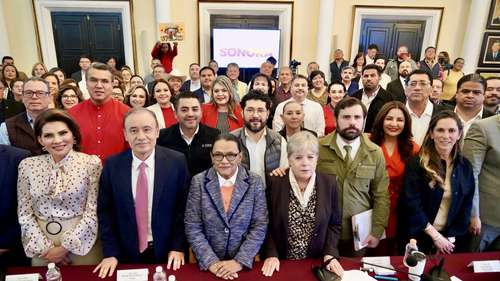
▲ The Secretary of the Interior was with the head of Semarnat, Alicia Bárcena, and the governor of Sonora, Alfonso Durazo, among other officials.Photo taken from X
Cristina Gomez and Georgina Saldierna
Correspondent
La Jornada Newspaper
Wednesday, December 24, 2025, p. 4
With a fund of 2,222.6 million pesos, the agreement will be financed by which the strike that the Cananea miners maintained for more than 18 years was concluded and the damages caused by the spill of copper sulfate in the Sonora River by the Mexico Group in 2014 will be compensated, announced the Secretary of the Interior, Rosa Icela Rodríguez.
More than a decade after having contaminated the riverbed and almost two decades after the outbreak of the mining conflict, Claudia Sheinbaum’s government managed to get the business consortium to contribute 70.14 percent of those resources. For its part, the Federation will give 21.7 percent and the public administration of the state of Sonora the remaining 8 percent.
The official explained that the arrangement contemplates a corporate participation of 1,500 million pesos, to which are added 59 million that it deposited with the Federal Conciliation and Arbitration Board in 2018 and 2019.
The federal administration contributes 483.6 million pesos and the Sonoran administration 180 million, added Rosa Icela Rodríguez, who highlighted the fact that “the government of Mexico was firm in demanding Grupo México for failure to comply with a series of conditions to reach a good agreement,” which will benefit the communities and the miners.
The settlement that ended the miners’ strike, the longest in the history of the Mexican labor movement and which marked generations of workers and entire communities, is part of the framework of the Justice Plan for Cananea. It provides for liquidation in accordance with the original collective contract and access to social security and the pension system for the benefit of 650 workers and their families, as well as the widows of 53 miners who lost their lives during the lawsuit, through a scheme of direct delivery of resources without intermediaries.
Social justice for miners
Accompanied by Governor Alfonso Durazo, the Secretaries of the Environment, Alicia Bárcena, and of Labor, Marath Bolaños; the federal attorney for the Environment, Mariana Boy; the head of the IMSS-Bienestar, Alejandro Svarch, and the director of the National Water Commission (Conagua), Efraín Morales, the head of the Interior highlighted that with the end of the work stoppage, social justice for the miners is finally achieved.
“Now workers, widows and their families are being cared for, and environmental restoration actions, water sanitation and improvement of health services will also be strengthened,” he added.
In these tasks, the coordinated work of the Ministry of the Environment, Conagua and the IMSS-Wellbeing is essential, which will expeditiously and effectively address each of the technical and specialized matters that correspond to them, he pointed out.
The official explained that 16 water treatment plants will be built by Conagua and others that already exist will be adapted. Likewise, a regional water quality laboratory will be equipped and operated, and monitoring stations will be built on the Sonora River.
The Ures Regional Hospital will also be built, with 60 beds, 21 specialty clinics, a center for kidney health and a specialized heavy metals and toxicology laboratory.
The IMSS-Wellbeing will improve its physical infrastructure and equipment to provide health care to the state’s population.
Governor Alfonso Durazo highlighted for his part that the coordination between the three levels of government made it possible to close one of the longest labor conflicts in the country and implement the Justice Plan, with the support of President Sheinbaum, which opens a new stage in addressing historical gaps in Sonora.
The program was born in July 2021, at the initiative of President Andrés Manuel López Obrador, with five fundamental axes: decent work, free medical care and medicines, well-being, environmental health, right to water, as well as urban improvement. The current head of the Executive decided to continue it.