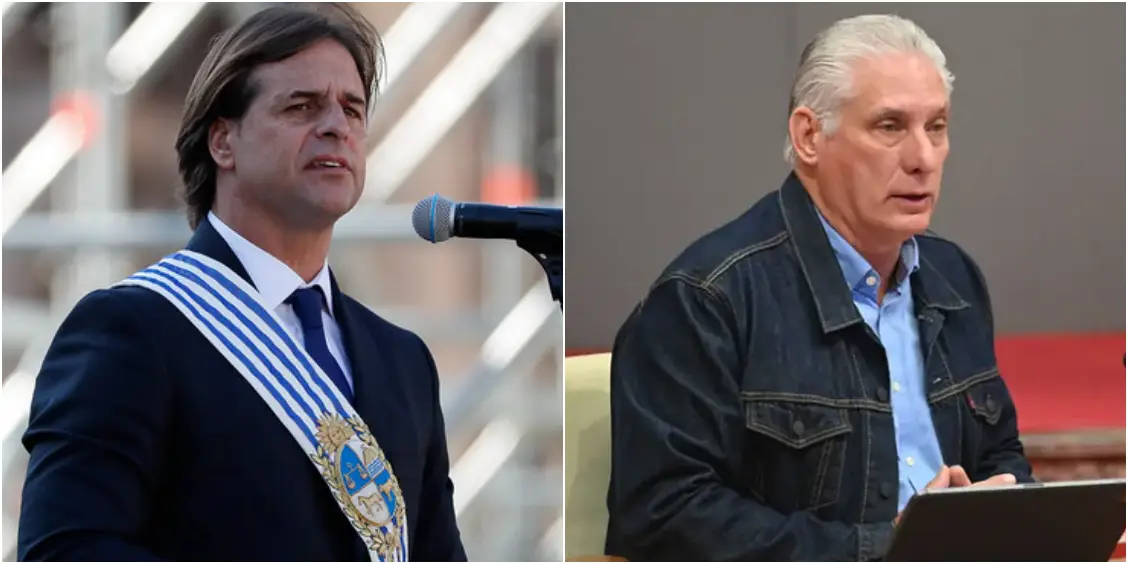
Miami, United States. – Uruguayan president, Luis Lacalle Pou, decided again Do not invite representatives of the regimes of Cuba, Nicaragua and Venezuela to the possession ceremony of the next president, Yamandú Orsi, to be held on March 1.
Uruguayan Foreign Ministry Sources confirmed to the EFE agency That the current president will not sign the corresponding invitations, a measure that he had already adopted at the beginning of his management in 2020.
The decision to exclude Havana does not surprise, since Lacalle Pou has maintained a critical position towards the Cuban government throughout its mandate. On multiple occasions, he has accused Miguel Díaz-Canel regime for not respecting human rights and maintaining a political system that “is not a full democracy.”
These statements have not been merely rhetorical: during the Celac Summit in 2021, the Uruguayan President starred in a direct confrontation with Díaz-Canel, when reciting the lyrics of the song Homeland and life in front of an international audience.
“Do not run the blood for wanting to think differently. Who told him that Cuba is yours, if my Cuba belongs to all my people, ”said Lacalle Pou on that occasion, underlining his rejection of the Cuban political model. This gesture, widely disseminated and commented, marked one of the strongest positions of a Latin American leader against the Havana regime.
The current context has only reinforce the position of Lacalle Pou. In 2023, Uruguay recognized Edmundo González Urrutia as the legitimate president of Venezuela, rejecting the continuity of Nicolás Maduro. This recognition has been part of a foreign policy that seeks to isolate the regimes that it considers dictatorial and strengthen ties with opposition figures. The close link with the Venezuelan dissent and the constant accusations to the lack of freedom in Cuba show that the exclusion of Havana is not an isolated decision, but part of a coherent strategy that has remained since the beginning of his mandate.
For his part, the president -elect Yamandú Orsi and his party, the Frente Amplio, have expressed a different position. The leftist coalition argues that Uruguay must invite all the countries with which it maintains diplomatic relations, regardless of the character of its governments. Both Orsi and other leaders of the Frente Amplio have indicated that not inviting Cuba, Nicaragua and Venezuela could be interpreted as an unnecessary act of exclusion.
However, the control of the invitations falls to the current president, and Lacalle Pou has already notified the future administration that he will not sign the invitations to the leaders of the three dictatorial regimes.