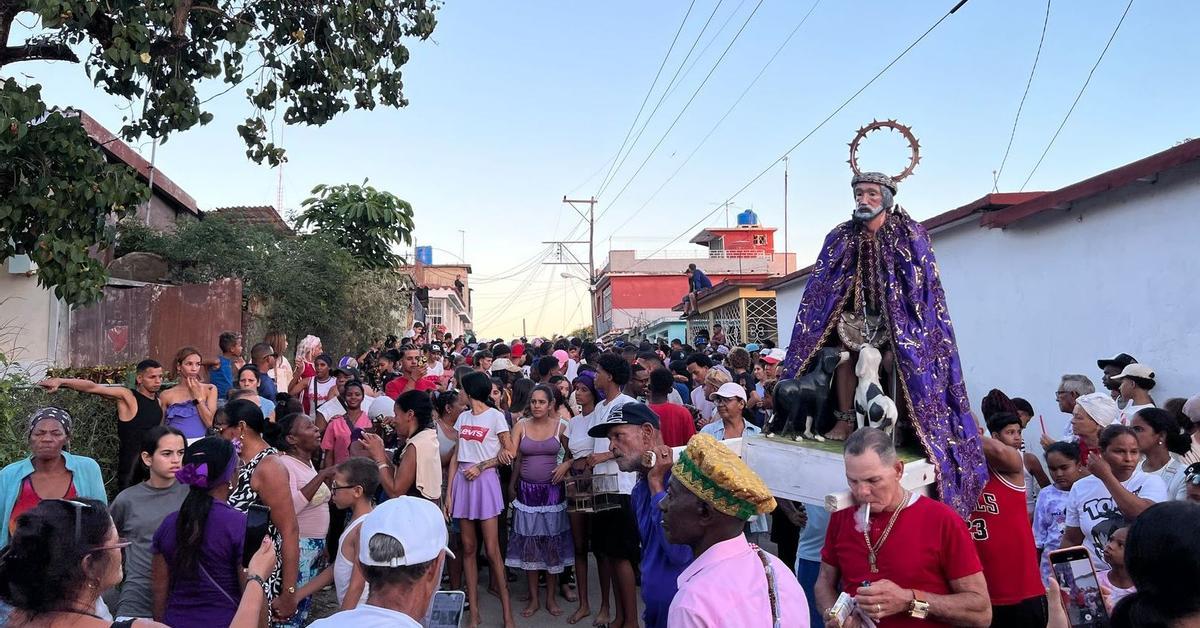
Havana/“The entire Jata is here,” says a devotee of San Lázaro or Babalú Ayé as the procession advances through the streets of the neighborhood. Every December 17, La Jata – in the municipality of San Miguel del Padrón, east of Havana – stops being just a residential space and becomes a territory of promises, drums and popular devotion, where faith organizes itself, without temples or microphones, and occupies the street as the only altar.
Devotion is reflected on the asphalt, in front of the doors or from the roofs of the houses. “A lot of folklore. Exciting. Something genuine, outside of all institutionality. Or so I think,” says another participant who advances barefoot behind the image of the saint. The procession does not respond to an institutional structure or a program, but is activated by tradition, by family inheritance, by a promise fulfilled or by fear of not fulfilling it.
/ 14ymedio
The importance of La Jata in the celebration of San Lázaro is linked precisely to that marginal and autonomous condition. While other parts of Havana – such as El Rincón – concentrate devotion under a more organized and monitored logic, in La Jata the celebration retains a neighborhood, almost domestic character, where the religious mixes with the everyday without asking permission. “Look how it’s celebrated. Young people, of all ages,” says a man while drinking coffee that another offers him in a plastic bottle.
In the center of this celebration appears the figure of Enriquitorepresented in a painting that accompanies the procession and to which many attribute a fundamental role in the religiosity of the area. Stories, versions and rumors circulate around him. “I heard a rumor that Enriquito was Fidel’s godfather. Hence the recognition and permission to show his photo. But that is a rumor,” a voice clarifies, marking the border between faith, legend and prudence.

/ 14ymedio
What does seem clear is that the tradition was not interrupted after Enriquito’s death. “The children inherited this tradition and it continues to this day,” says another attendee, underlining the family nature of the cult. This continuity explains, in part, why the procession continues to occur without major interference, although not without surveillance. “Police, of course,” says someone in a low voice, almost like an inevitable footnote in any spontaneous meeting in Cuba.
This December 17, 2025, the procession also occurred in a context marked by the proliferation of diseases like chikungunya. The street was full of vulnerable bodies, some dancing, others tired, others with recent after-effects or fear of “that thing that’s going around.” Saint Lazarus, saint of the sick, was invoked again in the midst of the health crisis.