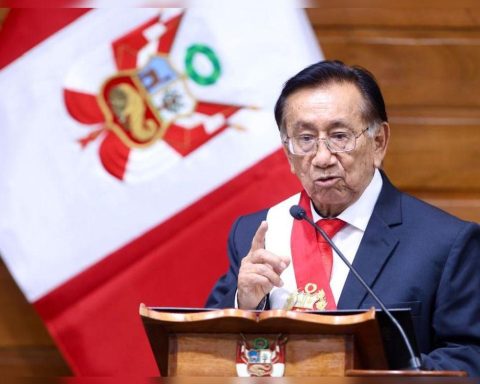
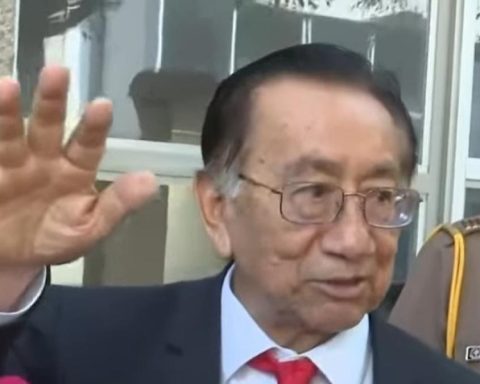
“The Supreme Court has just canceled the entire process against Death squad“, He repeated up to four times the still Minister of Justice on Wednesday, September 17 in the Supervisory Commission of the Congress of the Republic.
And it is that the news has been held by Santiváñez himself and other congressmen such as Fernando Rospigliosi of Popular Force, in both cases there was even talk of immediate release of those sentenced in the process, but, as among so many things that can be affirmed, here are half truths. The first, and more flashed, is that it is not the Supreme Court that has ruled – as the minister repeated – but an appeal room of the Superior Court of Lima.
The trial against the police of the evil called “Death Squad” was annulled. Raúl Prado Ravines and other police officers who dejected criminals were unfairly sentenced to 35 years in prison. Now they should be released. Thanks to Dr. Humberto Abanto and the lawyers …
– Fernando Rospigliosi (@frospigliosi) SEPTEMBER 16, 2025
The Second Criminal Court of National Appeals annulled a few days ago the sentence of 35 years in prison that was imposed on the former PNP Raúl Enrique Prado Ravines, leader of the death squad, criminal organization within the National Police that was commissioned to execute simulated operations and annihilate pseudodelncuentes. He ordered a new oral trial against the defendants Raúl Prado Ravines, Carlos Llanto Ponce, Williams Castaño Martínez and others, for the crime of qualified homicide. He didn’t acquit them.
When Juan José Santiváñez talked about the death squad
What is the death squad?
Prado Ravines, according to the first instance judgment, created false criminal scenarios to give the perception that there were results in the fight against crime during the Ollanta Humala government. Prado is an old acquaintance of Juan José Santiváñez.
And it is that before becoming part of the Executive Power and becoming one of the favorite ministers of the president, Dina Boluarte, Santiváñez was a lawyer from Prado Ravines for the internal investigation process opened by the Ministry of Interior in 2016.
In May 2024, days after assuming the conduction of the internal sector, in an interview with Peru21defended the presumption of innocence of his expatrocinated Prado Ravines forgetting his obligation to ensure compliance with the law that in this case translated into guaranteeing compliance with the judgment issued by the Judiciary, since at that time the expolish was fugitive from justice.
“You have to be very careful with that point because I understand that (the sentence) is appealed, and constitutionally while the sentence is not consented and executed the presumption of premium innocence,” he said.
He added that the legal effects of the sentence are subject to confirmation or revocation that may be in the second instance. “The judge in the first instance can determine whether the sentence is fulfilled effectively or in a suspended manner, but the provision of these rights is maintained as long as the sentence is consented,” he insisted.
As if that were not enough, in January of this year the Ministry of Interior gave the green light to the contracting of the legal defense of Raúl Prado Ravines for an amount of 50,000 soles that has now achieved a reevaluation of the sentence.
Prado will not be free – the joy of Santiváñez and company will have to wait – will continue in jail for a preventive detention order.
The death squad was divided into two processes: one known as the Piura case. Prado was convicted of the crime of homicide qualified against citizens Raúl Rivas Rimaycuna, Martín Tello Monja, Gian Fiestas Aquino and Hugo Yajahuanca Tineo, who were killed in Piura in the middle of a false operation orchestrated by the armed group. Being intelligence agents gave them the perfect facade to move around the country covered by a mantle of alleged legality. Thus, they traveled to Piura with the idea of planning an ambush that then allows them to present it as a successful police operation against a criminal gang.
The death squad not only operated in Piura. There are eight other cases of extrajudicial executions that are pending accusation by the prosecutor Álvaro Rodas, and that keeps Prado in pretrial detention. Five times in Lima, twice in Chincha and another in Chiclayo. They took the lives of 32 civilians, a policeman and the dome ended up being made up of 14 people.
It is important to highlight that research to this armed group was born from the same PNP. Honest agents, such as Colonel PNP Franco Moreno, promoted this investigation that echoed in the Ministry of Interior already commanded by Carlos Basombrío.