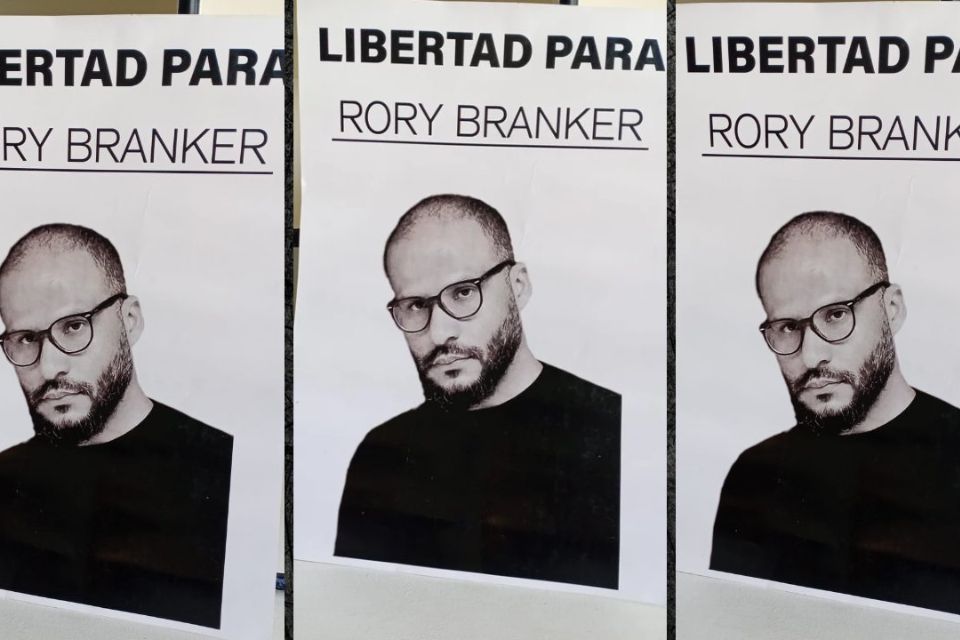
On February 20, Rory Branker was arrested in Caracas by alleged officials of the Bolivarian National Intelligence Service (Sebin), and since then his whereabouts are unknown. Nor have their relatives been informed if they have been presented to any court or the accusations that support their arrest
The journalist Rory Branker celebrated this Monday 180 days of his arbitrary detention and forced disappearance. His relatives demanded that the authorities “concrete actions to clarify their whereabouts.”
«We still do not not even significant progress in the investigation. Uncertainty and pain persist for us, their relatives and loved ones, while we demand justice and concrete actions to clarify their whereabouts, ”they said in social networks.
On February 20, Rory Branker was arrested in Caracas by alleged officials of the Bolivarian National Intelligence Service (Sebin), and since then his whereabouts are unknown. Nor have their relatives been informed if they have been presented to any court or the accusations that support their arrest.
*Also read: «I am safe»: lawyer María Alejandra Díaz informs that she is exiled in Colombia
The Branker family has indicated that since its disappearance a request for habeas corpus was introduced in court, but to date it has not been answered.
🗣️HOY They are 180 days since Rory’s arbitrary detention.
His mother, Cheryl Ann Branker, asks for his son’s whereabouts again. 180 days of uncertainty, of silence, of pain. 180 days without answers.
No family should go through this. We demand … pic.twitter.com/mykjxicnrf
– Release Rory Branker (@libeRenrbranker) August 18, 2025
They also do not know who is the public defender who takes the case, who at no time has contacted them. «Rory is a journalist and editor, a full professional, a loving son and an exceptional friend. He is not a criminal. His only “crime” has been to exercise his work with ethics and commitment. “
19 press workers remain under arrest in the country under accusations of alleged terrorism, incitement to hatred or association to commit crimes, among other crimes, according to the National College of Journalists and the National Union of Press Workers.
In addition, 12 press workers are subject to precautionary measures and another eight faced interrogations or escaped arrest orders.
*Journalism in Venezuela is exercised in a hostile environment for the press with dozens of legal instruments arranged for the punishment of the word, especially the laws “against hatred”, “against fascism” and “against blockade.” This content was written taking into consideration the threats and limits that, consequently, have been imposed on the dissemination of information from within the country.
Post views: 468