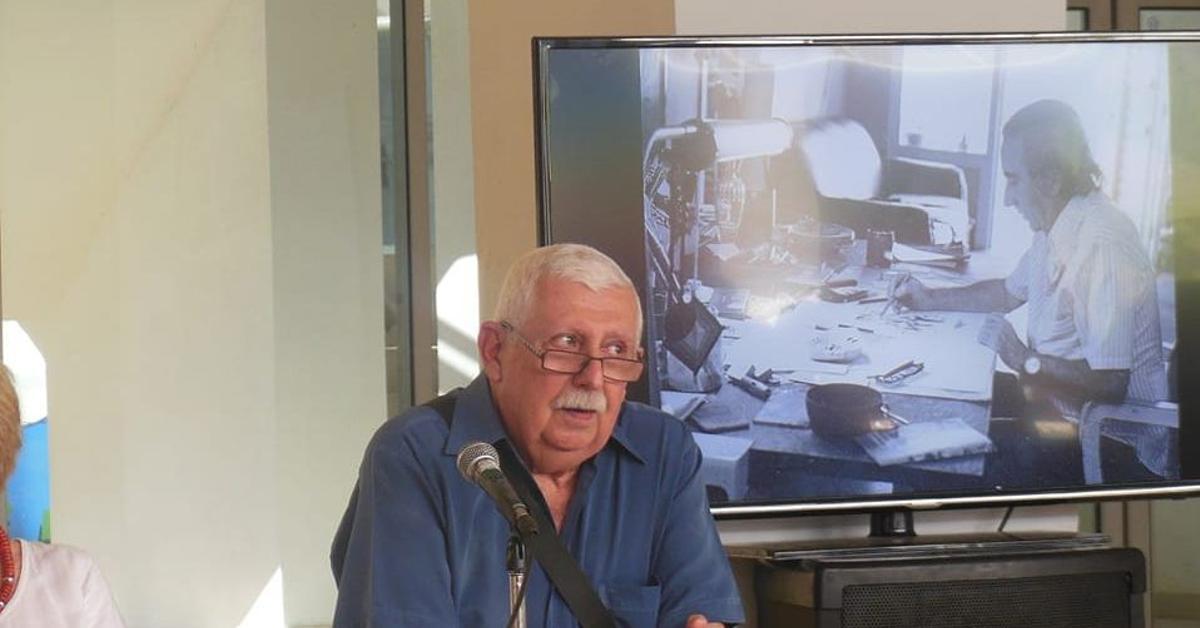
Havana/In the early hours of Friday, October 24, 2025, the death of José Veigas Zamora was confirmed by colleagues and friends. The researcher and critic, who died in Havana – in the Hermanos Ameijeiras hospital – at the age of 89, was a zealous archivist of Cuban culture.
From social networks, the official Union of Writers and Artists of Cuba (Uneac) regretted the death of the “outstanding researcher, archivist and promoter of Cuban art.” The Mariano Rodríguez Foundation also stressed that his work was a “silent work dedicated to the study and preservation of the history of art, the foundation for all today’s researchers” on the Island.
The Cuban artist and National Prize for Plastic Arts, Lázaro Saavedra, wrote: “Today we say goodbye to José Veigas, the guardian and researcher of Cuba’s visual memory. His Veigas Archive “It is the meticulous record of our artistic history through catalogues, magazines and publications that, without their dedication, would have been lost in time.”
He was not a figure who sought public seats or media recognition. Veigas built his career on the discreet threshold of the archive, curatorship, catalog raisonnés and detailed notes that would later serve as support for larger studies. In that sense, his work was systematic and abundant.
Its greatest contribution is, without a doubt, the CIFO-Veigas Archive, which housed hundreds of thousands of documents, photographic records, catalogs and correspondences.
In art institutions and museums he is remembered as a constant collaborator, occasional curator, and above all as custodian of essential documents and photographs. His public profile includes works such as Sculpture in Cuba, 20th century (Caguayo Foundation, 2005), Let me tell you. Anthology of criticism in the eighties (Artecuban, 2002), Memory. Cuban art of the 20th century (2002) and Pier. Luis Enrique Camejo (2012). He was the author of the catalog raisonnés of Mariano Rodríguez, and he intervened decisively – along with Katia Ayón – in the catalog Nkame by Belkis Ayón (2010), as well as its second edition Nkame Mafimba (2024).
His greatest contribution is, without a doubt, the CIFO-Veigas filewhich houses hundreds of thousands of documents, photographic records, catalogs and correspondences. On the official page for managing Belkis Ayón’s legacy, it was stated that having his “precise gaze and valuable observations” was a privilege, and that his departure represents “an irreparable loss for Cuban culture.”
Pedro Rizo Peña, researcher and professor at the Higher Institute of Art (ISA), as well summed up his legacy: “Veigas not only wrote about Cuban art: he organized it, rescued it, sustained it against oblivion.” Rizo added that Pepe Veigas taught, “without indoctrination,” that art cannot be appreciated only in the works, but in the lives that sustain them, in the improvised workshops, the yellowed letters, the lost conversations and the silences that are not always told.
Pepe Veigas taught, “without indoctrination”, that art cannot be appreciated only in the works, but in the lives that surround them
In a context where the State exercises almost absolute control over official culture, the independent work of the archive and memory also becomes a political act. If the archive disappears – due to deterioration or neglect – the discourse of art remains in the hands of those who decide to present it. And this imbalance usually favors official versions, censorship and omissions.
Veigas knew how to move in the interstices of Cuban cultural power. Although he did not openly oppose, he did not throw himself into the regime’s campaigns with blind obedience. He did his basic work, with notes, conversation and comparison. And the young researchers supported their work, because they already knew that behind many catalogs there was rigor and effort.
Veigas’ intellectual work is in the books, catalogues, exhibitions and essays that circulate today. But his most powerful legacy is in the archive that he gave to the Cuban cultural collective, and in that conviction that without memory there is no meaning, and without archive there is no reliable discourse.