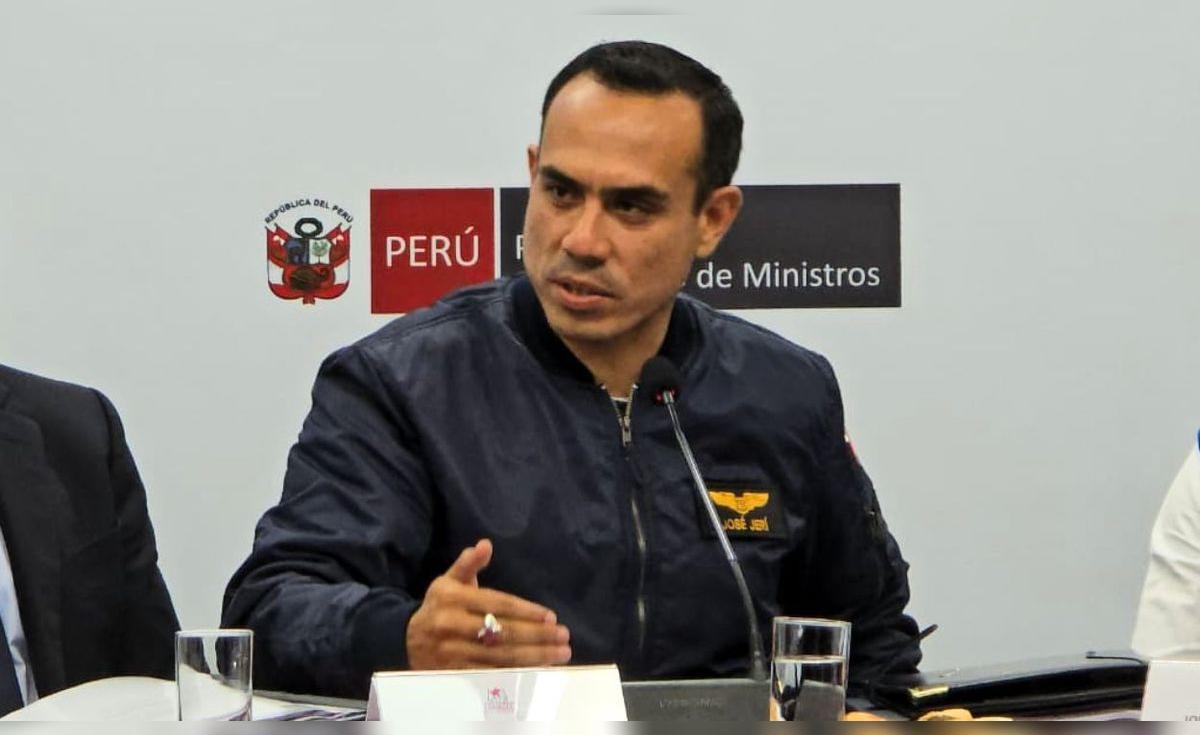
The figures from the Interinstitutional Statistical Committee on Crime (CEIC), presented by the Government of José Jerí, are “biased” and seek to “deceive” citizens. This was stated by the data analyst, Juan Carbajal, who highlighted that results were shown at the country level and not by department, which generates a “false idea” of a decrease in crime.
listen to the newsText converted to audio
Artificial intelligence
“What they have done is called cheating with the statistics. They do not show the result for each part (department), but rather the absolute result. The fact that in other parts of the country the rates are very low, causes the percentage to decrease at the national level. Twist, decontextualize, bias, that is what the Government has done,” he explained in an interview with La República.
WE RECOMMEND YOU
JOSE JERÍ IN CAPILLA DEFENDS HIMSELF | WITHOUT SCRIPT WITH ROSA MARÍA PALACIOS
Homicides in Lima increased in 2026
As an example, Carbajal cites a table that the PNP commander general, Óscar Arriola, presented. Or rather, a fact that was shown in one of the graphs, but that was ignored by the authority.
This is a table prepared with information from the Police and which details the number of homicides in the first 21 days of each year from 2023 to 2026 for each department of Peru. Thus, Arriola indicated that during the first 21 days of 2025 nationwide, 163 homicides were recorded, while in the same period of 2026, 145 were reported.
Seen in that way, the 18 fewer murders nationwide were shown as an achievement. However, there was no decrease but an increase when it comes to Lima.
In the first 21 days of 2025, a total of 61 homicides were reported in Central, North and South Lima; while in 2026 there are 77 in the same period and weighted by zones. This information was not mentioned by Commander Arriola during the conference, but in response to a question at the press conference, in which he indicated that, in fact, Lima is the department with the highest homicide rate so far this year.
In the case of Callao, there was a reduction of 4 in the 13 homicides recorded in the first 21 days of 2026 and the 17 of 2025.
Adding up, in Lima and Callao, there were a total of 90 homicides in the first 21 days of 2026, while in 2025 there were 78 in the same period.
Carbajal added: “Something that has not been said in such a conference is that the daily average in the first 21 days of the year 2026 is 6.9 (almost 7), which is a much higher average than the months of December (6.3) and November (6.0) of the year 2025, with which the month of January, if it continues with an average of almost 7, could end with more than 200 homicides, very similar to the months of September and October 2025”.
| Police Region | Year 2023 (from January 1 to 21) | Year 2024 (from January 1 to 21) | Year 2025 (from January 1 to 21) | Year 2026 (from January 1 to 21) |
| Lima Center | 51 | 52 | 63 | |
| North Lima | 8 | 8 | 14 | |
| South Lima | 1 | 1 | – | |
| TOTAL | 62 | 60 | 61 | 77 |
| Callao | 13 | 12 | 17 | 13 |
| TOTAL (Lima and Callao) | 75 | 72 | 78 | 90 |
CEIC data is not entirely accurate
On the other hand, Carbajal highlighted that the data from the Interinstitutional Statistical Committee on Crime may not be 100% accurate or current.
“Since 2021, the CEIC has not disclosed its data, so it is notable that it has now been made transparent. Despite this, it is questionable that the national figures have been compiled in such a short time. This means that the numbers presented by the Government are not accurate, but could increase as the data and sub-records are updated,” he noted.
In this sense, it stands out that the figures presented by the CEIC differ from those previously published by Sinadef, Sidpol and the Public Ministry.
“Four years have passed and look at what they report to us this year. There were 3,675 homicides in 2025 per 100 thousand inhabitants, according to CEIC figures, much higher than what Sinadef had been reporting to us. The data is even higher than what the PNP had been recording,” he expressed.
Likewise, the unknown about the real figure also arises in the case of complaints of extortion. This January 22, the Government reported that in 2025 there were 26,585, however, according to the Police Complaint System (Sidpol PNP), 25,196 were observed, while the Public Ministry indicated that there were 27,029. “There is a gap of more than 2,000 complaints between what the Public Ministry reports and what Sidpol reports,” he said.
The question, then, that Carbajal asks himself is “Who do we believe?” “Who do we trust?” “There is a gap in records between one institution and another. There should be a single entity that makes us visible,” he said.
Added to this is that the percentages of decrease presented are minimal, the specialist observed.
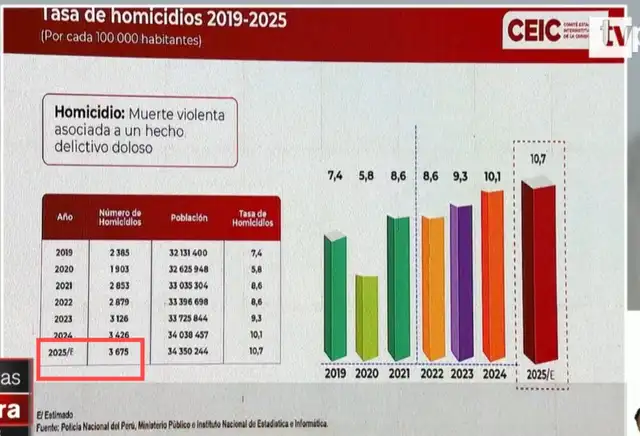
According to the CEIC, in 2025 there were 3,675 homicides. Photo: screenshot/TV Peru
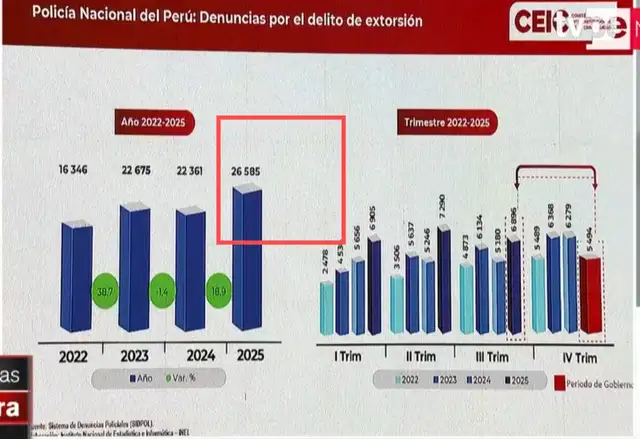
The CEIC indicated that in 2025 there were 26,585 complaints of extortion, however, the SIDPOL and the Public Ministry presented different figures. Photo: screenshot/TV Peru
Citizens could choose not to report out of fear
Finally, another aspect observed by Carbajal is the supposed decrease in complaints of extortion, theft and others.
Jerí indicated that complaints of extortion have decreased during his Government, however, the statesman warns that this alleged reduction does not mean that crimes occur less but rather it could reveal that citizens no longer report.
“The abrupt drop in the records of complaints of extortion in the months of November and December of 2025 certainly contradicts the current reality of our country in which extortion does not stop and does not even denote a decrease. So, what could be happening is that people are afraid to report or they simply do not do it anymore because they feel that nothing will happen,” he said, adding that the same Public Ministry reported on a “black list of complaints.”
For all this, Carbajal contradicts the president regarding the results presented. “Where is the reduction? What there is, statistically, are fluctuations and ups and downs without a clear sign of reduction,” he exclaimed. While Jerí clings to pointing out that what has been achieved is insufficient, but it is “positive.”