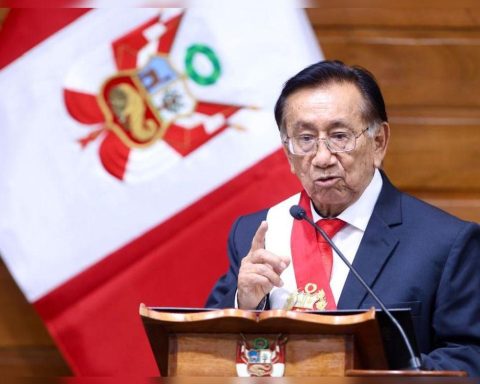
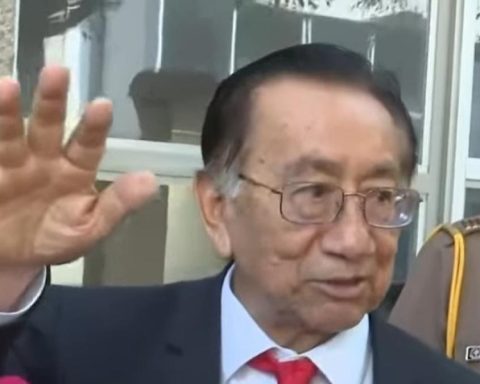
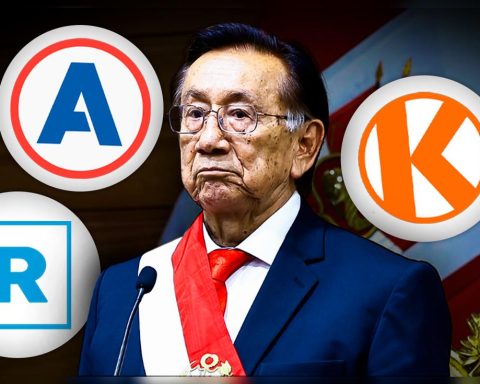
President José Jerí returned to the center of the controversy after it was revealed that he held a late-night meeting without official record. This is not the first time that these questioned practices have occurred, since in recent governments such as those of Dina Boluarte and Pedro Castillo similar cases occurred.
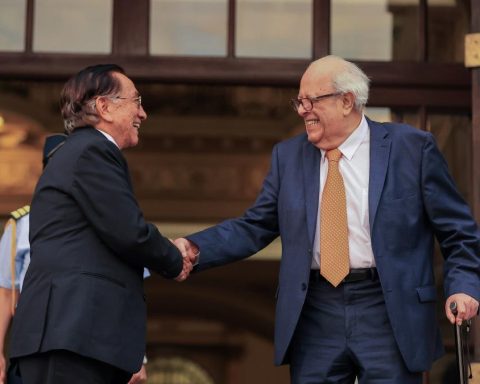
The report, which was a topic in the media and networks, showed images of Jerí arriving covered with a hood at a store in the district of San Borja, accompanied only by security personnel, to hold a dialogue with Zhihua Yang, general manager of Hidroeléctrica América SAC, the company that holds the concession for the Hidroeléctrica Pachachaca 2 project, in the Apurímac region, and a businessman linked to companies that have contracted services associated with the environment of Nicanor Boluarte.
The meeting, which took place on the night of December 26, reportedly lasted around an hour and a half in a building where several companies of Chinese origin operate. According to the official version of the Presidency, the reason for the meeting was to talk about the organization of the Peru-China Friendship Day, date established by law to be celebrated on February 1 of each year. Despite this, the fact that it is not listed on the Transparency portal as an official meeting raised questions.
In a press conference, after the dissemination of the images, the president sought to relativize the problem. “I was talking yesterday with my team and I remember the phrase that I always say ‘don’t do good things that seem bad’ (…) that’s because of yesterday’s report they published about a nighttime visit of mine. There is a very simple thing about it, we know that we have bad precedents and my dynamic will remain the same: half time in the office and half time on the street, I have to go out and interact. I go out early in the morning, afternoon or night depending on what my instinct says, but it is true that with a history they can be understood incorrectly. But no That’s how it is,” he said.
With this explanation, Jerí minimizes the importance of recording the meetings he has on official channels, and users on social networks have interpreted it as a defense of actions similar to what is considered ‘normal’ in the ways of exercising the position, despite the demands that must be made in terms of transparency and accountability.
The political scientist Alejandro Godoy warned about the institutional risks of this type of behavior. “This is a detrimental effect. The meetings held by the President of the Republic, being the highest official in the country, must be held in the Government Palace, with official registration. Holding them in a Chinese food restaurant, outside of working hours and surreptitiously gives rise to suspicions. The president’s investiture and probity must be tested at every moment,” he said for this medium.
It should be remembered that during the government of Dina Boluarte, the media outlet Ojo Público pointed out that at least 18 meetings with regional governors do not appear in the official report of the Presidential Office. Among the governors with unreported encounters are Wilfredo Oscorima (Ayacucho), Zosimo Cardenas (Junín) and Cesar Acuna (La Libertad), this last political ally of Boluarte. Journalistic investigations compared agenda records with visitor books and found discrepancies that suggest that several meetings were not formally recorded, despite the fact that there is photographic evidence and mentions in official Executive networks.
YOU CAN SEE: Martín Vizcarra is emergency transferred from the Barbadillo prison to the Ate Hospital
In some cases, such as that of Cárdenas, the governor himself denied having held unregistered meetings with the president, despite photographic evidence that showed him at official events with Boluarte without appearing on the Transparency portal.
But Boluarte was not the only one. Before that period, Pedro Castillo’s government was also questioned for meetings considered unofficial. Fourth Power showed that Castillo held meetings in his private home in Breña, outside the Government Palace and without official entry records.
In those nighttime meetings, attended by businessmen, officials and other figures, the president was captured leaving and entering at different times, which also raised questions about the transparency of those contacts.
“As head of state, I do not endorse any favoring of any company or person in particular. I urge the authorities that, if there is evidence of any indication of corruption during my administration, they do their job to clarify the facts within the framework of the law,” Castillo published on his social networks after the broadcast of that report.
Along the same lines, the political scientist Alejandro Mejia maintains that what happened with Jerí cannot be analyzed apart from the antecedents that occurred,
“The lack of transparency and informality has become recurrent practices that have been affecting the image of the highest office of the State. From Castillo, who turned Sarratea into a parallel office of the Palace and where various illicit acts were taking place, to Dina Boluarte, who ordered the elimination of visit records in the Palace, altering the existing protocols, President Jerí seems to follow the same line of maintaining these types of “secret meetings,” he declared.
“Jerí forgets that, apart from being president, he is a public servant and is governed by the Law of Transparency and Access to Public Information, which is clear in determining that the presidential agenda must be public knowledge, in order to avoid irregularities and acts of corruption in the exercise of office. In that sense, the argument that it was a meeting to see celebrations of the Peru-China Friendship Day, could clearly be carried out in accordance with the existing protocols in the Palace,” he added.
The background of Boluarte and Castillo shows that informality in the exercise of power and the lack of transparency in the presidential agenda have been recurring among our rulers. That is why what happened with Jerí calls into question the issue of whether we are moving towards more adequate standards of accountability or, on the contrary, a practice that normalizes little transparency is becoming familiar.