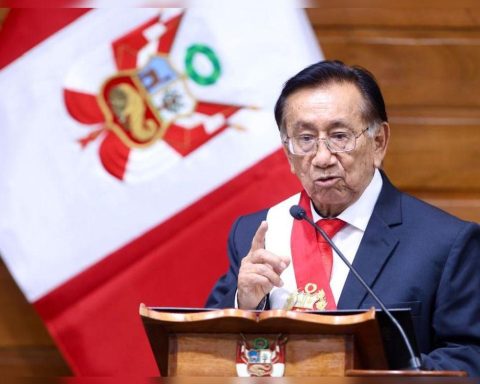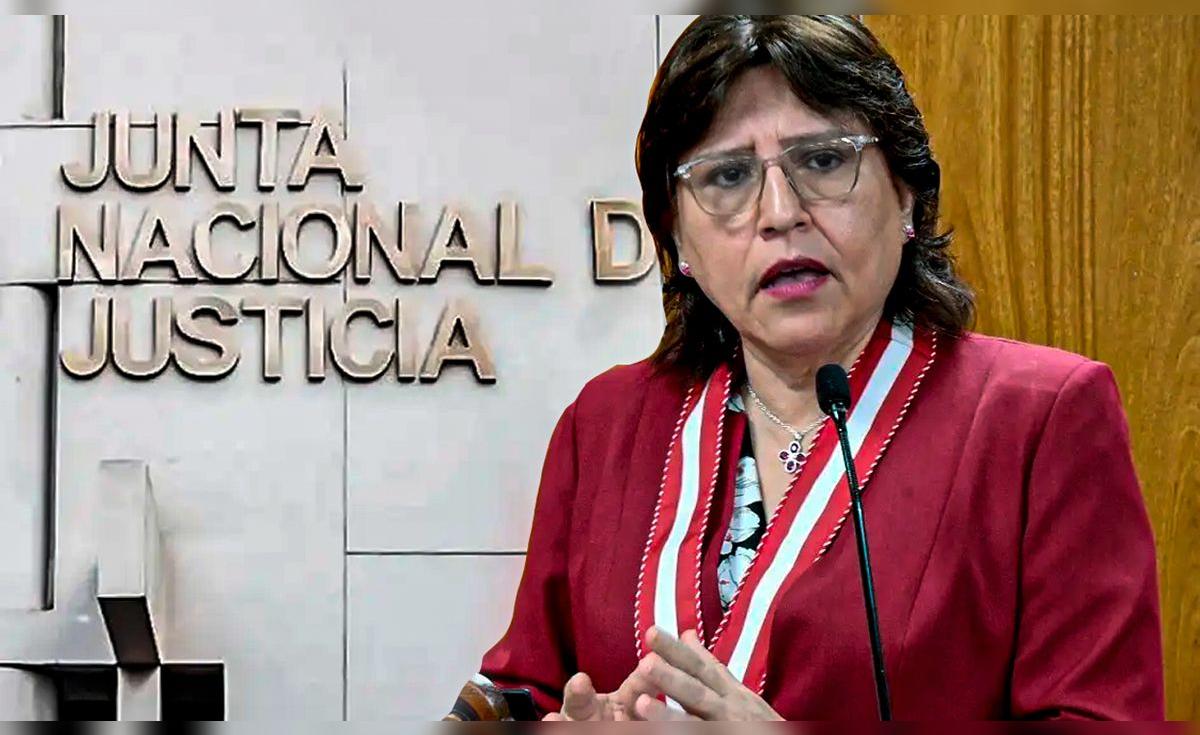
The National Board of Justice (JNJ), through its president Gino Riosfiled a jurisdictional claim against the Judiciary because he supposedly committed a “undermining of powers.” The reason is to intervene in the suspension process of the suspended nation’s prosecutor, Delia Espinozaas well as for admitting a IDL protection action against the elections of the members of the institution.
listen to the newsText converted to audio
Artificial intelligence
This request from the JNJ comes 8 days after the Ninth Constitutional Court ordered to suspend all disciplinary processes against Espinoza Valenzuela with the aim of returning him to his position as head of the Public Ministry.
WE RECOMMEND YOU
BUTTERS: “A MISTAKE WAS NOT COMPLETING MY UNIVERSITY STAGE” | WITHOUT SCRIPT WITH ROSA MARÍA PALACIOS
In the document shared by journalist Diego Casimiro, the JNJ bases its request on “the improper use of its powers by the Judiciary” because it “contravenes the principle of separation of powers” established in articles 154 and 157 of the Political Constitution.
The reasons
First, regarding the replacement of Delia Espinoza. The JNJ points out that they have not yet been “duly and formally” notified and that they have learned of the decision of the Judiciary through the media.
This is due to the resolution of the Ninth Constitutional Court that grants two days to reinstate Espinoza in office.
Regarding this fact, the jurisdictional claim mentions that this “constitutes an excess of the powers” of the Judiciary and constitutes “a breach of the principle of procedural consistency.”
“Things could not be otherwise because, as a consequence of Resolution 9 of November 10, 2025, a precautionary measure adopted by the JNJ within the framework of a disciplinary procedure of the utmost importance, in accordance with its constitutional powers, is at risk of ending up being unknown,” he warns.
JNJ against the lawsuit filed by IDL for the election of its members
Second, the JNJ argues that the request it made IDL to the Judiciary in February of this year — through an amparo action — against the Special Commission for the Selection of Members of the JNJ to nullify the election of its members “would generate an absolutely negative impact within the framework of its powers assigned by the Constitution and its Organic Law.
“If such a precautionary measure were to be approved, the JNJ would be prevented from continuing to process the selection and ratification processes, as well as the disciplinary files, under its responsibility,” says the JNJ and points out that, a possible situation, “would lead them to paralysis, which would cause serious damage to the functioning of the Justice System.”
In short, the JNJ mentions that, although the Judiciary It is within its powers to resolve protection claims against the institution, “this would imply a direct impact on constitutional functions” and “an irregular exercise of powers by the Judiciary would occur.”
Furthermore, he adds, a judicial decision ordering the complete deactivation of the functions of the JNJ “would constitute a clear impairment to the exercise of functions.”
Competence lawsuit filed against the Judiciary due to IDL’s request to suspend the election of the members of the JNJ
In February of this year, the Institute of Legal Defense (IDL) and two citizens presented objections to the selection process of members of the JNJ because they noticed alleged irregularities. However, they were not attended to.
“From the beginning, documentation, tools and protocols have not been shared with society that could prevent the contest rules from having deficiencies in instruments that help prevent conflicts of interest or ensure that academic merits are supported,” he declared to The Republic In September of this year the lawyer Cruz Silva.