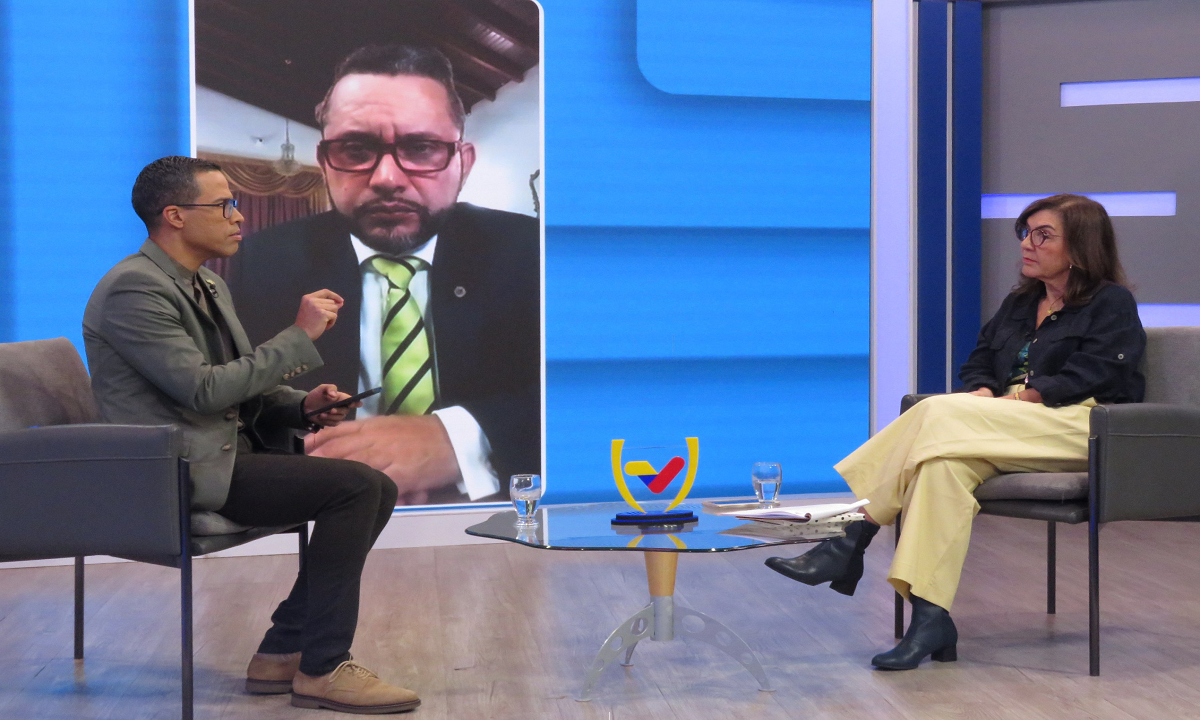
Regarding the special program “Amnesty Law: a step for peace”, broadcast by Venezolana de Televisión (VTV), the deputy to the National Assembly (AN), Jacqueline Faría, and the Human Rights specialist, Fernando Bello, analyzed the technical and political scope of the recently promulgated Amnesty Law for Democratic Coexistence.
Representative Faría described this instrument as a broad-spectrum norm that complements the historical vision of the Venezuelan State. “This law covers and acts as an umbrella over the laws decreed by Presidents Hugo Chávez and Nicolás Maduro.”
The parliamentarian emphasized that the legal framework that covers events that occurred between 1999 and 2025 “comes to address what was left pending, to open and establish peace in Venezuela (…).” Likewise, he highlighted the leadership of the president in charge of the Republic, Delcy Rodríguez, in the search for a stable peace based on two pillars: “rectification and reconciliation.”
“Those two words that require a lot from the political sectors, each sector has to forgive, we forgive, the opposition sector must forgive, and in that forgiveness we find ourselves and continue fighting for Venezuela to guarantee peace,” Faría asserted.
For his part, the jurist and Human Rights specialist, Fernando Bello, stressed that this legislative step positions the country as an international benchmark. “Venezuela is the spearhead when it comes to progress in human rights, as Venezuela is one of the few countries that has signed and ratified almost twenty treaties, pacts and agreements on human rights.”
Bello noted that the legal community has welcomed this law, whose purpose is to preserve fraternity and good faith under the constitutional mandate.
He highlighted the importance of the Monitoring Commission, the body in charge of “evaluating each of the cases, both in law and in fact, and that is respectful of the provisions of the Constitutional Mandate established in article 29 (…)”.
Two fundamental aspects of the articles:
The personal scope established in article 7 of the law: Representative Faría clarified that this article allows any person under investigation for the crimes contemplated to be eligible for the benefit, as long as they apply in person or through legal representation.
In this regard, Bello emphasized that this formulation guarantees that the beneficiaries “will not be deprived of their liberty.”
Regarding the events subject to amnesty contemplated in article 8: Jacqueline Faría described this section as the backbone of the norm. “There are 16 articles, this article is like the structure of the Law, it is based on amnesty for the 13 violent acts (…)”, he pointed out, while clarifying that the Military Rebellion is explicitly excluded and will be treated in another legal area.
Finally, Bello highlighted that Article 8 structurally addresses the country’s problems, responding to the 13 historical milestones where opposition sectors “have engaged in violent actions that have caused deaths, destruction, and the breakdown of the rule of law.”
With the implementation of this law, which has already borne fruit with releases, the Venezuelan State reaffirms its commitment to the right to peace and the consolidation of national sovereignty.