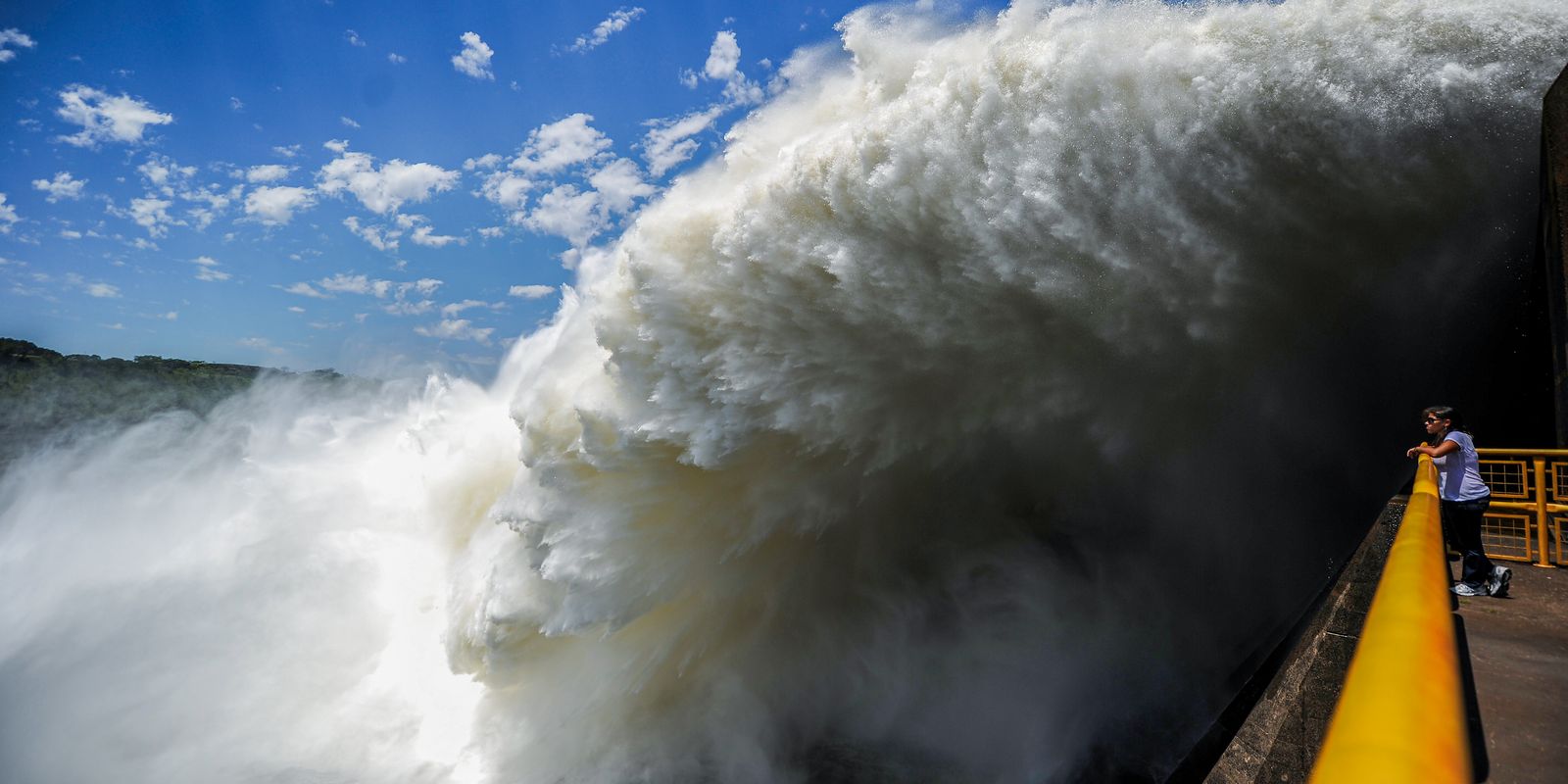
THE Itaipu Hydroelectric Power Plantin the Paraná River, it reached the historic mark of 3.1 billion megawatts-hours (MWH) produced since it went into operation in 1984. Marco was hit at 6:54 pm last Friday (5) and released on Monday (8) by Itaipu Binacional, a company that operates the hydroelectric dam.
To be aware, the production of 3.1 billion MWh is sufficient to supply the whole world for 44 days or Brazil for six years and one month. Even before reaching the level of 3.1 billion MWh, Itaipu was already the plant that produced the most electricity worldwide.
Located exactly on the border between Brazil and Paraguay, being the Brazilian side in the city of Foz do Iguaçu, Paraná, the plant is operated by Itaipu Binacional, administered equally by the two countries.
According to Itaipu Brazilian Director-General Enio Verri, the amount achieved goes beyond a statistic.
“It is the reflection of decades of joint work between Brazilians and Paraguayans, technological innovation and commitment to sustainable development,” he says.
Growth curve
The hydroelectric dam began to be built in 1973, producing energy nine years later. A huge reservoir on the Paraná River supplies the water that triggers the Itaipu turbines.
The first billion MWh was hit in 2001, when Brazil faced an energy rationing crisis. In August 2012, the plant reached 2 billion MWh. The 3 billion mark was beaten on March 10, 2024.
All the production of the enterprise is also divided between Brazil and Paraguay, however, according to the treaty governing the construction of Itaipu, the country that does not consume all the energy generated can sell it to the strategic partner.
Natural battery
Currently, Itaipu accounts for about 9% of Brazilian electricity consumption. More than simply providing energy to the National Interconnected System (SIN), generation capacity makes the plant behave like a natural battery of the system, ie it is always ready to generate energy when demanded
This behavior gains importance as they develop alternative energy sources in Brazil, such as wind and solar, whose characteristics are intermittent. The wind, for example, depends on the amount of wind. Solar is only available during the day.
Thus, Itaipu is one of the main forces of the so -called consumer ramp in the late afternoon, when hydroelectric – which may have production controlled instantly – are called to maintain the level of energy production and transmission in SIN.
On some occasions, Itaipu contributes up to 30% of the service to these ramps.
For the executive technical director, Renato Sacramento, “more important than production itself, is the strategic role that hydroelectric plants such as Itaipu have been playing to ensure the reliability and operational safety of an electrical system where, every day, more intermittent renewable sources come into operation.”
Crescent Paraguayan Demand
Historically, the amount of energy available to the Paraguayan side has never been fully consumed, and the surplus is always acquired by Brazil. 40 years ago, Brazil consumed 95% of the supply. This scenario followed the trajectory of fall over the decades, so that in 2024, Brazil consumed 69%; and Paraguay, 31%.
The growing consumption of Paraguay makes Itaipu Binacional project that, by 2035, there should be no more surplus.
Paraguayan demand has been driven by economy growth; the growing presence in Paraguayan soil of data centers (digital servers that process and store data), including those of Artificial Intelligence (AI); and cryptocurrency mining activity – digital process that depends on powerful computers to create and protect cryptocurrencies with intensive use of energy.
Conforming to Agência Brasil, this projection causes Itaipu to study the construction of two more generating turbines ─ Currently there are 20.
Another front of Itaipu is the generation of electricity by renewable sources besides the hydroelectric sources. A project already started studies transform the reservoir bed into the Paraná River into a solar plant park, which can even double the production capacity, today in 14 thousand megawatts (MW). There is also energy development from green hydrogen and biogas.
In July, the report of Brazil agency was in Foz do Iguaçu and met the projects.
The plant undergoes a process of technological update. The plan began running in May 2022 and foresees 14 years of implementation, with about US $ 670 million in investments already hired. Heavy electromechanical equipment, such as turbines, are not included in the project because, according to Itaipu, are in excellent condition and away from the end of typical life for these types of components.