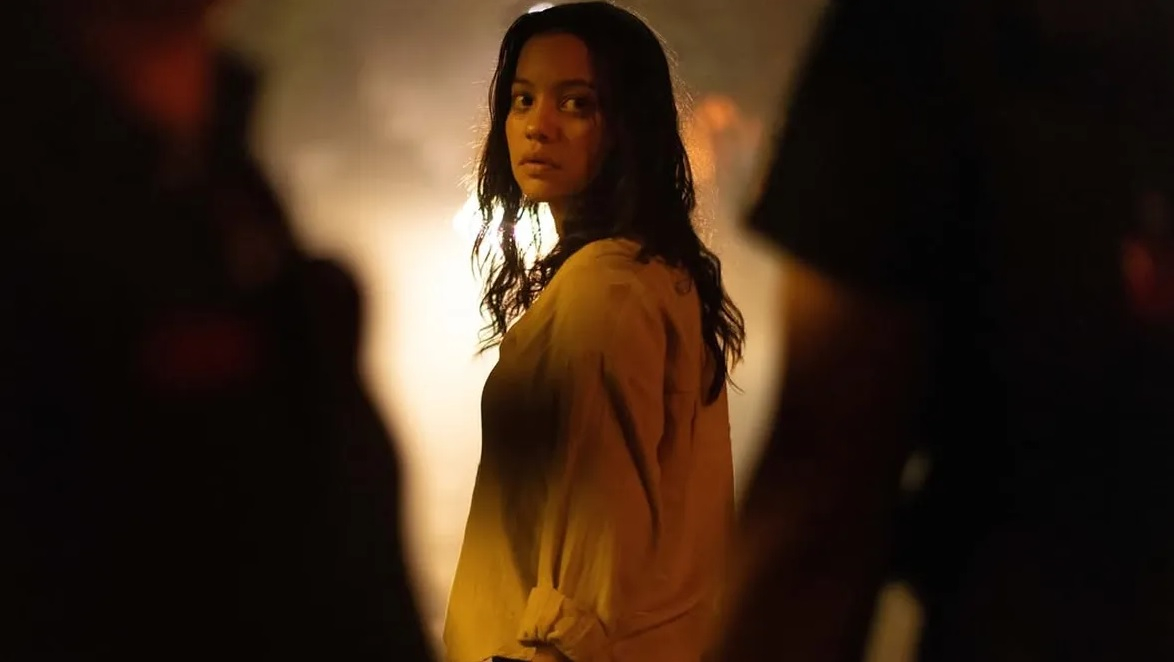
One night in Caracas, a woman has been left in the middle of a protest and runs aimlessly while bodies fall lifeless. His house has been occupied in the name of the revolution. “I’m exhausted and I’m afraid,” she tells the brother of a former university classmate, a political prisoner who was tortured and who now carries out the government’s orders by infiltrating the marches. “In our previous films we talked about the Venezuelan reality, but some thought we were exaggerating. Now, we even used an archive album; then we had the chance to tell this story from this feminine, empowered thing, even if it was a flight of questionable ethics, but it was this intimate look,” responds Peruvian filmmaker Marité Ugás.
Adelaida Falcón is played by Natalia Reyes in It’s still night in Caracasfilm based on the novel The Spanish woman’s daughter. “It was one of the first Venezuelan novels that talks about drama, it fascinated us and, a few months after the pandemic, they invited us to make the adaptation. We found it a formidable challenge and even more so to direct it,” says Ugás from Mexico, the country where the film was filmed and where it had 300 movie theaters for its premiere.
YOU CAN SEE: Milagros Samillán, sister of the doctor who died in the protests: “The cinema listened to us and has been our voice”
The film was premiered at the 2025 Venice Film Festival. Since that moment, the foreign press has reviewed the film, but its impact is greater after the intervention of the United States government in Venezuela. “They went from one nightmare to another,” says the filmmaker. “We never imagined that we would have this situation. What it is causing, since we released it, is having an immense community, especially of people who are in exile in the diaspora, telling their neighbor: ‘you saw that I am not here because I am crazy.'”
The film shows a destroyed country. Adelaida Falcón’s professional life fell apart while she was trying to survive and save her mother from cancer. He bought medicines on the black market without knowing if they were fake or expired. “Let’s remember that we are human,” he says at one point when he was able to find supplies for a dinner. One of the things that achieves It’s still night in Caracas is to invite the viewer to compare the Venezuelan reality with the democracy of each country.
“It is, above all, a wake-up call to put us on the lookout for any abuse that is increasingly approaching in these populist governments. If they are neglected, they become this authoritarian thing, with autocratic and mediocre politicians,” says Ugás. “I think that the strongest xenophobia on the continent has come from our country and that has been very, very painful, and I say this not only because of the puppets we have had as governors, but also because of the humor in the television programs that have stigmatized Venezuelans; it is something that was embarrassing. On the other hand, we must turn to see how southern Peru is mobilizing, how part of our country is mobilizing. Let’s not ignore them.”
In that sense, both Ugás and Mariana Rondón give as an example what happened with the film Uyariy, the documentary that shows the repression in the government of Dina Boluarte. “It is very important that this documentary exists. And also how important it is to talk about these things from fiction. From both readings I am going to reflect because, if we are distracted, we can fall into one of those populisms.”
“Populist discourses belong to both extremes”
“It’s a long time coming. Unfortunately, it’s still going to be night,” Mariana Rondón responds about the United States’ intervention. “But there is something that is a small hope, but very big for the relatives of the political prisoners who have begun to leave. The Peruvian and the French are the only ones who have spoken because all the others have been trapped by something or a relative. What the political prisoners went through is hard and in that, the film falls short. The only fight that all Venezuelans can give now is for them all to come out. It is the only way to start over.”
YOU CAN SEE: Paolo Tizón: “Beyond the film law, there is a systematic attack on culture”
They present stories that can be transversal and can be repeated. With this film they tell us that any country can fall into an authoritarian government of the right or the left?
Mariana Rondón: Absolutely, yes. Superficiality when it comes to seeing our political realities makes us really at risk. We get on that populist truck, of easy speech, of speech that does not promise me work, nor effort, nor respect and there we are going to crash. Populist speeches belong to both extremes. We cannot believe in a Messiah, in which he promises you the easy world, that they roll the dice and you win; no, nothing like that. And don’t promise revenge. How many Peruvian candidates are offering to wipe out Venezuelans as a banner to save the country? Of course, any number of people have come to do improper things in all countries, also ordered by the government, but there is also a number that are working and have made Peru their country. So, for that to be the electoral promise is a poverty to rebuild any country.
What was the most difficult thing about filming a film that portrays a country, but having to make it somewhere else?
Mariana Rondón: The hardest thing was when those kids were in the middle of filming a demonstration and they were hurt, and suddenly we said: “Cut.” They saw each other and, emotionally, they were broken, they were destroyed, and we had to start saying: “Guys, we are making a fiction, we are filming, come on!” There was a doctor who had to leave Venezuela because diabetes patients did not have insulin and she made a protest. We had to stop, we had to get up; The production had to create a psychological line for everyone, because each one was breaking down along the way and feeling like they were living their own life. Edgar Ramírez always comments that we could remove the name Venezuela and we would be talking about a lot of countries that need to vindicate themselves.
- Production. Venezuelan actor Edgar Ramírez has a character in the film and is one of the producers of the film based on the novel by Karina Sainz Borgo.