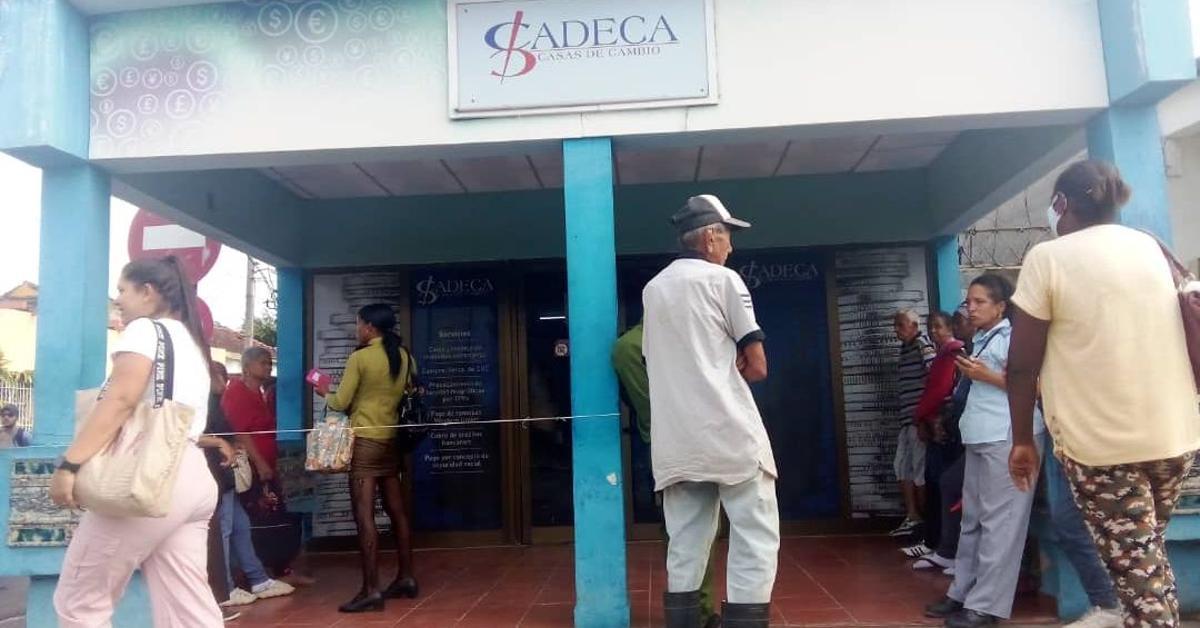
San José de las Lajas (Mayabeque)/In San José de las Lajas, the new floating rate of the dollar does not feel like a change, but rather like a number –410 pesos–, foreign to the real life of the population. In front of the municipality’s Cadeca, the morning advances slowly, with the sun falling squarely on the sidewalk and a queue where almost no one talks about currency, although the signs and figures are there, before everyone’s eyes.
Gisela arrived early to collect her mother’s pension. With the recent change in the exchange rate, I had doubts about whether there would be more lines and whether the checkbook collection would have been separated from the foreign currency purchase and sale operations. He asked the gatekeeper and the answer was simple: all those who wait are about to retire. The last one to arrive is an old man in worn-out clothes, in no hurry and with no intention of exchanging dollars.
“For me, the Government can set the dollar at the price that best suits it,” says the retiree, while adjusting his cap with the letters USA. “With my pension of 4,000 pesos, the most I can hope for is to eat for a week,” he clarifies about a payment that does not even exceed the equivalent of 10 dollars, according to the official exchange rate. “Everything is more expensive on the street,” says the man, without raising his voice.
/ 14ymedio
The custodian pops his head in from time to time and asks the usual question: “Is there anyone to exchange currency?” Nobody answers. Throughout the morning, no person has stopped in front of the portal with the intention of selling dollars. “They want to compete with the informal market but they don’t do it well either,” says Gisela, leaning against the wall. His experience is not theoretical. “Since February I signed up to buy 60 dollars through the digital queue and I am still waiting. So it is clear that the problem must be resolved fula down the street.”
In San José de las Lajas, as in much of the country, it is enough to open Facebook or Telegram to see that informal buying and selling is still intact. Announcements follow one another, rates change several times a day and operations are carried out without papers or blackboards. “If my brother sends me a few dollars, I’m not going to go sell them to the State at a lower price than what others offer me,” says Gisela. “You don’t have to be an economist,” he points out. For her, the new rate is just another chapter of unfulfilled promises, too similar to those of the Ordering Task.
“To make matters worse, now we have tremendous confusion because many businesses are setting an intermediate exchange rate, between the one published The Touch and that of the State, that is, now you have to do a lot of mental calculations to be able to pay directly with dollars or when selling them,” he tells 14ymedio the woman

/ 14ymedio
The queue of pensioners moves slowly. There are no relieved faces or optimistic comments. The fatigue of those who live calculating each peso predominates. Mario, a retired agronomist, looks at the blackboard with irony. “This is a mockery,” complains the man who spent most of his professional life in a Cuba “in which the dollar was prohibited or very frowned upon.” It was in the early 2000s when he had his first contact with the US currency, a time when he worked in Venezuela and managed to save some.
Mario does not believe that the measure announced by the Central Bank of Cuba will benefit the majority. “That’s for a small group, not for ordinary people,” he says, leaning on his old bicycle. “All we do is stand here praying that the cash doesn’t run out before we get to the window.” Around them, several elders nod as they try to take advantage of the shadow of the portal.