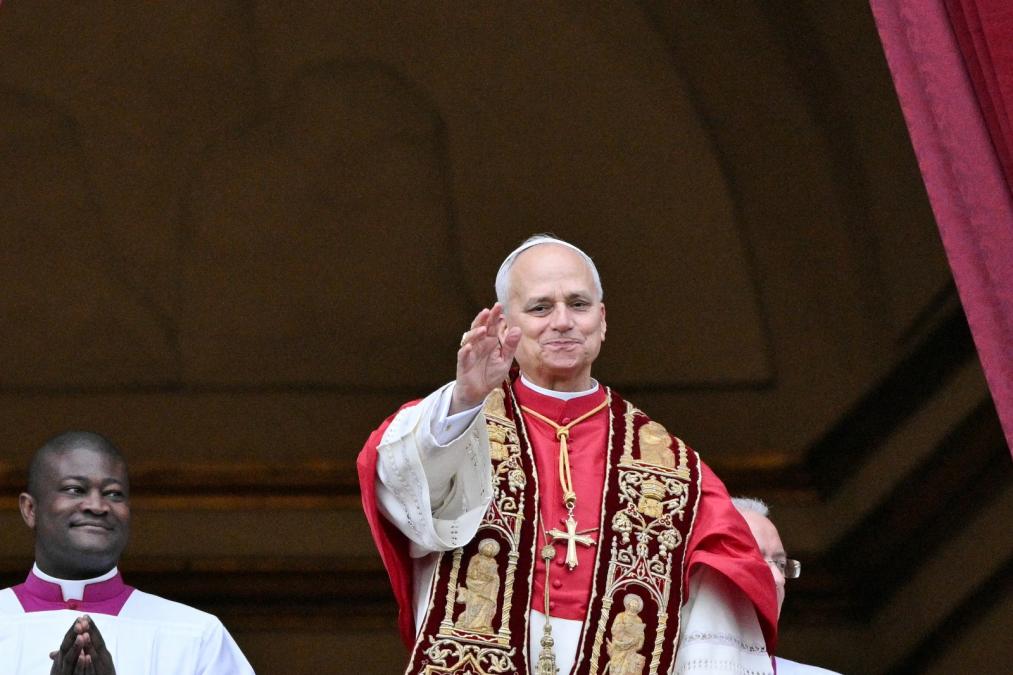
His election, in May, as successor to Pope Francis made Cardinal Roberto Prevost, a Peruvian at heart and with a national ID, today Pope Leo XIVin the most important positive personality for Peruvians who, in the midst of social and political ups and downs, insecurity and disappointment with respect to their authorities, still look to the future with hope.
Four imprisoned former presidents of the Republic, the increase in crime – translated into extortion and murder -, the advance of illegal mining and, once again, a presidential vacancy certainly marred 2025, but in the face of this many Peruvians also emerge who with their work make us feel proud in the economic, sports, gastronomy and art fields.
The national Ipsos survey reflects this. Conducted on December 11 and 12 among 1,211 people from urban and rural areas, the study identifies Pope Leo XIV as the most important positive public personality, according to 39% of Peruvians, followed by the president José Jerí (36%), who took office to replace the incumbent Dina Boluarte on October 10.
Without a doubt, another notable Peruvian is the president of the Central Reserve Bank, Julio Velarde, architect of the country’s monetary stability and whose experience and career have earned international recognition, which is why he occupies third place with 24% support.
But just as there are positive characters, citizens also identify those who have rather had a negative action and on that list it is the former president Dina Boluarte who occupies first place with a categorical (71%), followed by the leader of Fuerza Popular and today again candidate for the Presidency Keiko Fujimori (42%) and by the former president Pedro Castillo (36%) currently held in the Barbadillo prison.
Negative events and occurrences
Respondents also spoke about the most positive events of 2025, placing Boluarte’s vacancy in first place (47%) and then the election of Pope Leo XIV with 30%.
But just as there are bright spots, there are also dark ones, and there the discomfort and concern of Peruvians regarding the climate of insecurity is evident. In this context, they consider the increase in extortions (60%) and murders (39%) as the most negative events of the year. In third place, in addition, the Congress scandals are mentioned (38%) that this year not only brought ‘Children’ and ‘mochasaldos’. Also parliamentarians who used their staff for domestic tasks like Lucinda Vásquez or who threatened journalists for fulfilling their role of investigating and reporting, like Kira Alcarraz.
TECHNICAL SHEET: National urban-rural survey conducted by Ipsos among 1,211 men and women over 18 years of age from all socioeconomic levels. Technique: Quantitative through face-to-face household surveys using mobile devices. Margin of error for total results of +-2.8%. Field work: December 11 and 12, 2025.
ANALYSIS
A paradox called Peru
Álvaro Henzler, President of the Transparency Civil Association
Peru is a paradoxical country: ancient, megadiverse and entrepreneurial, at the same time complex, wounded and informal. We Peruvians live daily with a plurality of feelings: pride and discontent, resilience and frustration, hope and apathy, conviction and insecurity. “Another country would not have resisted what Peru has resisted,” a pertinent recent statement by Julio Velarde, who has already transcended the public figure of an exemplary central banker to become a national archetype of institutional prestige.
This 2025 reflects our paradoxical nature. We maintain one of the most stable and solid currencies on the globe. We have broken historical export records. Our cuisine is a global standard, with the choice of the Maido restaurant and the bread and pork rind breakfast as the best in the world. We even received the blessing of having a pope with a Peruvian ID. Interesting that a high percentage of Peruvians consider positive the negative consequences for politicians who, we consider, do not represent the republican values that we still defend: Boluarte’s vacancy, Castillo’s sentence and the conviction against Vizcarra.
On the other hand, the 5 main negative events of the year fully represent such an institutional degradation that it already affects our daily lives. Millions of Peruvians live insecure and extorted. We agree that the advance of illegal and criminal economies is harmful. And we clearly recognize that political power and the judicial system are today more part of the problem than the solution. So that there is no doubt about it, all of the top 8 negative characters of the year are politicians.
A religious man, a central banker, an athlete, two singers and a chef represent our best version as Peruvians: faith, excellence, effort and creativity. Celebrating their victories allows us to keep our resilient national soul alive. Although if we want to begin to break the inertia of this paradoxical country, it is essential to choose our next authorities better and more consciously. In the 2026 electoral supercycle, Peruvians will have the opportunity to completely change the political cast: new government, new bicameral Congress and new regional and local authorities. It is a priority, then, to reflect on who we give our trust to with our vote. And, thus, I hope 2026 will be remembered as the beginning of a change in the trajectory of this wonderful and complex country towards a full and functional democracy, with opportunities and progress for all.
ANALYSIS
“Politicians are an expression of citizen rejection”
Guillermo Loli, Director of Opinion Studies at Ipsos
It is a national urban-rural survey that represents Peru as a whole and clearly highlights the figure of Pope Leo XIV as well as his election, the social issue mixed with the religious one, given his close relationship with the country and his work in Chiclayo. In second place, on the list of prominent personalities, is President José Jerí.
Let us remember that her predecessor, Dina Boluarte, had a very general level of rejection, practically in the entirety, there were only 2% or 3% of people who approved of her; Therefore, his departure and the appearance of a character unknown to many, surprising, with some symbols in communication terms that were enough to make a difference, would explain this position that could also be related to the image that the president projects of apparent political stability. And although he registered a drop in his approval in the last month – according to a survey carried out by Ipsos – his symbols, his first messages and the fact that he is a president who is seen morning, noon and night, contrasts with the indolence, ineptitude and inability that Boluarte demonstrated throughout the months he governed. Joining them among the positive personalities is Julio Velarde, who—as president of the Central Reserve Bank—is the great architect of what concerns the economy to ensure the main lines of the model. These three characters are also related to the three main positive events.
But there are also the personalities considered the most negative and there they are all politicians; It is not new, in general, politicians in Peru are a clear expression of the rejection of public opinion. Former president Boluarte stands out with 71% and Keiko Fujimori—beyond the second place she has in the polls, still within a lot of dispersion—maintains a very important rejection, an anti-vote that is reflected in this list with 42%, even though she is not in the first marquees of national politics. Obviously, he is credited with the leadership of the congressional caucus that, like Parliament, has been rejected; There is the perception of a leadership that is not so positive in terms of political stability. Finally, there is former President Castillo, related to the coup d’état, not counting the corruption accusations against him that are still under investigation.
As for negative events, those that occupy the first two places reflect the country’s main problem: insecurity. Extortion has grown very significantly and is something that hits and is widespread at all socioeconomic levels and in all regions, and that is closely related to the increase in murders, while in the case of Congress the scandals have damaged its image.
Subscribe for free to the most prestigious Gastronomic Guide in the country. SUMMUM, the weekly newsletter. http://bit.ly/4imAPEI