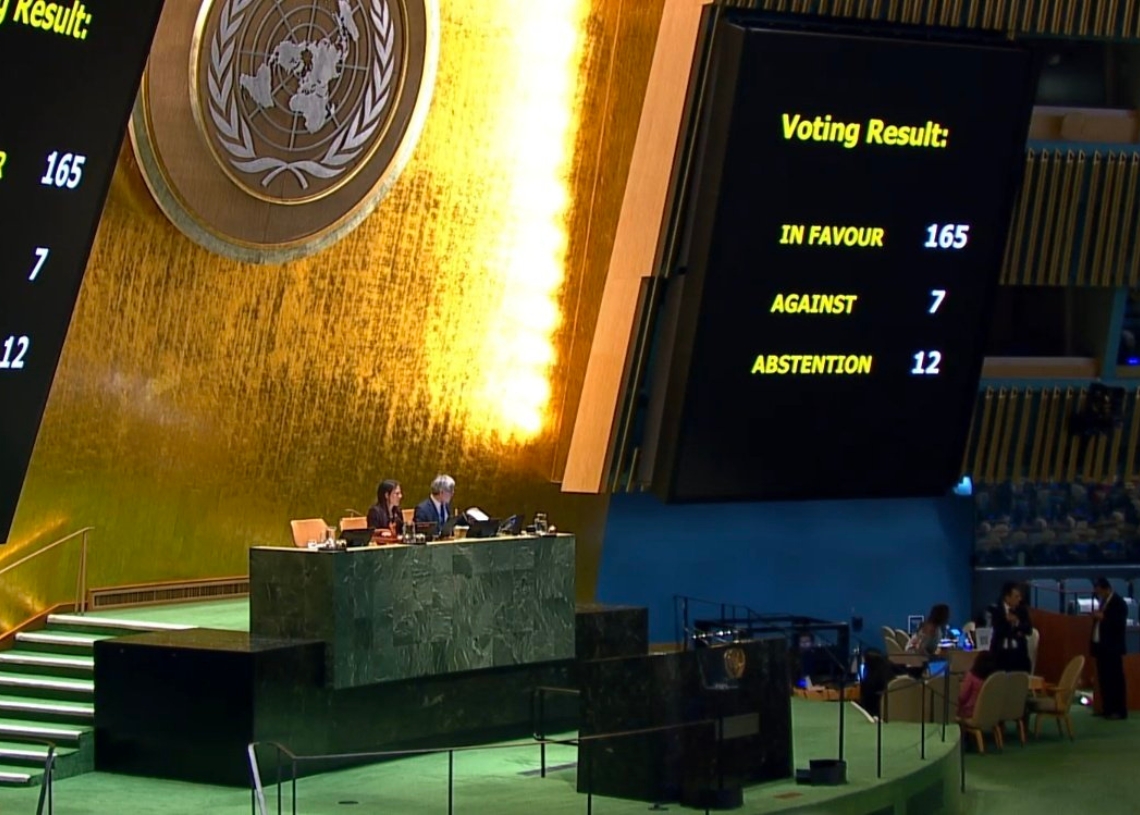
Cuba once again obtained majority international support in the vote in the UN General Assembly on the draft resolution “Need to end the economic, commercial and financial blockade imposed by the United States against Cuba.”
The resolution without binding effect received 165 votes in favor, 12 abstentions and 7 votes against: Argentina, Hungary, Israel, North Macedonia, Paraguay, Ukraine and the United States.
This has been the occasion in which the Cuban demand receives the greatest number of disapprovals since it began its presentation to the United Nations every year since 1992.
Abstentions also increased: Albania, Bosnia-Herzegovina, Costa Rica, Czech Republic, Ecuador, Estonia, Latvia, Lithuania, Morocco, Poland, Moldova, Romania.
The debate around the draft resolution presented by Cuba began this Tuesday, October 28, in the UN General Assembly, where representatives of several nations showed their support for Cuba and against the blockade that the United States has maintained since 1962.
In this context, a tense moment occurred this Tuesday derived from the speech of the US ambassador to the organization, Mike Waltz, who expressed that “the Cuban regime has undermined the democracies of our hemisphere. It has oppressed its own people and steals from them so that, I quote, the members of the regime can maintain their elite status.”
Cuba accuses the US of lying and expressing itself “in a rude and arrogant manner” at the UN
Cuban Foreign Minister Bruno Rodríguez Parrilla intervened in the Assembly this Wednesday minutes before the vote was to be taken, and described Waltz’s speech as “infamous, threatening, arrogant, lying and cynical.”
Rodríguez Parrilla denounced that “in recent weeks the deployment of pressure, intimidation and toxicity by the State Department on a planetary scale to force sovereign states to change their vote on the resolution has been brutal and unprecedented. They have used all their weapons and tricks, especially coercion.”
He also recalled the deprivation of the use of banks and access to credit and international economic operations to which the bloc subjects the island; admitted the deterioration of some health indicators in Cuba, and said that these results cannot be divorced from the impact that the blockade has on the maintenance of the Cuban health system.
Cuban authorities affirm that between March 1, 2024 and February 28, 2025, the blockade caused Cuba some $7.5 billion in material damages and losses.