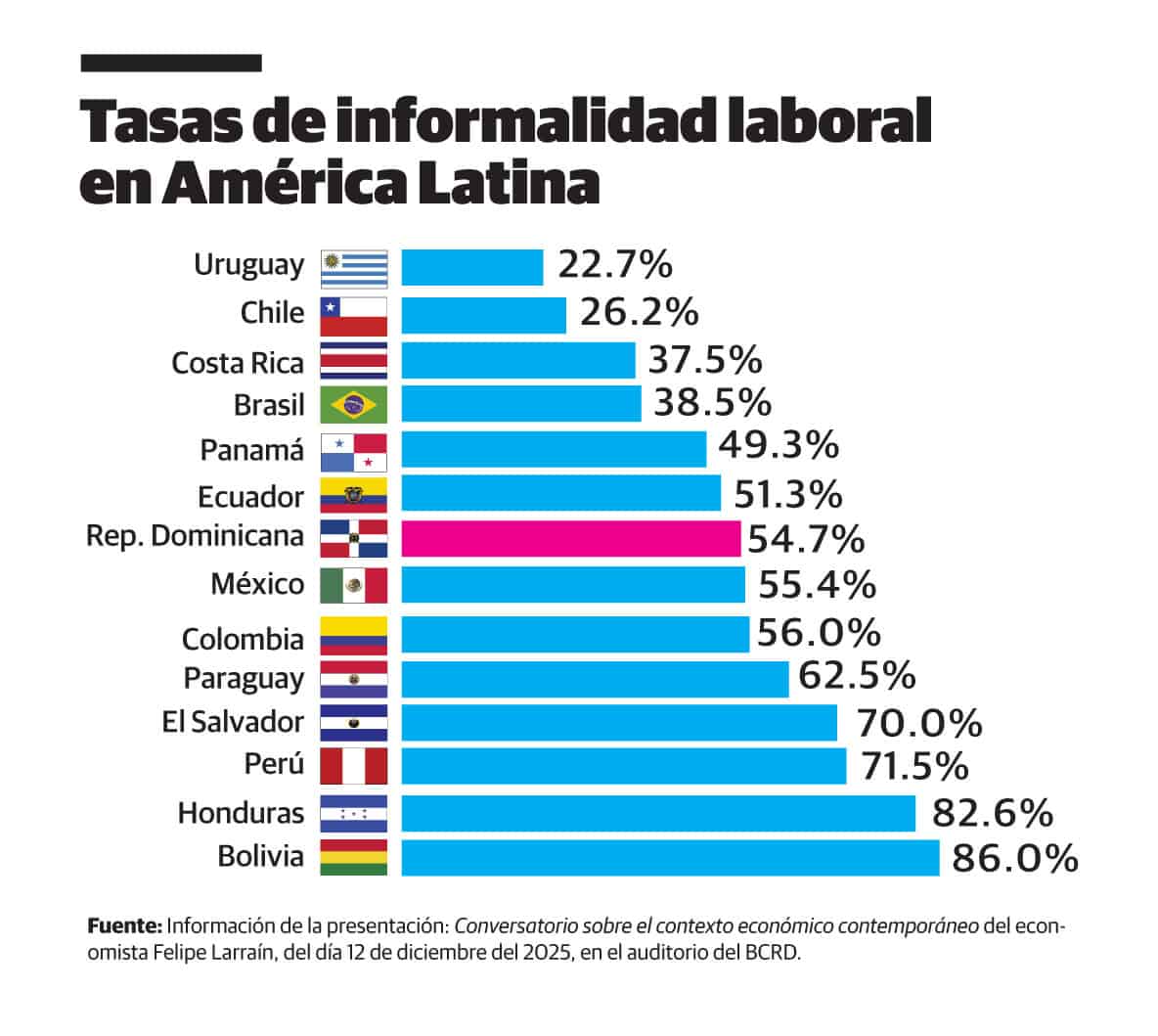
As can be seen in the graph, the labor informality in Latin America It continues to be a widespread problem, although with differences between countries. Uruguay and Chile are the two countries with the relatively lowest rates, while at the other extreme are countries such as Bolivia, Honduras and Peru, where more than 70% of workers operate within the informality.
This implies that the majority of people work without a contract, without social security and without protection against layoffs, illness or old age.
This is not an anomaly, the trend in region it has been that the informality be the rulenot the exception.
Despite the relative economic growth of the country in recent years, in the case of the Dominican Republicthe majority of the population continues to operate in the informalitydepending on jobs that are usually low productivity and low income.
This is because, although there has been growth, structural obstacles persist that encourage informal occupation.
Among the obstacles that encourage informality is found a tax system uncompetitive, multiple procedures, administrative costs and work obligations that can be difficult to assume, especially for small businesses and independent workers. For many people, the cost in time and money required to comply with these obligations hinders formalization, which in many cases pushes both employers and workers into the informal sector.
while you are conditions don’t change, informality will continue to be a recurring way for people to get job.
__________
A collaboration of the Regional Center for Sustainable Economic Strategies (Crees).