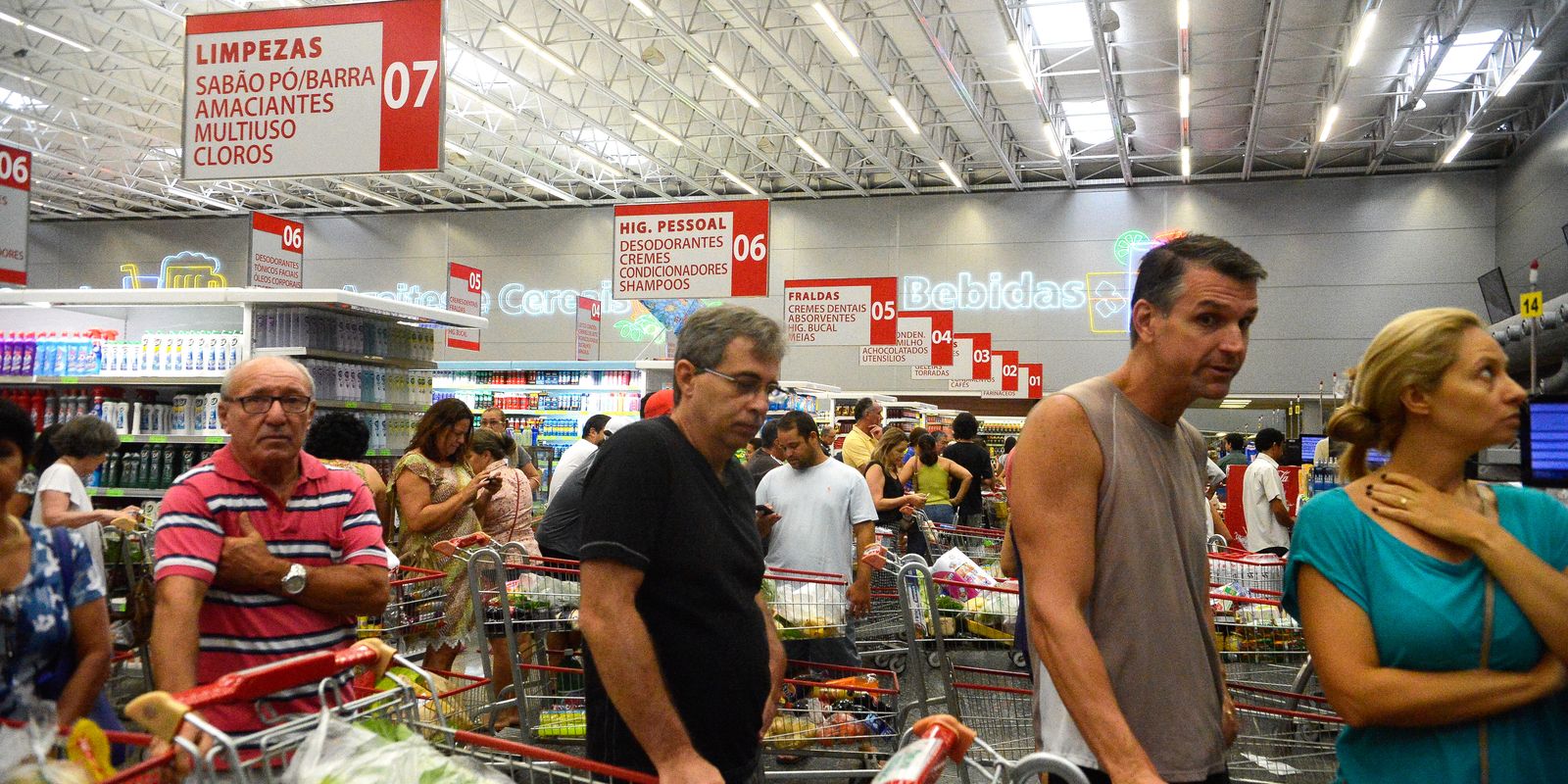
Official March inflation closed the month by 0.56%, pressured mainly for the price of food, which had the highest increase since December 2024. Despite this pressure, the National Consumer Price Index (IPCA), released this Friday (11) by the Brazilian Institute of Geography and Statistics (IBGE), lost strength compared to February, when it marked 1.31%.
With the result of March, the 12 -month accumulated IPCA reaches 5.48%, above the government’s target ceiling and the largest since February 2023, when it reached 5.60%.
The inflation target stipulated by the National Monetary Council (CMN) is 3%, with tolerance of 1.5 percentage points for more or less, ie a window of 1.5%to 4.5%.
March 2025 had the largest result for the month since 2023 (0.71%). In the same month as last year, the IPCA marked 0.16%.
All nine IBGE surveyed products and services groups were discharged in March.
- Food and Beverage: 1.17%
- Housing: 0.24%
- Residence Articles: 0.13%
- Clothing: 0.59%
- Transport: 0.46%
- Health and Personal Care: 0.43%
- Personal Expenses: 0.70%
- Education: 0.10%
- Communication: 0.24%
The diffusion rate, which shows the percentage of products and services that became more expensive, marked 61%.
>> IGP-M, known as rent inflation, falls 0.34% in March, says FGV
Coffee, Egg and Tomato
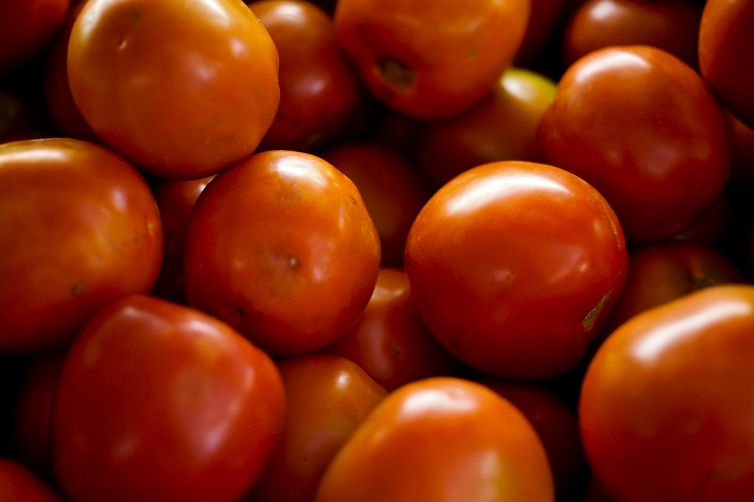
The tomato rose 22.55% with an impact of 0.05 percentage point on inflation. Photo-Archive: Elza Fiúza/Agência Brasil
IBGE pointed out that the food and beverage group represented almost half (45%) of all March inflation. In February, food inflation had been 0.70%.
The March result is the largest since December, when food rose 1.18%. The data also marks an inflection after three months in a row of loss of strength of food inflation. In 12 months, food is 7.68% higher.
Food inflation is one of current government’s main concernswhich expects the current crop to help to overthrow prices.
Food within the home rose 1.31% in March; and outside the home, 0.77%.
The feeding villains in the Brazilian pocket were tomatoes, which rose 22.55%, impact of 0.05 percentage point (PP); ground coffee (8.14%, impact of 0.05 pp) and chicken egg (13.13%, impact of 0.04 pp). Together, these items responded for a quarter of inflation of the month.
The research manager, Fernando Gonçalves, explains that the discharge of tomato is explained by heat in the summer months.
“There was an acceleration in maturation, leading to the anticipation of the harvest in some squares. Without these harvest areas in March, there was a reduction in supply, bringing high pressure on prices.”
For eggs, he pointed to two reasons: increased cost of corn, base of bird feed and the period of Lent, when the demand for egg is Mayr.
The ground coffee accumulates high of 77.78% in the last 12 months. Fernando Gonçalves indicates internal and external factors for the increase. There was an increase in price in the international market, because of the reduction of grain supply on a world scale, with the breach of crop in Vietnam, due to climate adversities, which also impaired internal production.
Other groups
In the transport group, the 0.46% increase had the second largest impact (0.09 pp) in March, but was below February (0.61%).
The result was influenced by the airfare, which rose 6.91% – third largest individual impact on the March IPCA.
IBGE shows the separate IPCA into two groups. Services, considered as a result of the relationship between supply and demand, rose 0.62%. In February it was 0.82%.
The monitored price group, controlled by government and contracts, went from 3.16% to 0.18%.
The 12 -month accumulated service inflation rose from 5.32% in February to 5.88% in March. According to Gonçalves, the explanation goes through the country’s economic scenario, with unemployment at low levels. “The salary wine being larger ends up bringing boost for consumption.”
Service inflation behavior is one of the factors evaluated by the Central Bank Monetary Policy Committee (Copom) to decide the level of the basic interest rate, Selic, currently at 14.25% per month. The definition of SELIC is one of the ways to seek inflation control.
The index
The IPCA investigates the cost of living for families with income between one and 40 minimum wages. The price collection is made in ten metropolitan regions – Belém, Fortaleza, Recife, Salvador, Belo Horizonte, Vitória, Rio de Janeiro, Sao Paulo, Curitiba, Porto Alegre – besides Brasilia and in the capitals Goiânia, Campo Grande, Rio Branco, Sao Luís and Aracaju.