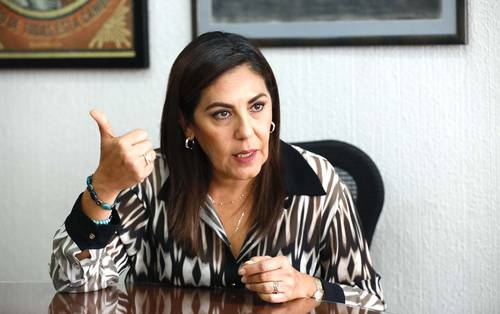
▲ The purpose is to strengthen the democratic regime on the eve of an electoral reform promoted by the president, said the counselor Claudia Zavala.Photo Germán Canseco
Fabiola Martínez
La Jornada newspaper
Saturday, October 4, 2025, p. 6
Claudia Zavala Pérez, counselor of the National Electoral Institute (INE) proposed to establish the mandatory vote and regulate the consequences in case of absence to the polls.
“It would be thought that it is a restrictive method, but no, I think it is a conducive moment in Mexico so that those who stop sovereignty – all people are people – and those who are enabled to make the decision of who will be the representatives, governments and judges, we go to say what we want,” he said to The day.
The purpose, he added, is to strengthen the democratic regime at a time when the consultation towards an electoral reform (promoted by President Claudia Sheinbaum) is open.
“Until now it has not been done because it has only been seen how to guarantee that right, but I think it is a conducive moment to start generating the scheme that forces us to go to the polls to express our sovereignty, because this will strengthen it. In that idea it is how I make a proposal, regarding all the public discussion that is being generated,” he said.
In Mexico there are two constitutional provisions related to the subject; One indicates that voting and being elected is a right and another refers to the vote as an obligation.
However, the counselor explained, the latter is an imperfect norm, because although voteing is a constitutional provision, no consequence is stipulated in the event that it is not fulfilled. Obviously there would be exceptions for those who are unable to do so.
“Why is it the proposal to establish the mandatory vote as a mechanism that allows us to know what people want? Because it is not the same to go to the urn and cast a vote in favor of a political force, to leave it blank and annul it; there is already a manifestation of the will of those sovereign people.”
Then, in the face of the positions that say ‘we have the representation of the people’, because we will have to decipher what that diverse conglomerate says.
He proposed that in principle the mandatory voting model in Latin America will be analyzed and see which one is the most effective. Nations of the region such as Argentina, Bolivia, Brazil, Chile, Ecuador, Paraguay, Peru and Uruguay have that option, while others, such as Mexico, establish it in the Constitution but in practice it does not apply, lacking a sanctioning framework.
In some countries of the world there are even fines for those who do not vote and in a few it is conditioned for administrative procedures; Even in cases like Argentina, this obligation extends to its citizens who live abroad.
In this regard, the counselor said that it is time to build here, in consensus, an integral model that includes the respective sanctions.
In the most recent presidential election 60 percent of citizens with a current credential (nominal list) voted, while in the first judicial contest it only 13 percent did so.
“Today in this open discussion (towards an electoral reform) it is necessary to sit down to analyze how we want the country, the design of our electoral political system, to define the social political scheme,” he said.
Capacity of the National Electoral Institute
– Would the INE have the capacity to attend in 2027 crowds in the boxes, to participate in different elections and even a mandate revocation process?
– That is what more than 100 million people who will then be in the electoral roll will vote; That is what democracy is about, that is the participation of the people that have so much diversity, and the electoral authority always has to guarantee a table so that the total registered in the nominal list arrives, the premises do not change, ballots are printed for all.
“It is that all those people who are enabled for decision making, let’s listen to the voices because today it would seem that some say ‘we have legitimacy because all the voices chose us’; there was a significant percentage, but when you build the social consensus that helps us live in peace, we all have to be represented.”
Obviously, he abounded, the mandatory vote would increase citizen participation, but also in defining the direction of the country.