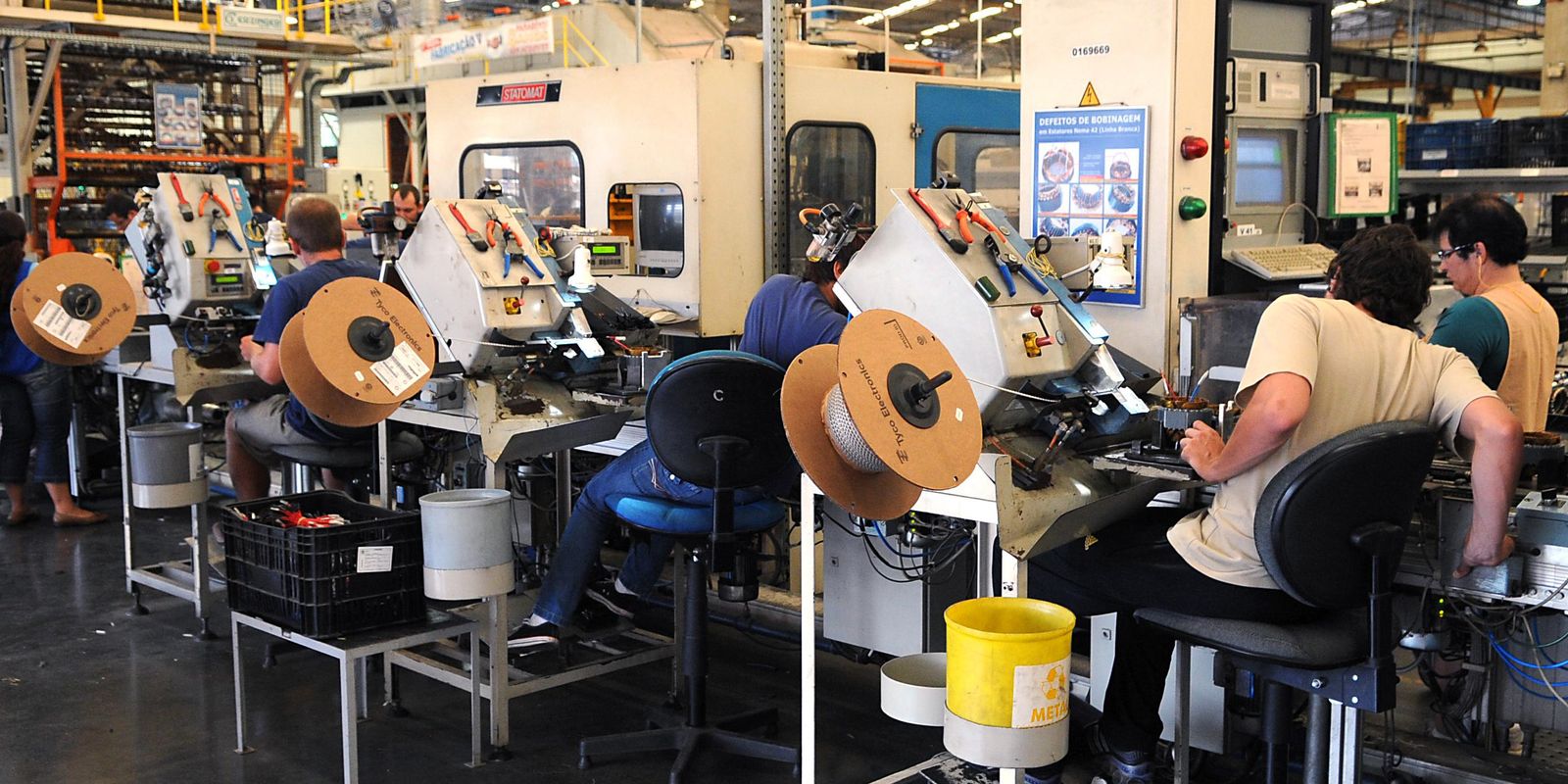
The production of oil, iron ore and natural gas helped Brazilian industry grow 0.1% in October compared to September. The result reverses the 0.4% drop identified in the previous month.
With data from the Monthly Industrial Survey released this Tuesday (2) by the Brazilian Institute of Geography and Statistics (IBGE), the national industry shows an increase of 0.9% in the 12-month period.
This annual performance shows deceleration, being the lowest since March 2024 (0.7%). In March 2025, the accumulated figure reached 3.1%.
In comparison with October 2024, there was a decrease of 0.5%. The quarterly moving average shows an increase of 0.1% in relation to the three-month period ending in July.
October’s performance places the industry at a level 2.4% above the pre-covid-19 pandemic period (February 2020) and 14.8% below the highest point ever reached, in May 2011.
Activities
IBGE found that between September and October, there was an expansion in production in 12 of the 25 industrial activities surveyed. The positive highlights were:
- extractive industries: 3.6%
- food products: 0.9%
- motor vehicles, trailers and bodies: 2%
- chemicals: 1.3%
- computer equipment, electronic and optical products: 4.1%
- manufacture of clothing items and accessories: 3.8%
The research manager, André Macedo, points out that the extractive industry was what boosted industrial production the most. “The advance was influenced by the greater extraction of oil, iron ore and natural gas.”
Among the activities that stood out in the negative field are:
- pharmochemical and pharmaceutical products: -10.8%
- production, coke, petroleum products and biofuels: -3.9%
- printing and reproduction of recordings: -28.6%
- tobacco products: -19.5%
Effect of high interest
IBGE analyst André Macedo explains that one of the main factors preventing a better result for the industry is the restrictive monetary policy, that is, the high level of interest rates.
“It ends up preventing further progress, not only in the industrial sector, but in the economy as a whole, as it has an impact on the granting of credit”, he says.
The basic interest rate in the country, the Selic, is at 15% per yearthe highest level since July 2006 (15.25%). The rate is decided by the Monetary Policy Committee (Copom) of the Central Bank (BC), which defends the high level as a way to combat inflation, accumulated at 4.68% in twelve months.
Since September 2024, inflation has been above the government’s target ceiling, which goes up to 4.5%.
By cooling the economy, high interest rates tend to reduce demand for goods and services, in order to stop rising prices. The side effect is the obstacle to job creation and economic growth.
The IBGE manager considers that, on the other hand, the job market accumulates positive results and an increase in income, which partly favors the industry’s behavior.
Brazil has recorded in recent quarters the lower unemployment rates already investigated.
Localized pricing
André Macedo points out that some niches of activity pointed to American tariffs as responsible for the decrease in production in October.
“Wood is the segment in which this issue is most evident”, he mentioned.
Other segments that reported an impact, according to the analyst, were:
- shoes
- non-metallic minerals, such as granite
- machines and equipment
Macedo explains that when providing information to IBGE, industrialists are not obliged to justify drops in production, that is, there may be other sectors that felt impacts, but did not report them.
The researcher highlights that the high interest policy had a more significant effect than tariffs as an obstacle to industrial production.
Understand the pricing
The tariff came into force in August and, in the view of the American government, has the role of protecting the domestic economy.
In July, at announce rates in letter of 50% on Brazilian products, the US president even claimed that the imposition of very high interest rates was in retaliation for the treatment given by Brazil to former president Jair Bolsonaro. For Trump, the former president of Brazil suffers persecution.
Since then, the Brazilian and American governments have been negotiating ways to seek agreements for the commercial partnership. On the 20th, Trump removed additional taxation of 40% to products such as meat and coffee.
The vice-president and minister of Development, Industry, Commerce and Services, Geraldo Alckmin, calculates that 22% of exports to the United States remain subject to surcharges.