The prices of the dollar and the euro in the informal market far exceed the purchasing power of Cubans.
HOLGUÍN, Cuba. – “Every rise in the dollar affects my business. The costs of flour, oil, cheese and other products rise with the dollar, and every day I cannot change the price of my offer because I lose customers. I spend the day calculating and, in the end, I feel that I worked almost for free,” says a woman from Holguín who manages a gastronomic establishment in the city and who asked to be identified as Elena to avoid reprisals.
The immediate reality is that the prices of the dollar and the euro in the informal market far exceed the purchasing power of Cubans: one is already close to 500 pesos and the other reaches 530.
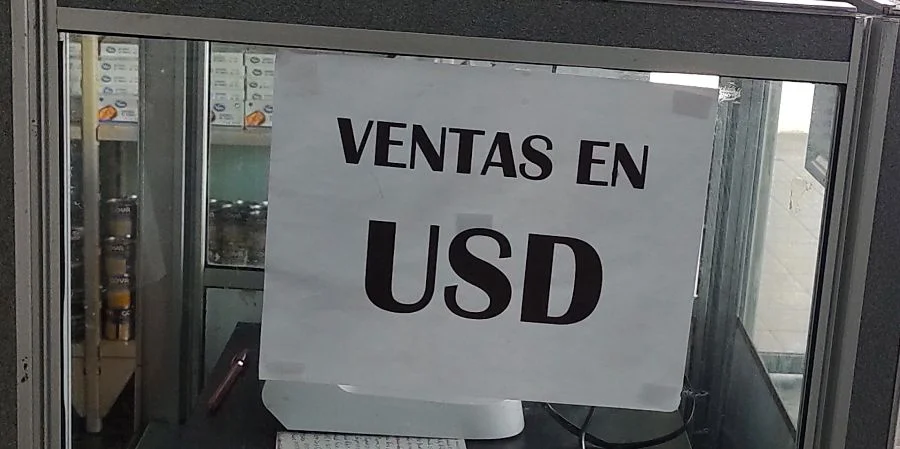
In this context, and given the instability of the exchange rate, several private sector businesses have decided to offer their products in dollars.
This dynamic of financial survival also affects transportation, a vital sector dominated by the dollar. A private taxi driver who preferred to identify himself as Carlos explains: “People complain that we charge a lot, but do you know how much a tire, a spare part, gasoline or a liter of engine oil costs? All of this has to be paid in dollars in government stores or bought from people who bring it from outside. If the dollar goes up, I have to raise the price of the ticket, it’s a chain.”
However, Holguin native Roberto Hernández points out that prices always rise with the dollar, but rarely fall with it. “When the dollar rises, prices skyrocket instantly; oh, but when it falls, the sellers ignore it and do not lower the price. At the end of last year the dollar fell from 500 to almost 400 and not even the prices of oil, rice, chicken, beans and other products fell in MSMEs.”
Marlenis Proenza, a mother from Holguín, describes how the fluctuation of the foreign currency directly determines what is put on the table. “When the dollar rises, the price of oil disappears or costs more than 1,000 pesos. Chicken, don’t even mention it: a 40-pound box costs 15,600 pesos. You spend the day calculating and giving up things so that your children can eat.”
For her part, Alina Pérez from Holguín argues that criticism against the private sector diverts attention from the root of the problem: the Government’s inability to generate supply.
“It is a mistake to blame the MSMEs for the rise in the price of the dollar. The problem is the inefficiency of the Government, which does not produce or have offers that compete with the MSMEs. If the Government wanted to lower prices, it would fill the stores with food in national currency and the abuse would end. But no, they prefer to raise prices and send inspectors, who only make the sellers hide the merchandise and raise the prices.”
The contradiction of a system that pays salaries in a devalued currency while selling its products in another inaccessible to the majority is pointed out by Holguin native Eduardo Aguilera as the main cause of illegality: “Who is the first culprit of this laxity? The State itself. You are going to a cupet [punto de venta de gasolina] or to a ‘good’ store and everything is in dollars. If the Government pays me in Cuban pesos that are worth nothing, how does it force me to please the reseller on the street?

The authorities, although they try to appear controlled, have had to accept the severe limitations they face. Recently, Ian Pedro Carbonell, director of Macroeconomic Policies of the Central Bank of Cuba, recognized the complexity of the current situation. “It is very difficult to regulate [una economía como la cubana] without an exchange market that works, and, above all, that does so reflecting reality,” he said.
Carbonell also admitted the State’s lack of liquidity to intervene effectively, citing a “decrease in the Gross Domestic Product (GDP), exports and a level of dollarization.”
To put the financial crisis in perspective, the professor at the University of Havana and first vice president of the National Association of Economists and Accountants of Cuba (ANEC), Ayuban Gutiérrez, offered an estimate of the resources that would be needed to stabilize the currency, a figure that today seems unattainable for the national coffers: “600 million dollars for three years.”
Faced with this vacuum of economic authority, people like Alejandro Leyva emerge, who from the informal market takes advantage of the scarcity to impose his conditions: “If the dollar rises, I raise the price of what I sell. I resell whatever appears: oil, detergent, motorcycle parts. The rise affects me because people have less to buy from me, but I always look for the return. In this country, the dollar is king and he who has ‘greens’ rules.”

Meanwhile, state workers see how years of work turn into a miserable retirement or salaries that do not even cover the first week of the month. Although the National Office of Statistics and Information (ONEI) indicates While the average salary rose to 6,830 pesos, real inflation makes that number insignificant for people like Roberto Zaldívar. “I have been working for the State for 30 years. Before, my salary was more or less enough for me. Now my salary of 5,560 pesos per month is very little. Every time the dollar rises, my monthly salary is worth less.”
The impact on the professional sector is alarming. Sonia, a primary school teacher, confesses that economic necessity forces her to leave her profession to seek support in the private sector, where she earns more.
“I like my profession, but my vocation doesn’t give me food. The rise in the dollar has devalued it. It’s sad to teach classes and think about what I’m going to cook when I get home.”
For youth, the economic crisis encourages the desire to emigrate. Javier Batista, a 22-year-old young man, sees his future linked to the possibility of buying dollars to pay for his departure from the country: “There is no one who can withstand the daily blackouts and shortages of all kinds; every time the dollar rises, the procedures become more expensive and my desire to leave the country recedes.”
All this happens under the official name of “war economy”, a term used by the Cuban Prime Minister, Manuel Marrero Cruzto describe the current stage.
The government response has been to opt for partial dollarization, a measure explained in the program Round Table by Alberto Javier Quiñones Betancourt, vice president of the Central Bank of Cuba, as a necessary adaptation to the circumstances. “This is an option so that people who have dollars can use them to purchase certain products,” said the official.
However, prestigious economists warn about the dangers of this strategy.
Pedro Monreal concluded that the Government is renouncing the defense of the national currency and, thus, contradicting the principles of the so-called “monetary order.”
It is more forceful the criticism of the economist Mauricio de Mirandawho describes the current management as incompetent and disconnected from popular suffering.
“To the extent that dollarized spaces increase, the Cuban peso will depreciate more; and given the paralysis of national production, this will mean more hardship for Cubans,” the specialist wrote. “Cuba has never had a leadership so incompetent, so irresponsible and so mediocre, but in addition, they have exceeded all limits of insensitivity with the tragedy that the country and especially the simple people are experiencing,” he concluded.