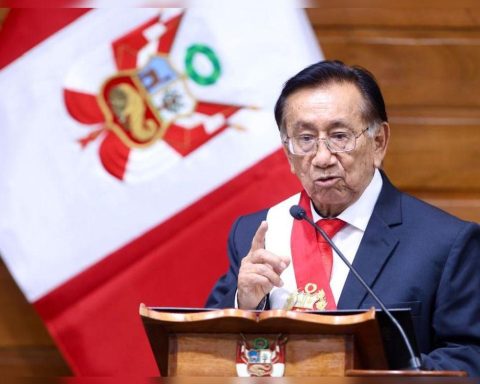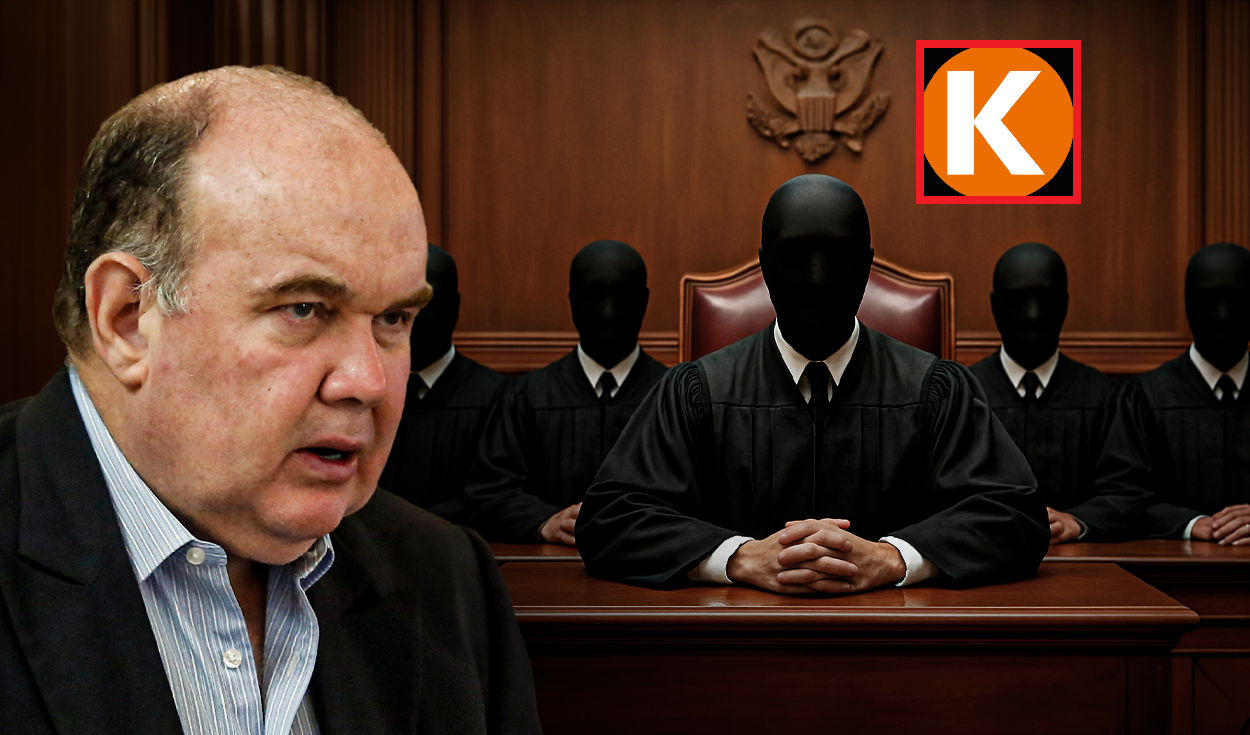
More coincidences. In the same style as Fujimorism, the presidential candidate for Popular Renewal, Rafael Lopez Aliagaproposed the return of the so-called faceless judges in the face of the wave of extortion and contract killings that are taking place in the country. He proposed this measure despite the fact that the Judiciary has been against of it because there has been a negative experience when it was applied in the nineties.
“There has to be another root reform of the Prosecutor’s Office that is rotten. We have to return to the faceless judges so that those who have the courage to establish order do not wake up and send the criminal to jail. But since they are afraid, faceless judges (are needed) again if it is terrorism. We already know how to kill terrorism, terrorism is fought with actions. General (José) Baella (former head of the Dircote) already defeated those people. We must defeat urban terrorists again,” said López Aliaga, last Friday, at an activity in Santa Anita.
This approach by the former mayor of Lima, which went unnoticed, became known days after the congresswoman of Fuerza Popular, Patricia Juárez, will also announce that it will present a bill for the return of faceless judges, including prosecutors, with the aim of “protecting the physical integrity of magistrates who could be intimidated by criminals.”
PJ and Prosecutor’s Office reject initiative
But is this proposal feasible? Last Tuesday, October 28, during a work table in Congress, the head of the Cabinet of Advisors to the Judiciary, Braulio Andrade, made it clear that The institutional position is contrary to that option because there is a negative experience in the past and because it violates the commitments assumed by Peru before the Inter-American Court of Human Rights.
“The issue of faceless judges is a little more complicated and We do not agree because we already have precedents about iton the constitutionality declared at the level of the Inter-American Court of Human Rights, at the level of the Constitutional Court itself, that it is not appropriate to have faceless judges as such, because precisely the right of defense is affected,” he stated.
In that same activity, the national coordinator of the Specialized Prosecutor’s Offices against Organized Crime, senior prosecutor Jorge Chávez Cotrina, also showed his opposition to the proposal. “We already have experience. All the sentences were dropped because there was an international body and currently we continue judging to people who were sentenced by faceless judges. “I think it is not the way out,” he said.
Criminal lawyer Julio Espinoza considered the proposal for faceless judges unviable and added that, opportunely, it is presented in an electoral situation where populist initiatives are prioritized by the candidates.
“The criminal system is not only exercised by judges, judges, police, specialized experts, witnesses also intervene. Then it would not be a special system of faceless judges but practically an anonymous process, without identity, which would end up disrupting the essence of minimally guaranteed processes in the 21st century,” he explained.
He recalled that in recent years Experiences of this type have already been presented in the region, such as in Brazil, with Jair Bolsonaro; and Mexico, with Andrés Manuel López Obrador. “This shows that this proposal is not associated with an ideological origin but rather with a populist purpose of giving symbolic, but unviable, measures,” he asserted.
The experience in Peru
The figure of faceless judges for terrorism cases was made official with article 15 of Decree Law No. 25475, published on May 5, 1992, during the dictatorship of Alberto Fujimori. However, it was repealed on October 15, 1997, by Law No. 26671.
Despite this, the Inter-American Court of Human Rights, on May 30, 1999, through the ruling in the case of Castillo Petruzzi et al. Peru, established that the Peruvian State violated article 8.1 of the San José Convention of Costa Rica because this instance did not respect the minimum standards of impartiality. The Constitutional Court (TC) also declared the subtraction of the matter because that figure had already been repealed.
“When applying a measure like this, it is not possible to verify the independence of a judge when his identity is unknown and it was precisely this lack of transparency that opened the door to convictions without sufficient evidence. Fujimori himself had to pardon more than 500 people for three years due to national and international pressure due to the errors of these courts,” the founder of the Legal Defense Institute, Ernesto De La Jara, explained to this newspaper.
The lawyer of the Association for Human Rights (Aprodeh), Gloria Cano, added that Alberto Fujimori, now deceased, had to back down not only because he violated due process, but because he took hundreds of innocent people to prison.
“Fujimori commissioned the Ombudsman with an ad hoc commission to review the rulings, and appointed Father Hubert Lanssiers as his representative. Through this commission, The irregularities and mistaken mistakes of many people were recognized. Furthermore, the TC indicated that new trials were necessary for all those who were subjected to this type of court,” he told The Republic.
Cano pointed out that they seek to repeat history so as not to recognize the measures dictated by Congress that favor crime.