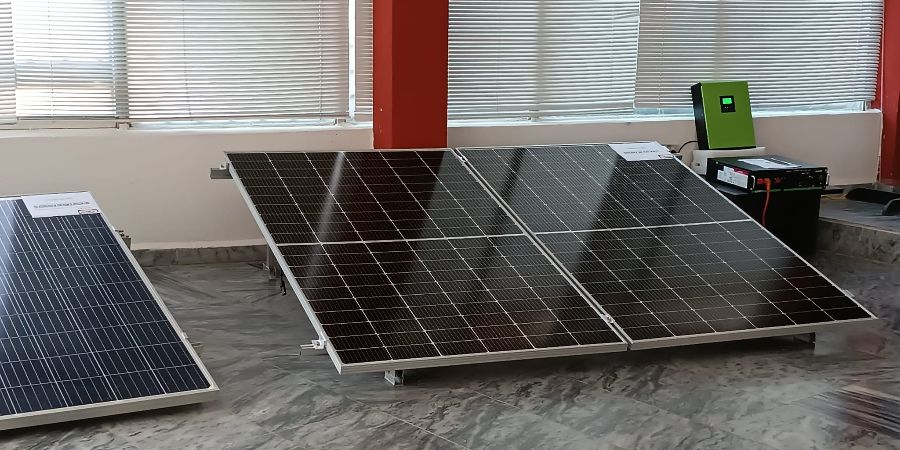
Madrid/In a race to promote a change in the energy matrix, the Government has approved new regulations full of tax benefits for investment in renewables. The resolution introduces incentives to also promote efficiency and use, both in the state and private sectors. For the latter, the exemption from taxes on personal income stands out for self-employed people who decide to opt for self-consumption projects and for those who decide to contribute electricity to the national energy system.
The Vice Minister of Finance and Prices, Yenisley Ortiz Mantecón, explained the regulations to the official media, published this Thursday in the Official Gazetteto the official presswhere he confirmed that the provisions are maintained approved already in 2025. In that regulation, intended primarily for state and private companies to import solar panels and their parts free of tariffs, they were also exempt from paying the profit tax until the investment was amortized.
Now, with the latter, agricultural producers, artists or any other self-employed professional will also be part of the beneficiaries, with a period of eight years, which is the time that the National Office for the Rational Use of Energy (Onure) will certify in the technical opinion that must be available to enjoy the aforementioned tax advantages. To obtain it, you must present the documentation at the National Tax Administration Office (Onat) where the self-employed person’s tax domicile is located.
Now, with the latter, agricultural producers, artists or any other self-employed professional will also be part of the beneficiaries, with a period of eight years
The 2025 resolution expanded the first of its kind, signed in 2021 for the exemption of tariffs on the purchase of solar panels by natural persons. For them there is also a novelty: this equipment will not be part of the import value without permitted commercial value, as long as it is presented to Customs independently of the rest of the imported items.
But in addition, the standard approved yesterday updates the list of equipment to be imported exempt from payment, among which are solar heaters, photovoltaic pumps, small wind turbines, biodigesters, chargers for electric vehicles and solar air conditioning systems.
The standard also aims to encourage the national industry through the exemption of tariffs for a long list of parts and supplies necessary to produce or repair these devices, ranging from screws and washers to motors, including cables, transformers, accumulators, fuses and measuring devices.
Ortiz Mantecón stated that since the first regulations for companies were approved, Onure has received 168 license applications, of which 95 belong to private companies. However, only 56 projects have been installed and are operational, which indicates that the agility of the system has been quite poor to date and we will have to wait to see if now, in the midst of a growing need for alternative energies due to the US oil fence, there are more economic actors willing to invest in these systems. The objective, with an unprecedented crisis upon us, seems complicated.
The vice minister insisted that the measure implies a reduction in tax revenue for the State, but that the priority is to promote the energy transition.
The announcement was also accompanied by the warning of a penalty for those who violate the conditions of the exoneration. There will be inspections for those who decide to take advantage of the benefits and, if it is found that the regulations are not complied with, the certificate will be revoked.
It could also be canceled if the imported equipment does not correspond to the approved project or the documents supporting the investment are not presented.
It could also be canceled if the imported equipment does not correspond to the approved project or the documents supporting the investment are not presented.
The placement of panels is, on the other hand, not a bed of roses. In a city where overcrowding continues to mark the pace of housing in many buildings, disputes over the common space on the roof to install these devices are already beginning to be a battlefield. The protection of these structures, which require frequent maintenance and care, must also be done in areas protected from impacts and away from thieves, who are already beginning to have these photovoltaic panels in their sights.
The need to have large spaces in which to deploy them, the dangers posed by the impacts of objects, in a nation where frequent hurricanes cause blinds or pieces of tiles to become projectiles that fly through the air, are some of the dangers that the new “solar wave” faces. Also, vandalism and looting, which has traditionally involved everything from air conditioners to the cables that run from the electric clock to the interior of homes.
The transfer of this equipment also requires careful handling that is complicated in the midst of an energy crisis that prevents messages from transporting goods and forces cyclists and motorcyclists to be used to move products.