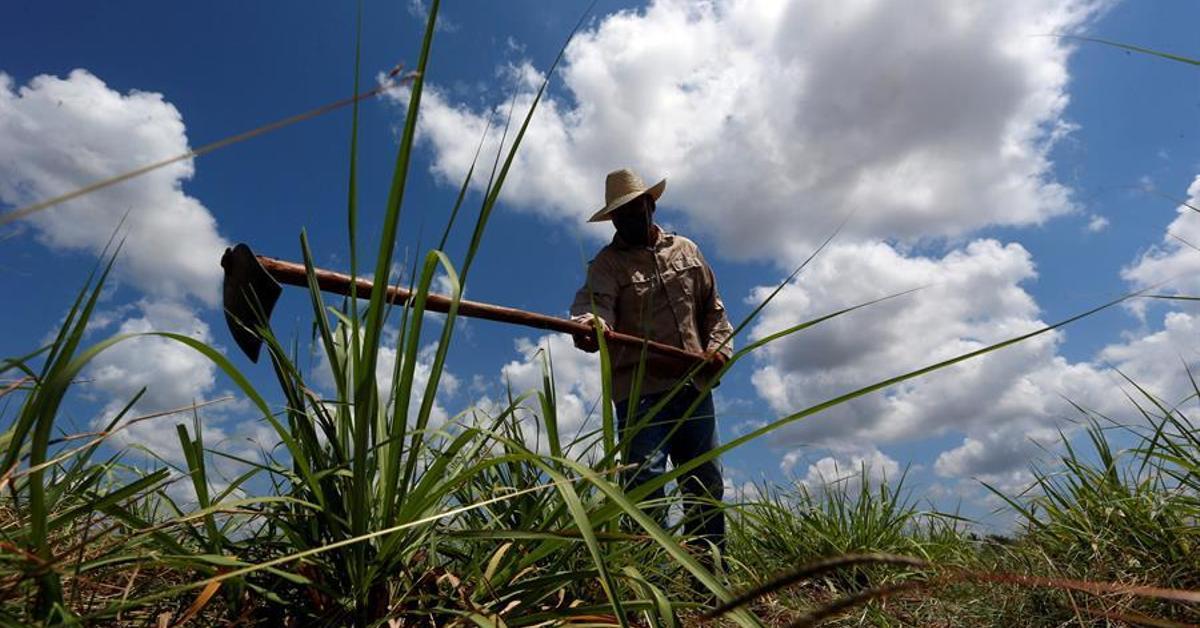
Madrid/The machinery for the 2025-2026 sugar harvest to begin is beginning to be greased with the doubt of how much the planning will amount to, in a year that could delve into the bottomless pit that the former reigning industry in Cuba has become. The season should be “a watershed” compared to recent years, said last September Joel Queipo Ruiz, the first secretary of the Communist Party in Holguín. And, although he was referring to the province, the message is valid for everyone.
Fall below the 147,652 tons that were produced at most in 2025 It would be disastrous, but it is very possible. The loss of the workforce is one of the factors that adds to the agricultural and technological problems, says José Luis Jomarrón Cera, president of the Diego Felipe cooperative. Located in Puerto Padre, Las Tunas, the company is one of the few that is doing well, although the plant to which it delivers the cane – the Antonio Guiteras – remained at 16% of what was planned last year, 7,200 of the 45,000 tons planned.
So far this year, he has achieved a good yield – 42 tons of cane per hectare “on very poor quality soil and in dry lands,” he says – and in the spring campaign he achieved the goal of planting the planned 82 hectares. “Now we have the land prepared to start the cold season and plant another 73.4,” he tells the newspaper. Newspaper26, who today interviews the producer to try to understand what is going wrong in the Cuban sugar industry and how it could be acted upon.
So far this year, he has achieved a good yield – 42 tons of cane per hectare “on very poor quality soil and in dry lands,” he says.
“Producers know how to do it and we are aware that a lot can be done,” he begins after considering that the sector suffers from the dilemma of whether it is the chicken or the egg. “Should more cane be planted if the industry cannot process it?” they ask him. “If the industry does not grind there will be no cane, and if there is no cane the industry will not grind,” he reasons. It is not the first time that the provincial newspaper has asked that same question: On October 18, he published a long and hard article in which the industry was directly questioned for being “totally obsolete.” For Jomarrón Cera, however, the main obstacle is the lack of incentives for the union’s workers.
“In the last harvest we were left unharvested with 14,000 tons of sugarcane with approximately 28 million pesos to be collected, of which eight would be for expenses and 20 for distribution, which would represent 200,000 pesos in profits for each worker,” he explains.
In his opinion, the farmer must be aware that he is the owner of the production, assure him of the materials and inputs and motivate him. “This is not new, but we have to pay them for encouragement, for productivity, quality, discipline. There is legal support to implement payment systems that take these attributes into account, but there is laziness in their materialization,” he says, without specifying how.
The producer affirms – despite the fact that, for now, the data that contradicts him – that the Government has adopted decisions that have improved the situation, the well-known 93 measures to strengthen sugar production that came into force in 2022, and assures that the State accompanies the workers through all institutions, except one that he accuses of the complete opposite: the National Insurance Company (Esen).
“The insurance is too expensive and, despite this, it does not cover even 10% of the expenses that harm production. There are persistent droughts, floods with great productive and economic effects, and Esen does not cover anything, it always looks for justifications and in most cases it does not come. It is the general criterion among farmers.”
This figure should be around 20%, but in many companies, he says, they are working with percentages of between 40 and 70%.
Jomarrón Cera, despite his conviction that the State supports them, drops considerable criticism. “The first thing is to serve the worker, because right now it is the only asset we have available and is capable of generating many of the resources we lack. We have lost 10 times more than what we would have spent on actions of that type, but we have not attended to that force, we have remained in speeches, good intentions and stereotyped phrases.”
In his case, he considers that the cooperative has achieved good results as a result of achieving the link between the farmer and the land and achieving a good balance of remaining vines. This figure should be around 20%, but in many companies, he says, they are working with percentages of between 40 and 70%. “In addition, they are milled out of date due to delays in the harvest.” Jomarrón Cera says that his company is also failing to earn a lot of money – “We had planned to charge, between a basic advance and a stimulus for performance evaluation, up to 17,000 pesos per month, and it was not possible” – but he still provides a weekly stimulus to his workers.
And the producer, who praises the ability of other countries to make money from the sugar sector, still defends the production model. “The State must give autonomy, but control more. It has to play another role, another role,” he considers. And he highlights that the cooperative model is a work organization “perfect for a socialist model” that is not sufficiently recognized. “We cannot continue betting on privatization,” he concludes.