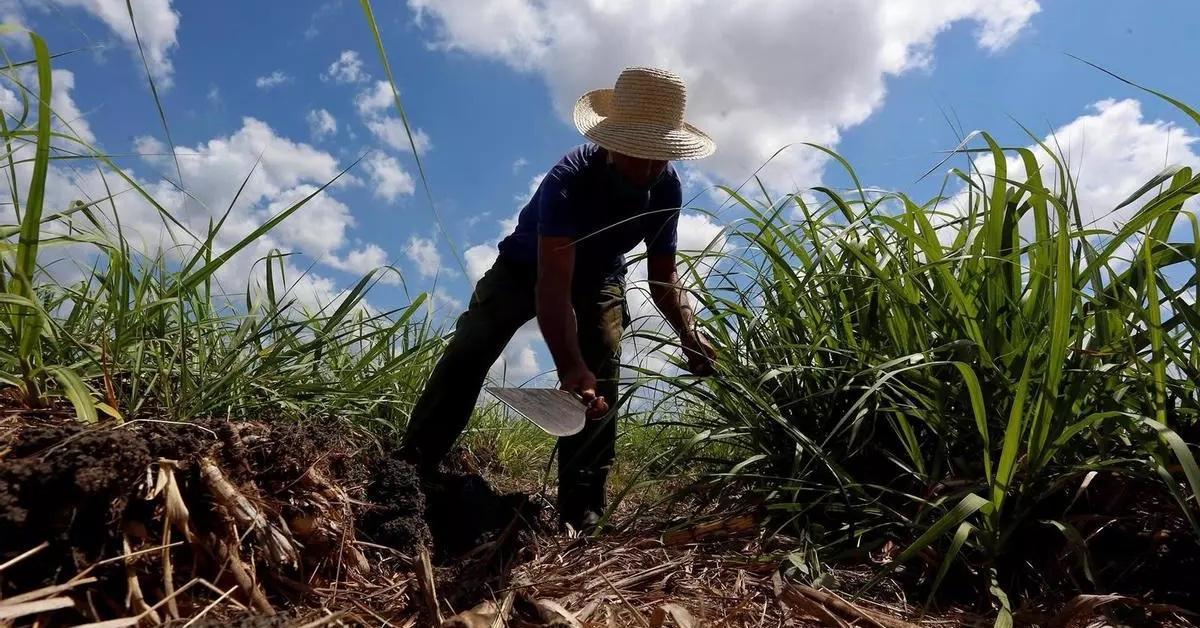
Havana/Day zero arrived. The machines will not cut the cane at the Enidio Díaz Machado mill in Campechuela (Granma) and, if the goal of producing more than 17,000 tons of raw sugar is to be achieved, it will have to be done as it was a few centuries ago: by hand.
According to a text published this Saturday in Granmathe provincial authorities “evaluated” the preparations for the next sugar harvest. Given the “complex period” that they foresee, due to the “complex situation with the availability of fuels and other inputs”, such as lubricants, the “key strategy” will be to “increase by almost 80% the volumes of cane to be ground through manual cutting.”
“It will be a complex harvest and we cannot give up contributing as much as possible to production. We have to rely on intersectorality and the participation of all Granma municipalities,” said Governor Terry Gutiérrez during a session of the Provincial Government Council that took place on Friday.
To encourage workers to carry out this arduous work, a payment of 700 pesos per ton was offered to the macheteros, who, according to Granmacould reach incomes of up to 22,000 pesos per month.
Production also faces “the unfavorable behavior in land preparation and planting activities”
The production, which is intended to be allocated “fundamentally to the regulated family basket and social consumption,” also faces “the unfavorable behavior in land preparation and cane planting activities during January, a situation that involves the five agroindustrial sugar companies in the province.” Likewise, “the occurrence of fires” is latent, so a call was made to monitor the sugarcane fields.
The difficulties in starting the grinding machinery at Enidio Díaz Machado are a chronicle of a death foretold. A year agothe province of Granma “officially” celebrated the launch of the 2024-2025 sugar contest, but “technical problems stopped the machines” just two hours after starting work.
The causes have not changed anything since then. The harvest, which was to begin in December 2024, could not start due to “lack of lubricants and fuel” for the machinery. Several weeks passed to try to solve the “technical failures and inconveniences,” and when the cane grinding began, it was only from 5:00 to 7:00 am and barely at 70% of its capacity.
The state of the mills is one of the reasons why milling in the country is minimal. It is worth remembering that, in 1959, Cuba had 161 sugar mills that produced 5.6 million tons of sugar that year in private hands. The plants remained in shape during the decades of Soviet subsidy, leaving the best sugar production data between the 70s and 80s – more than 8.5 million tons –, without reaching, however, the Fidelista utopia of “10 million”.
In 1959, Cuba had 161 sugar mills that produced 5.6 million tons of sugar that year in private hands.
Traditionally, Cuba consumed 700,000 tons and exported the rest, but, with current production, the panorama has changed radically: now it has been forced to import a large part of the sugar it needs for its population and has been unable to comply with export contracts. And there is a more serious symptom: since at least 2020, each harvest that takes place on the Island is classified as the worst in the last 100 years. For example, that of 2021-2022 closed with 473,720 of the 911,000 projected tons. The next one fell to 350,000 tonswell below the 400,000 required for internal consumption.
A year later, the 2023-2024 harvest was, practically, the death of Cuban sugar, with a production of barely 160,000 tonswhile the latter, according to data collected by the EFE agency and published by this diarybarely reached 147,652 tons.
All of this led to the fact that only last year, the Island will pay to the United States 14.9 million dollars for this product, while in 2024 it paid 11.1 million, according to figures from the Department of Agriculture of that country, in addition to importing significant quantities from France and Brazil.