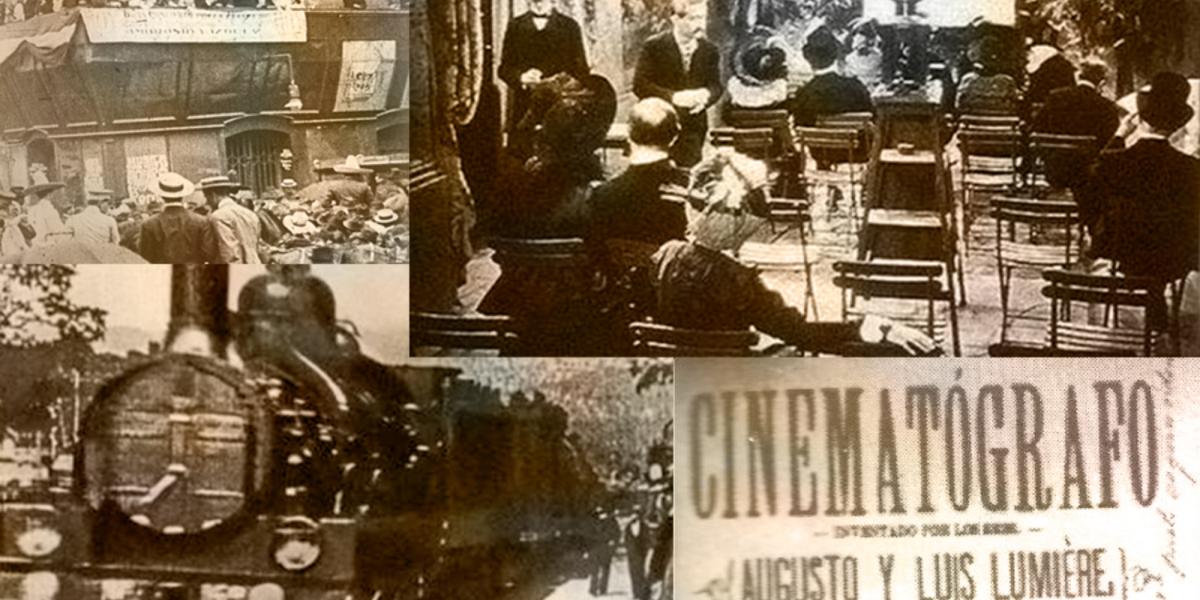
It was on August 6, 1896 when Chapultepec Castle opened its doors to allow the entry of an invention that General Porfirio Díaz had ordered France to encourage a small intimate dinner. The device, creation of such Lumière brothers, reproduced on a screen and everyone’s view, images in natural size that were not drawings or paintings but sounded and moved as if they were real. As if they were there, but they weren’t. (Would it be a blessing, a malevolent, was encouraged by a miracle or was it the sample of the existence of Satan here on earth?)
The party was a success, despite a soponcio that ended up in fainting and a first general scare. According to the chronicles, the Romero Rubio family and the general’s friends were captivated. They asked and learned that the device was a sensation in Europe, epitome of progress and was called “cinematographer.” The joy and expectation were so great that at the end of the function they repeated from the Soufflé de Chicharrón, they took more champagne and mezcal of worm and, then, for great content of the attendees, the general had given his permission so that the fantastic device began to function again, lasting the exhibitions until one in the morning. Before the farewell, the president said that Mexico had become the first country of the continent to enjoy the wonders of the progress represented by cinematographer.
Not even fifteen days passed for the entire city to find out about such wonders and on Friday, August 14, the sessions for the general public began. The exclusive dealers for Mexico, Messrs. Veyre and Bernard, envoys of the Lumière brothers and experts in the operation of the apparatus, found a place in the entresuelo of the drugstore Platleros, in the second street of the same name – today Madero – and placed large posters announcing the new wonder (paradoxically, that place, a few years later it would become the first film room in the country.
Despite the terror of some ladies and gentlemen, azorados to see the “creatures as Christian as us and as animated by souls like ours”, the function was carried out. 1500 people arrived and given the great demand, the programs had to be repeated every half hour. The Republican monitor, taking the exclusive, reported the event. In chronic color, the titles of the “views” that were offered, each of them with a duration of between 20 and 40 seconds were detailed: they highlighted “The Regador and the Boy”, “Letters of cards”, “Arrival of a train”, “Yerbas burners”, “Russian mountains”, “Demolition of a wall” and “The Food of the Child”.
It was also reported that in some views – especially in which it represented the arrival of the train – people got scared and rose alarmed from their seats because they did not know if that locomotive who approached quickly and in front was going to rolle them, removing their lives. (From that moment, you see it dear reader, we are all afraid of taking the train).
In a few days the public lost fear, began to enjoy the confusion between fiction and reality and the desire not to miss anything. Then, the competition began. Jacalones, garages and vacant lots acquired the category of “cinematographic halls” and the dissemination became massive. “The novelty of” The Sight of the Day “became the issue of all conversations and the matter, for some, completely degrading and dangerous:” How have we come to the current decline? A desperate chronicler is asked. “What does it depend on that we no longer paint, or write, nor sculpt, nor build on such a vast scale, or with such a deep aesthetic feeling, or with such a pure artistic inspiration? Will it be because of the easy fun to which everyone comes in herd?”
You dear reader, the answer has already guessed: as soon as the cinematographer arrived, instead of taking feathers, rules and brushes, everyone went to sit in front of a screen. (And they still don’t return).
In a very short time the “views” became short, the themes diversified and by 1900, the city already had 22 stores between rooms for the “decent people” and tents destined “to the plebe”, where a weight was charged to the first and 50 cents to the seconds. Madero still did not appear with his revolution, he barely settled the twentieth century and Don Porfirio, delighted with the seventh art he ordered more than thirty films – one of them where he himself appeared as the first actor riding through the Chapultepec forest, another, where his wife, Mrs. Carmelita Romero Rubio strolled in his carriage.
The time passed, the views became films and the public was captive. The cinema, that painted mirror, true illusion, invention of the demon and eye in the lock of the heart of an artist, still remains and loves. And he arrived in the summer, in that distant month of August.