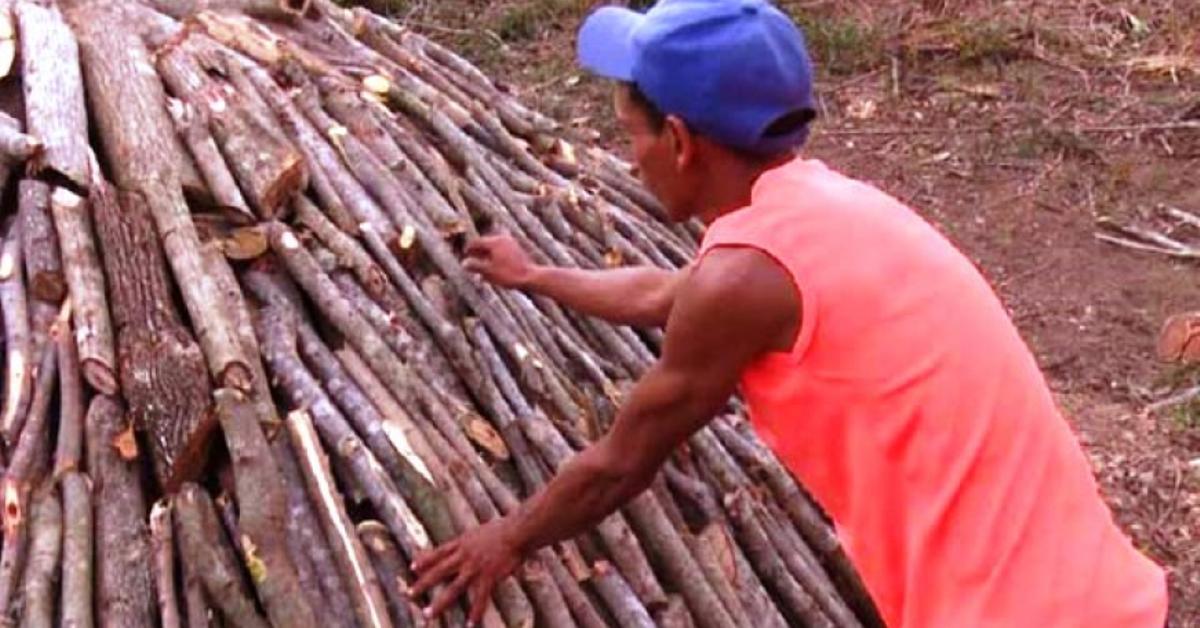
Havana/The Guamá Agroforestry Company, in Santiago de Cuba, intends to take advantage of the ravages left by the Hurricane Melissa and use wood from fallen trees to boost the charcoal production program for export. The goal is to fill nine maritime containers in three months, according to the provincial media Sierra Maestra.
According to Ramón Velázquez Núñez, director of the company, exports could bring more than 8 million pesos in income to the company, “in addition to providing fresh foreign currency”, with an approximate value of between 3,900 and 4,000 dollars per container, which, in turn, will allow the company to allocate resources to other sectors, such as coffee, vegetables and livestock.
To carry out this task, 15 employees work in a rudimentary way or, in the words of the manager, “in a fundamentally artisanal way, with low fuel consumption, in coherence with the current energy context of the country.”
Without having to cut down the trees, the workers work between six and seven hours a day, although they must watch the ovens at night to guarantee the quality of the charcoal. This means not sleeping, since you must ensure that combustion is correct, that too much oxygen does not enter and that the batch is not ruined.
The workers work between six and seven hours a day, although they must watch the ovens at night.
Although it is a “cumbersome and physically demanding” job, according to the media, “the group remains motivated.” Even so, employees have pointed out the need to improve conditions such as food and lighting in work areas, “aspects that directly affect performance and safety,” he says. Sierra Maestra.
However, workers know that profits are high when compared to other items, because demand “has skyrocketed” in recent months, due, above all, to the instability of the electricity supply and the lack of liquefied gas: 50 30-kilogram bags can achieve monthly income between 50,000 and 63,000 pesos, “and if they produce more, they earn more,” the newspaper notes.
When those tons are sold, producers could keep 38 cents of every dollar that enters the country for those exports in foreign currency, according to Resolution 25/2025 of the Ministry of Economy and Planning (MEP), approved in April of last year. Of the rest, 30 cents go to the central financing account, and 32 go to the state company that markets it.
The export of charcoal, mainly to Europe, became a light in the middle of the darkness for a weakened Cuban foreign trade, especially shortly after Russia’s invasion of Ukraine, in 2022.
This led Cuba to become one of the suppliers of this fossil fuel to that continent. However, the industry has also seen a very rapid drop in overseas shipments due to the fuel crisis. Thousands of bags have been left in warehouses in various parts of the country because there is no way to move the product.
Thousands of bags have been left in warehouses in various parts of the country because there is no way to move the product
Just last November, 20 tons ready for export were stored in Maisithe easternmost municipality of Cuba. Until then, the product did not have an estimated date for its shipment abroad.
These stories have been replicated in other parts of the country. In Las Tunasthe Agroint Agricultural Company, in the first quarter of 2024, suffered an alarming drop in its exports. Of the amount of charcoal that they planned to sell to Europe in that period, the state company barely fulfilled 25% of its plan, about 400 tons. The problem is not the company, said Agroint’s director of exports and imports, Argel Pupo, which has “enough raw materials on Las Las Tunas soil” to respond to demand, but the lack of fuel to move the product.
Although there is no updated national export data, in 2022 Cuba produced 39,400,000 tons of charcoal, less than half than two years before, when it achieved 75,600,000, in the midst of the covid-19 pandemic.
Meanwhile, data from the Economic Complexity Observatory indicate that, in 2022, Cuba exported 41,000,000 dollars in charcoal, which positioned the Island in 15th place as a world exporter of that product. Also in that year, charcoal was the eighth most traded economic item internationally in the country. Greece, Spain, Portugal, Italy and Türkiye are the main destinations for Cuban coal.