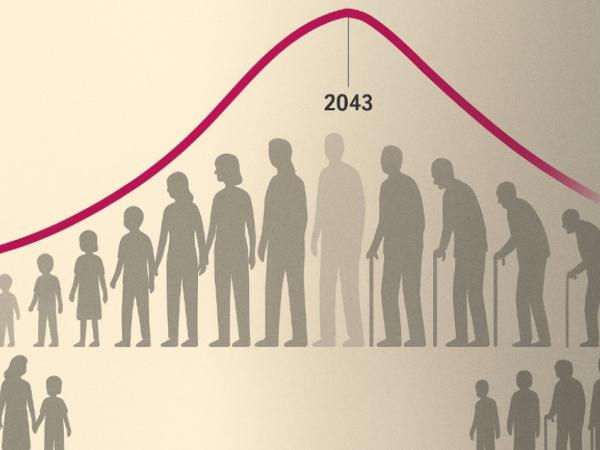
Colombia quickly approaches a demographic turning point in which, according to the most recent projections of the DANE, the country’s total population will reach its maximum in 2043, with 56.04 million inhabitants and from that moment on, a sustained decrease will begin that will take the figure to 50.59 million in 2070; very close to the levels that were observed during the pandemic.
This structural change, which combines a pronounced fall in birth With a constant increase in life expectancy, it will transform the age composition and will have deep effects on the labor market, productivity, public finances and the demand for goods and services.
See here: YouTube begins to implement new age verification system with AI
This was clear in population projections and demographic studies, carried out by the DANE, which show that the population has gone from 48.26 million in 2018 to 53.05 million estimated by 2025, but that the speed of that growth is reduced year after year; ratifying the theory that says that the country is aging.
While in 2018 the annual rate was 1.75%, by 2070 a decrease of -0.75%is expected; So, in the face of the previous projection of the DANE, the population peak was advanced eight years and the reduction rate is greater, which confirms an acceleration in the process of aging and population reduction.
In 2070, Colombia would enter the most critical stage of the population.
Chatgpt image
Meanwhile, urbanization will continue to be the dominant trend in which although in 2018, 75.5% of Colombians lived in municipal headwaters; In the population peak this percentage will approach 81%; While the rural population, populated centers and dispersion areas, will go from 11.84 million in 2018 to a maximum of 13.27 million in 2039, and then fall to 9.63 million in 2070.
A very announced change
In order to know the genesis of this situation, Portafolio spoke with three experts, Among them César Pabón, director of Economic Research of Corficolombiana, for whom the main cause is the sustained fall in the number of births, which between 2019 and 2024 have been reduced by 31%.
Other news: Inflation in Colombia: What keeps it outside the target range, between 2% and 4%?
“This has led to the fertility rate being 1.1 children per woman, well below the generational replacement rate of 2.2 children. Each generation will be smaller than the previous one,” warns the pabon.
This phenomenon is the final stage of the demographic transition, characterized by low levels of mortality and fertility and pabon considers that it cannot be reversed, although Yes mitigate through policies that promote the migration of population of productive age.

In 2070, Colombia would enter the most critical stage of the population.
Chatgpt image
The impact will be remarkable and around 2070, the workforce would be reduced by 3.2 million people, which could subtract up to 1.5 percentage points to economic growth if measures are not taken. At the same time, health spending and in the solidarity pillar of the pension system would increase more than three points of GDP, ”he added.
However, opportunities also arise: the greatest presence of older adults It will generate demand in sectors such as health, adapted housing, specialized tourism and financial services, opening a field of action for companies and public policies.
It may interest you: ‘Not once I get an answer ‘: President of the Andi questions’ silence’ of Petro
An accelerated challenge
Andrés García-Suaza, Dean of Economics of the University of the Rosario, points out that Colombia already presents fertility rates similar to Japan, one of the most aging countries in the world and points out that “the sum of a greater expectation of life and a fall in fertility leads us to a tendency in which in twenty years the population of the country will stop growing. It is difficult to reverse it, but the impacts can be mitigated”.
Likewise, the academic underlines that the speed of change in Colombia is greater than in other regions, which amplifies the challenges, since in some sectors signals such as the decrease in demand are already perceived of children’s gardens, schools and universities; that undoubtedly has a direct impact on the economy.

In 2070, Colombia would enter the most critical stage of the population.
Chatgpt image
“This, in turn, will be transferred to the productive sectors, since a lower population implies a lower production capacity, aggravated by the historical productivity problems of the country,” said García-Suaza, who also warns that rural areas and sectors such as the coffee maker will be especially vulnerable to the scarcity of labor, which could compromise strategic productive chains.
Finally, the analysis of the Anif Economic Research Center puts figures precise to the change in the composition of the population and tells that the child population (0 to 14 years) will be reduced more accelerated than the provisions of previous estimates: it will go from representing 22.5 % of the total in 2024 to just 10.3 % in 2070.
More information: ‘The figures show that the change in the strategy worked’: Success group
Similarly, the population of active age (15 to 64 years) will decrease from 67.3% to 60.6%, while those over 65 will increase their 10.1% participation to around 29%.
“The dependency rate illustrates the change and the child will fall from 36.6% in 2020 to 17% in 2070, while that of the elderly will rise from 14% to 48.2%, surpassing the Infant towards the mid -2040 When the burden of older adults compensates and exceeds that fall, ”said these experts.

In 2070, Colombia would enter the most critical stage of the population.
Chatgpt image
In parallel, they maintain, the gross birth rate will go from 15.1 births per thousand inhabitants in 2018 to 5.84 in 2070, while mortality will increase from 7.21 to 13.63 in the same period, reflecting the aging of the population.
Challenges and possible answers
With all the above, for César Pabón, the country must adopt a combination Of strategies such as resenting the adult population, facilitating the labor reintegration of the elderly, promoting migratory flows of people of productive age and increasing productivity through technology and automation, especially in sectors with high demand for labor such as agriculture and health.
Related information: Luis Carlos Sarmiento Angulo received order to the business merit of the Andi
It is also key to strengthen private financing for old age, with instruments such as life income insurance, specialized coverage and voluntary pension savings.
For its part, Andrés García-Suaza agrees that migration will be one of the few tools to mit programs to a lower number of students and a more aging workforce.

In 2070, Colombia would enter the most critical stage of the population.
Chatgpt image
If the projections are fulfilled, the Colombian of 2070 will be smaller, more urban and much more aging; So preparing for that scenario is a task that cannot be postponed.
Daniel Hernández Naranjo
Portfolio journalist