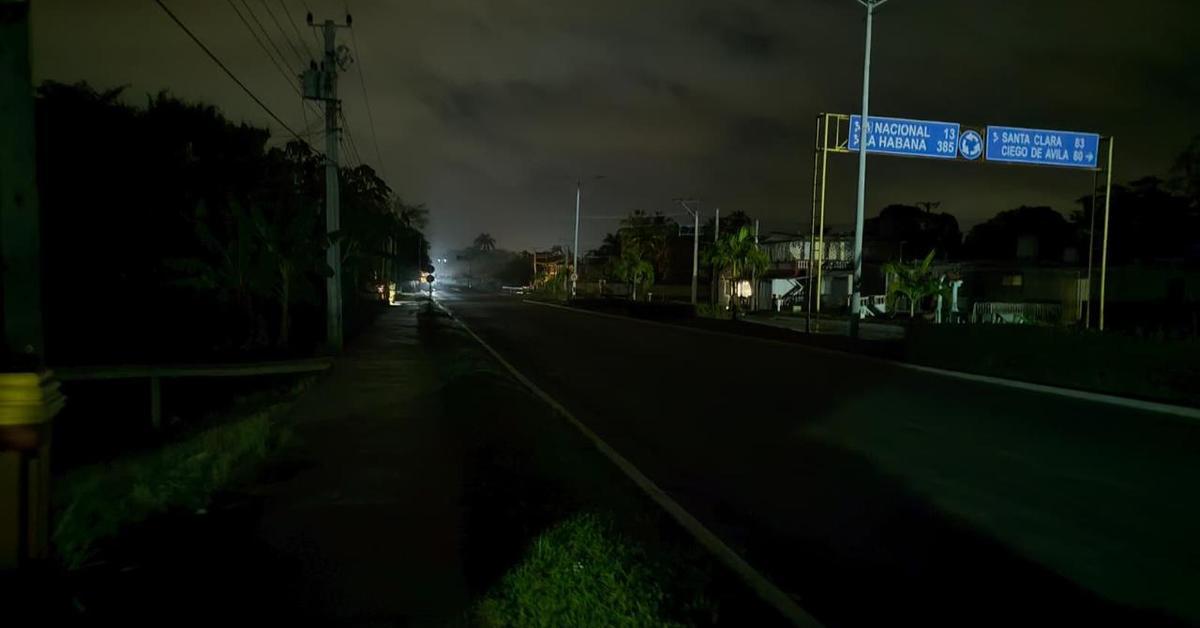
Sancti Spíritus/At three in the morning this Monday in Sancti Spíritus they had to be on their feet. At that time the authorities gave a truce to the blackout, and many residents took advantage of the brief return of electricity to cook.
“Coal is lost and so is oil,” says Yanet, a woman from Sancti Spiritus with two children, tired of the calendar of power cuts in her neighborhood. “A gallon of oil is around 2,000 pesos,” he says, corroborating fuel inflation in the informal market due to shortages, more acute since the capture of Nicolás Maduro by the United States in Caracas on January 3.
A comment spread throughout the neighborhood: “Things are going to get worse, some are talking about the total blockade and that now not a drop of oil is going to enter.”
“Here the MSMEs put some small oil stoves on sale, and the luckiest ones were escaping coal with that,” says Miguel, another resident in Sancti Spíritus, ratifying Yanet’s testimony. “I say the luckiest, because they cost between 15,000 and 20,000 pesos, depending on the model, but now oil is scarce and very expensive.”
“Here the MSMEs put some small oil stoves on sale, and the luckiest ones were escaping coal with that”
Being energy self-sufficient is a lifeline, which explains the new award from the Las Tunas government for outstanding workers in “prioritized sectors”, such as education or health: being able to buy – not for free – solar panels with payment facilities. The initiative, reports Newspaper 26foresees the sale of a total of 584 photovoltaic systems and the gradual installation “thanks to a sales program” managed by the Copextel subsidiary in that province.
The kits are offered in two models: one with 800 watts and another with 1,200, “with differentiated prices.” The distribution depends on the workers designated by each organization. “The process is activated once Copextel receives the official and approved lists of beneficiaries from the governing bodies,” Ailín Yaneisy Rodríguez Castillo, commercial manager of the entity, explains to the provincial newspaper, adding that any payment method can be used.
The note, which does not indicate the prices at which the systems are sold, recognizes that “the total cost may represent a challenge for some,” which is why Copextel has established a credit mechanism. The process is not simple either, as can be seen from the words of Rodríguez Castillo: “The company delivers a pre-invoice and the applicant must present two co-signers. Once the loan is approved, the amount is deposited on the client’s card, who must return to our offices to formalize the payment.”
The installation at least, yes, is carried out by Copextel. With the usual exaggerated prose, the director of the National Office for the Control and Use of Energy (Onure), Maritza González Llorente, is quoted as saying that “the province has the mission of guaranteeing that each beneficiary client receives their equipment, since they are exemplary managers and workers of the prioritized organizations, in addition to four Labor Heroes. The monitoring includes checking the degree of satisfaction of the families with these systems, which represent a direct benefit for the quality of life of each of them.”
As a result of the blackouts, and as the authorities recognize, there are about 80,000 people in the Cuban capital without water service.
Officials suggest, however, that there may be workers who do not even get credit, since the condition of two co-debtors is sine qua non. If this is the case, says González Llorente, the status of exemplary worker does not entail a gift, quite the opposite: “The possibility is granted to another client who meets the requirements, thus guaranteeing the execution of the financing.”
The official newspaper highlights the benefits that these systems provide, such as “the reduction of electricity grid consumption, the use of a clean and sustainable source, the optimization of institutional resources and the positive impact both economically and environmentally”, but is careful about the drawback: they only generate energy during daylight hours and when there are no clouds.
This Monday, meanwhile, the blackouts will continue unabated. The Electrical Union (UNE), in his daily partacknowledged that yesterday the service was affected 24 hours a day. The maximum deficit was more than expected, stated in the official note, due to “a greater demand” and due to the departure of two units of the Antonio Maceo thermoelectric plant (CTE), Renté, in Santiago de Cuba.
Added to these are the shutdown due to breakdown or maintenance of a unit at the CTE Mariel, another in Santa Cruz, two at the Carlos Manuel de Céspedes plant, two in Nuevitas and another at Felton.
The UNE still does not publish data on the lack of fuel, as it used to do before, but states that “there are limitations in thermal generation that keep 450 MW out of service.”
For peak hours, they forecast a demand of 3,250 MW and only an availability of 1,293 MW. The real impact will be 1,987 MW, that is, barely 39% of what is necessary will be available.
As a result of the blackouts, and as the authorities recognize, there are about 80,000 people in the Cuban capital without water service. “The state of the electro-energy system directly affects the water supply to the population. Even when there are people who have electricity service, they lack water, because from where it is pumped there may be an impact. This causes us to have to make corrections and adaptations to the schedule to comply with the corresponding cycles,” said Yosvani Rubí Bazail, general director of Aguas de La Habana, in statements collected by the provincial press.
In the last week, says the note Havana Tribune“delays of up to 10 hours were recorded compared to the original scheduled time, in addition to damage to mechanical and electronic equipment as a result of voltage variations.”