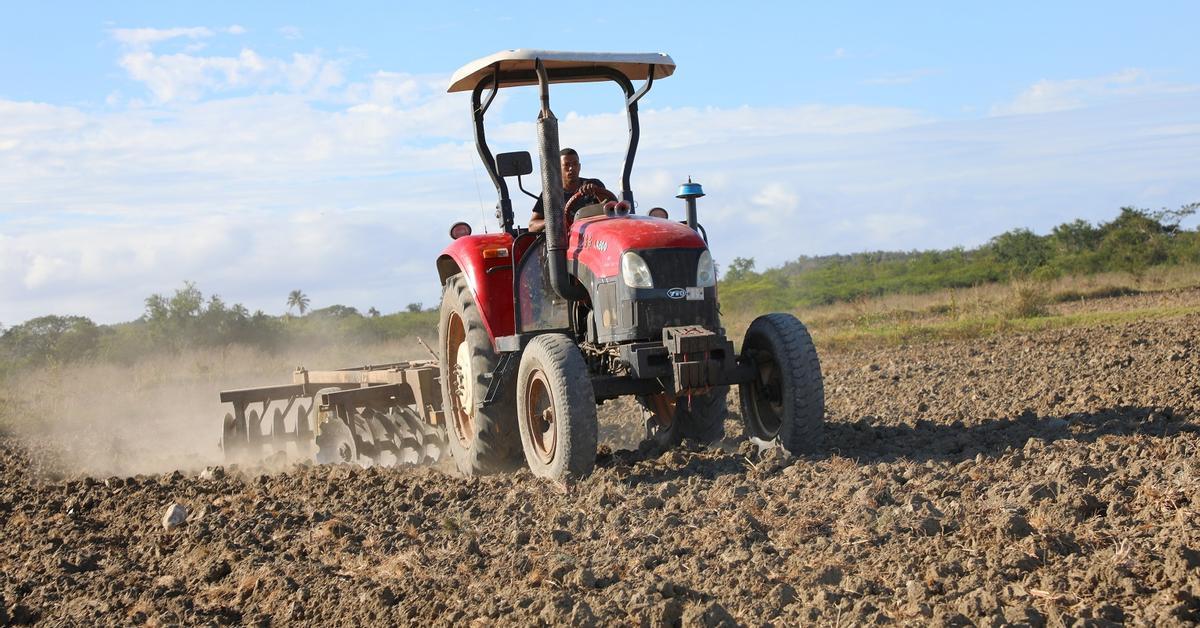
Havana/In the midst of severe fuel rationing, closures or readjustments of basic services and a collapsed economy that barely manages to sustain its most basic functioning, the Enrique Campos Caballero Credit and Services Cooperative of Guantánamo assures that it will quadruple the rice harvest. The goal for this year: 640 tons.
Against the grain of the country’s poor rice production, which has plummeted in the last decade, Heriberto Martín Campos, president of the cooperative, optimistically tells the newspaper we will win “They plan to plant a total of 240 hectares and “perhaps yield a little more” because today the fields have permanent water. ” The official even dares to predict that, “in the immediate future”, his cooperative “can plant about 400 hectares a year, with the addition of new producers and the incorporation of lands currently to be cleared.”
The drought in recent months in the country hit agriculture, which “prevented growth in planted areas for a long time,” he says, but “now the situation is different, since the La Yaya dam, the supplier of the liquid, ensures it for several years.”
To this, he says, we must add “the decent payment of rice to the producer”, which “has motivated the incorporation of numerous farmers to the sowing of the grass, including young people and even a woman, in what will be her first foray into this crop.”
“Now the situation is different, since the La Yaya dam, which supplies the liquid, ensures it for several years”
we will win and the producer echo the Government’s announcement last week, in which the plan was outlined to promote the planting of rice “in order to move towards food sovereignty.” For this year, with more than 23,000 producers, the aim is to plant 200,000 hectares throughout the country, 61,035 in the cold season and 138,965 in the spring season. The goal is to at least double what was obtained in 2025, when 122,990 hectares were planted, with a production of 111,528 tons, although these figures pale if we take into account that last year it generated only a third of what it obtained between 2012 and 2018, with more than 304,000 tons.
However, various producers in the country have accused that they do not have inputs for the crops, even before the crisis worsened due to the oil siege of the United States. Odisnel Traba Ferralesagricultural director of the Fernando Echenique Agroindustrial Company, in Granma, told the official press just in December that they had “practically four years without having this technological package”, a kit that the State previously distributed to producers, which had imported fertilizers, herbicides and pesticides, transcendental for some crops, in this case, rice, also considered “very technical.”
“The total commitment to planting in the province is a fairly strong goal in the current context”
The complaint arises from a province that is essential if the goal set by the State is to be achieved. Granma, once among the elite of rice producers, plans to plant 41,000 hectares of rice out of the 200,000 in the country, but the data does not invite optimism. Traba Ferrales himself admits, between the lines, that the calculation is quite outside of reality. “The total commitment to planting in the province (30,000 hectares by the Fernando Echenique company and 11,000 by José Manuel Capote Sosa) is a fairly strong goal in the current context,” he remarks.
The manager’s feeling is no less. The Government’s announcement last week does not mention a single plan to confront the crisis and only admits that, given the serious limitations with fuel, essential for soil preparation, cleaning irrigation systems and planting, “some producers with a better economic situation bought oil in foreign currency and thus have been able to ensure production.”
The only action that the authorities have taken is the production of bioproducts and biopesticides. “More than 140,000 hectares have already been treated with these means, especially biofertilizers, to make up for existing deficits,” they highlighted.