Guantanamo/In Guantánamo, the word “Optics” is pronounced lately with a hint of irony or nostalgia. As if we were talking about a service that existed in another time—more imperfect than efficient, but at least existing—and that today survives only as a sign on a facade. On the downtown streets, where the sun mercilessly bounces off the sidewalks, more and more people walk around frowning, holding their cell phones inches from their noses or wearing glasses patched with duct tape.
The lack of glasses and frames in state opticians compromises the quality of life of those who have been waiting for years to be able to update their glasses, get contact lenses or purchase prescription glasses that allow them to walk through the streets without squinting at the glare.
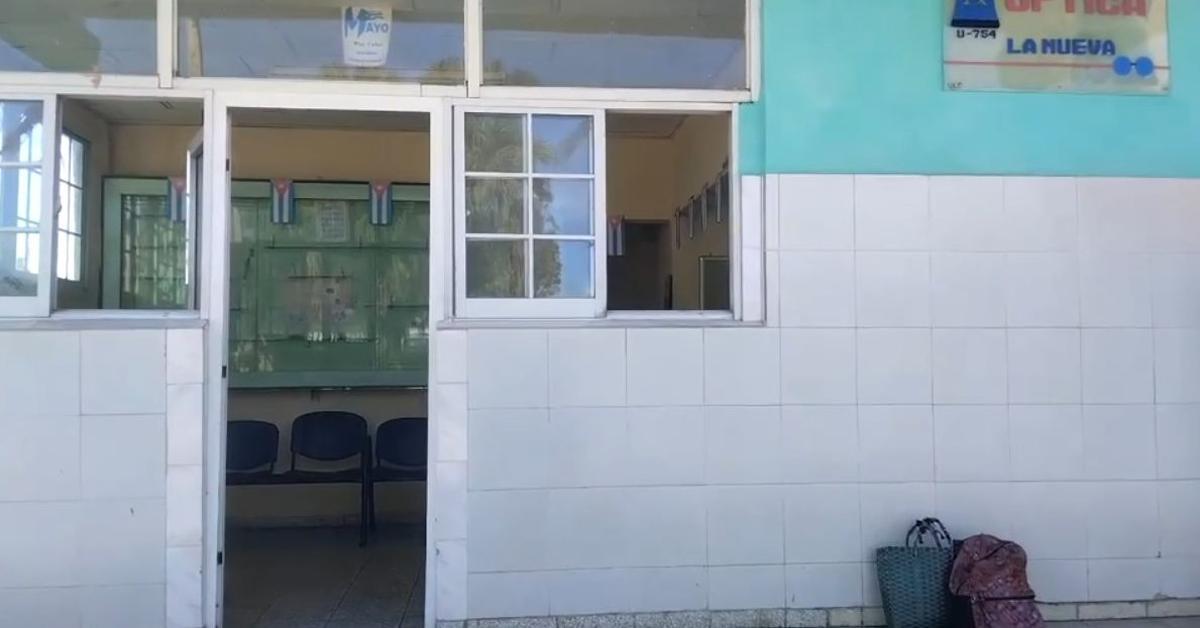
In front of one of the closed opticians, a woman in her sixties holds some broken frames and says with resignation: “I come every time I can to see if they have been stocked but nothing,” she tells 14ymedio. “Sometimes they don’t have frames and most of the time they don’t have material for the graduation that I wear, since I am nearsighted.”
A man in a work uniform says he has been trying to change his windows for months: “They tell me to come back in two or three weeks to see if the supply has arrived but they have been telling me that since August of last year.” The scene, repeated in various parts of the city, shows closed stores, empty shop windows and employees who can only offer apologies.
There are no glasses, there are no frames, there are no screws, there are no hinges
“There are two in this area where only the custodians remain because they have been without materials for so long that not even the other employees are going to work, there is one of those premises that was even given as a home,” laments the client who needs the glasses “to read and see up close.” His solution for the moment: use his wife’s, which, although they are not the same size, at least “serve to avoid cutting a finger with a knife.”
In Guantánamo, the few state opticians that remain open function more as urban decoration than as a real service. The furniture is there, as are the cases and the mirrors, but they lack the essentials: there are no glasses, there are no frames, there are no screws, there are no hinges. A woman points to the door of an establishment that was once a landmark in the city: “This here has been closed for a while. They removed the equipment. They tell people to go to another municipality, but there are none.”
Faced with this void, the private market takes the place of the official framework. Just enter any buying and selling group in the area to see an almost endless catalog of modern frames, bright colors, children’s designs and lenses “for seeing up close” or “for reading.”
The abundance contrasts with the state’s penury, but it comes with an exorbitant price: a simple +1.75 glasses cost more than 900 pesos in Guantanamo. If they have better quality or a greater increase, they can reach 1,800 or 2,000 pesos. The national average salary is around 6,500 pesos per month, so a worker must allocate between 15% and 30% of their income just to clearly see what is in front of them.
“I do magic,” says one of these particular technicians, laughing, “but not miracles.”
“I work sewing, how can I do without glasses?” asks a woman who proudly shows off a pair that a niece brought her from Jamaica. Other testimonies agree: “Everyone depends on those who travel”, “if you don’t have family abroad, you are lost”, “seeing well is a luxury now.”
For those who cannot afford a new pair, salvation lies in the hands of repairers: artisans of detail, guardians of an almost ritual skill. Few survive in Guantanamo, almost always older men who work at tiny tables, surrounded by magnifying glasses, recycled screws and worn-out tools. They can straighten a leg, put a piece of wire where the hinge broke, or tighten whatever is loose. But making glasses from scratch requires machinery that only the State has. “I do magic,” says one of these particular technicians with a laugh, “but not miracles.”
The crisis has consequences that are not always seen. Not being able to wear glasses affects productivity, learning, safety. A retired teacher explains that many older adults stop reading or doing other activities because they lack glasses and that this “turns them off.” Others mention frequent headaches, stumbling when walking, difficulty performing basic tasks. In a city where many people work in manual labor, the inability to focus correctly becomes an economic barrier.
Meanwhile, on the streets of Guantánamo you can see people winking their eyes, enlarging the letters on their phones as much as possible or wearing frames patched with adhesive tape. For those who cannot afford the high prices for eyeglasses on the informal market, the city is becoming a blurry landscape.