Despite the dirt, the poverty, the swarms of mosquitoes and the danger of deadly epidemics, there was in our city something like a feeling of respite after the shooting.
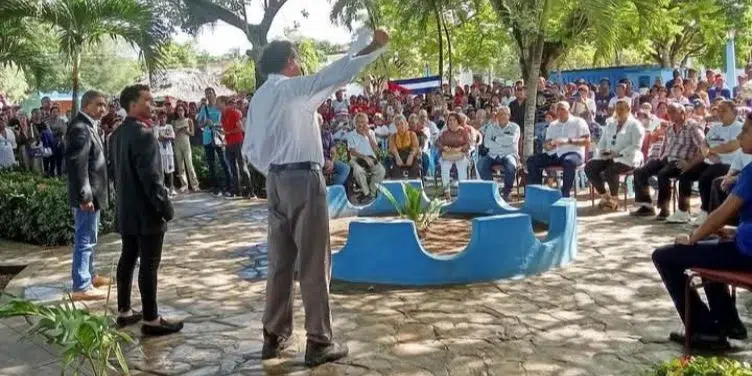
PUERTO PADRE, Cuba. – At the headquarters of the Communist Party of Puerto Padre, with the access streets closed by police on foot, on motorcycles and patrol cars, the XXVI National History Congress met this Tuesday, which began a day earlier in the provincial capital. The event began with a visit to the town of Bartlett, founded at the beginning of the last century by American and Canadian settlers dedicated to livestock and citrus cultivation, but which today has little or nothing to remember of its origins.
Despite the dirt, the poverty, the swarms of mosquitoes and the danger of deadly epidemics, there was in our city something like a feeling of respite after the shooting; And on Sunday we were without electricity for 24 hours in a row, but on Monday, due to the preparations for the congress, and on Tuesday, due to the congress itself, we had electricity until after 5:00 in the afternoon.
In Puerto Padre it has been a week since the most needy people have not had bread, and not because of a lack of flour, but of sugar. It turns out that the state bakeries do not produce the rationed bread and the poor cannot pay 120 pesos for a loaf. So I don’t know if on Tuesday the historians went without breakfast or if a particular baker took charge of their breakfast.
But in this context of lack of “soft” bread due to lack of sugar, I also do not know if the participants in the XXVI National Congress of History 2025 visited the “Antonio Guiteras” Central, formerly Delicias, which already in 1952 was the largest producer of cane sugar in the world, but whose production in this harvest (2024-2025) was not even enough to satisfy the demand for rationed sugar.
And in the midst of this panorama of nudity, not only socioeconomic but also moral, in which police close streets so that historians of the powers of the State can meet at the headquarters of the Communist Party – what better place for that “historiography”?! -, I went to the municipal cemetery. I was already arriving at the pantheon of the hero and martyr Commander Paco Cabrera, who was head of a guerrilla column in the Sierra Maestra and head of the personal escort of Fidel Castro, who died by accident in 1959 in Venezuela, when I saw a car from the so-called Association of Combatants of the Cuban Revolution and several people in that place, and I heard one say: “When I put my hand on the shoulder of Fidel…”
I didn’t need to hear more. So that? Someone close to Fidel Castro, close enough to put his “hand on his shoulder,” had arrived at Paco Cabrera’s grave in Puerto Padre without the slightest gesture of respect, without a flower, but rather talking about himself. That scene was a portrait of Cuba in more than 60 years. It said more in a single word, egomania, than all the history books written by those who at that same minute were sitting in the meeting room of the Communist Party with the access roads closed by police. Poor Cuba! The Cubans are very poor!