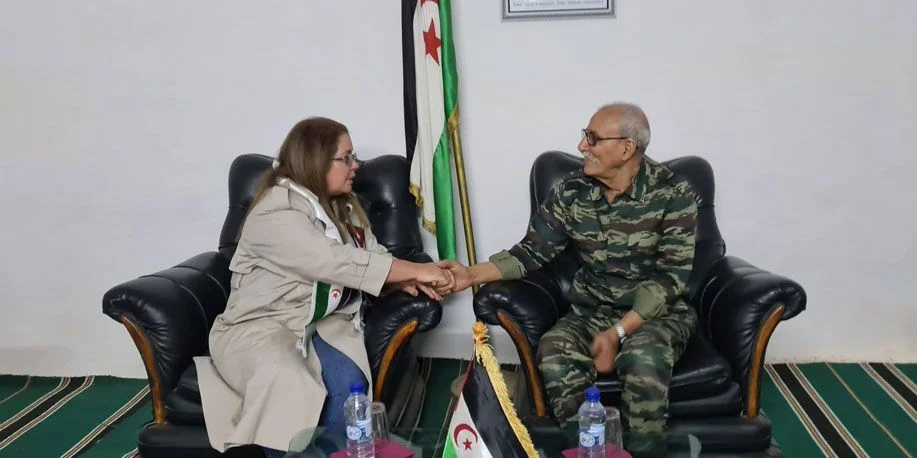
The Castro bosses, who despise the losers, if they have not completely forgotten the Sahrawis, it is to avoid getting on the bad side of Algeria.
HAVANA, Cuba. – Back in 1986 I had a Sahrawi friend. His name was Abdel, he was in his twenties and was studying Medicine in Cuba. He didn’t have much to do with the image one might have of a son of the Sahara: he was an atheist, he dressed like a geek, he smoked, he drank rum, he spoke Spanish without an accent, he danced casino (which he had learned when he was on a scholarship on the Isle of Youth), he called me “asere” and he never tired of asking me, when he went to my house, to play Led Zeppelin and the Rolling Stones.
He was amazed by my interest in his land. He said that I was one of the few Cubans who was well informed about what was happening there, but that things were not exactly as they were told to us in the newspapers and on television.
He seemed very disenchanted and complaining about the Polisario Front, which he blamed for the vicissitudes and mistreatment that his parents suffered in a camp in Algeria and about which he had not heard since they sent him to Cuba, more than 10 years ago.
He was worried about what would happen to his parents and him when he returned to his homeland. The last time we talked, in 1991, he told me that he dreamed of going to Spain. Afterwards, I didn’t hear from him again.
Abdel was one of the thousands of Sahrawi children and adolescents who were sent to study in Cuba in the second half of the 1970s, when Marxist-Leninist-Castro internationalism became involved in the war waged against Morocco by the Popular Liberation Front of Saguía el-Hamra and Río de Oro (Polisario).
Western Sahara was a Spanish colony for 90 years. In February 1976, a few months after the Green March, ordered by the Moroccan king Hassan II, taking advantage of the end of the Franco dictatorship, to annex Western Sahara, Spain ceded sovereignty over that territory to Morocco. But the Moroccans had to face resistance from the Polisario, created in 1973, which was supported by Libya and Algeria and received a copious supply of Soviet weapons.
The main victims of that war were thousands of nomads who inhabited the disputed territories. Subjected to shortages and deprivations, they found themselves trapped, in no man’s land, between two ruthless enemies: the Moroccan army, with its scorched earth tactics, and the abuses and doctrinal rigors of the Polisario Front.
From the refugee camps surrounded by barbed wire and fortified walls, Sahrawi children and adolescents of both genders emerged and were sent to study in Cuba. Most were orphans or children of prisoners.
They were sent to rural schools on the Isle of Youth (formerly the Isle of Pines), where boys from other African countries also studied. There, in addition to making them work in agriculture, they indoctrinated them, instilling in them the love of Fidel Castro and hatred of the United States and Israel. They were told that “the future belonged to socialism.” Teachers who barely knew what they were talking about tried to make them forget their beliefs and customs. Several times, when pork was served in the dining room on holidays, they had to violate the ordinances of the Koran and devour it, because their meager diet did not allow them to choose.
Some who finished university degrees, like Abdel, spent more than 10 years in Cuba. At that time they had no communication, not even by mail, with their families. His only contact with his land was limited to one of the visits to Cuba by the Sahrawi leader Mohamed Abdelazis or some other Polisario leader. But with them you couldn’t send messages or find out about the family. It was all about listening to harangues and chanting slogans at political events.
The graduates in Cuba took away few good memories from here, where uprooted, longing for their family and their land, they lost their innocence and became adults.
When they returned with their diplomas to the camps, the relatives of many of these young people were no longer there. It was difficult for them to find someone to ask if they were still alive, because in the desert camps people don’t just die from hunger or disease: there are cases of murders and disappearances that no one, out of fear, wants to talk about.
Years ago the Spanish press reported the cases of Saadani Ouilainie and Galli Ben Talebtwo Sahrawi girls who, after spending the first years of their childhood in the inhumane conditions of the camps, were sent to Cuba. Nobody counted on her parents, who were “enemies”: Saadani was the daughter of a Moroccan prisoner, and Galli’s father, a dissident of the Polisario Front, imprisoned by his former comrades, accused of treason.
Saadani came to Cuba when he was eight years old and Galli when he was 10. They spent 10 years in Cuba, without knowing about their relatives.
Galli’s father, after spending 10 years in prison, immediately traveled to Havana in search of his daughter. But he couldn’t see it. Cuban authorities detained him at the airport. They accused him of being a spy and unceremoniously put him on a flight to Madrid. Saadani’s father died (or was killed) in prison.
Both girls managed to flee to Mauritania. Galli joined his parents in Barcelona, Saadani left Morocco.
The truce imposed by the UN Security Council since 1991 has been in force in Western Sahara. Last October, the UN approved a resolution for the autonomy of Western Sahara under Moroccan sovereignty. But the Polisario Front, which maintains the headquarters of its provisional government in Algeria, does not give up its stubborn and unrealistic dream of establishing a Gaddafi-style socialist Yamahiria, even if it has to return to war and face an army almost 10 times its number. And continue, with their stubbornness, without any possibility of success, prolonging the suffering of the more than 160,000 people who, hungry, overcrowded and thirsty, in the Tindouf camps, suffer the Maoist-tinged rigors of those who say they are fighting for their liberation.
In Cuba there is hardly any talk about the Polisario Front. The Castro bosses, who despise the losers, if they have not completely forgotten the Sahrawis, it is to avoid getting on the bad side of Algeria, which has so much oil.