In events held in Rio de Janeiro, São Paulo, Brasília and Maranhão, demonstrators protested this Friday (31) against the Operation Containmenta police action carried out in the capital of Rio de Janeiro this week and which left 121 dead, considered the deadliest in the country’s history. 
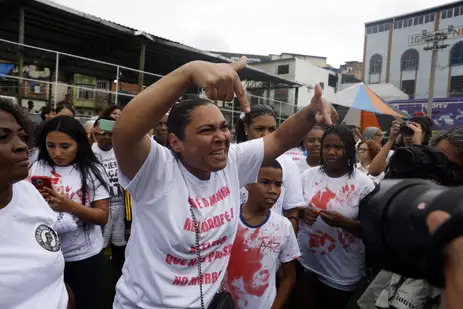
Rio de Janeiro (RJ), 10/31/2025 – Residents of Vila Cruzeiro demonstrate their rejection of Operation Containment. Photo: Tânia Rêgo/Agência Brasil
In Rio, residents of the Penha and Alemão complexes and other favelas in Rio de Janeiro took a walk. Even in the rain, thousands of people gathered on a football field in Vila Cruzeiro, one of the communities in Complexo da Penha.
Among the participants, the mothers of young people killed during other police operations.
São Paulo
In a demonstration (featured photo) on Avenida Paulista, the black movement demanded the federalization of the investigation of police actionin addition to the criminalization of governor Cláudio Castro and military police officers.
“For the federalization of investigations and the creation of reception policies and access to justice for families who are victims of violence. For reparation to residents for moral and psychological damage caused by this genocidal policy of the Brazilian State”, highlighted Douglas Belchior, from the Black Coalition for Rights, and the Union of pre-university popular education centers for black, indigenous and peripheral youth (Uneafro Brasil).
The event began in front of the building of the São Paulo Museum of Art (Masp) and started in a march towards Rua da Consolação. Among the participating entities were the Unified Black Movement (MNU), the Marcha das Mulheres Negras de São Paulo, the União de Negras e Negros pela Igualdade (Unegro), trade union entities and popular movements.
“They killed more in one day than in Gaza. War is declared there, not here, but it exists, it always has. We are here to fight. But without firearms. With our brains and with the strength of social movements and the population”, said Zezé Menezes, founder of the Marcha das Mulheres Negras de São Paulo.
Maranhão
In São Luís, social movements gathered at Praça Deodoro, in the center, with posters, banners and flags criticizing police violence.
Student Alex Silva, 18, classified the police action in Rio de Janeiro as necropolitics, which “segregates poor and peripheral black populations” and criticized Governor Castro for considering the operation a success.
“We know that among the more than 100 dead, there were good people, there were people who contributed to society,” he added.
A member of the Quilombo Classe e Raça movement, Claudicéia Durans, 54 years old, said that this type of operation cannot be normalized in communities because the residents are poor.
“It cannot be normal for a situation like this in which the State does not implement any public policy and when the population is at the mercy of criminal factions this massacre occurs. We are totally against the criminal factions, we are in favor of the population. The police, when they entered these territories, did not pay attention to whether people had any involvement with crime”, pointed out the professor at the Federal Institute of Maranhão (IFMA).
The member of the Conlutas trade union, Saulo Arcângelo, 54 years old, criticized the absence of public policies that bring education, culture, income generation and citizenship to young people, “who do not have a job perspective, do not have an education perspective, including being easy prey to the drug trafficking process that is increasingly growing”.
The Revolutionary Black Front, the Correnteza Maranhão Movement and the Maranhão Popular Union called for the event. The movements highlighted reports that victims had signs of execution.
Brasilia
In the federal capital, the event was held near the Esplanada dos Ministérios. Protesters called for an independent investigation into Operation Containment.
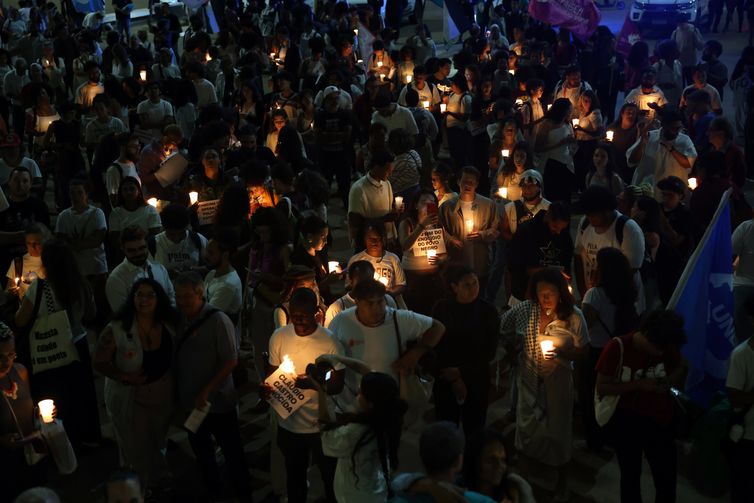
Brasília (DF), 10/31/2025 – Demonstration against the police operation Contação in Rio de Janeiro. Photo: Valter Campanato/Agência Brasil
“What happened was a brutal attack on the lives of black and favela people,” said Maria das Neves, member of the National Human Rights Council.
The council made a request to the Federal Supreme Court (STF) so that the governor of Rio de Janeiro, Cláudio Castro, provide information about the police action against the criminal faction of Comando Vermelho. Another request was sent to the Minister of Human Rights, Macaé Evaristo, for a independent expertise.
* Collaborated with Antônio Trindade, from TV Brasil in Brasília