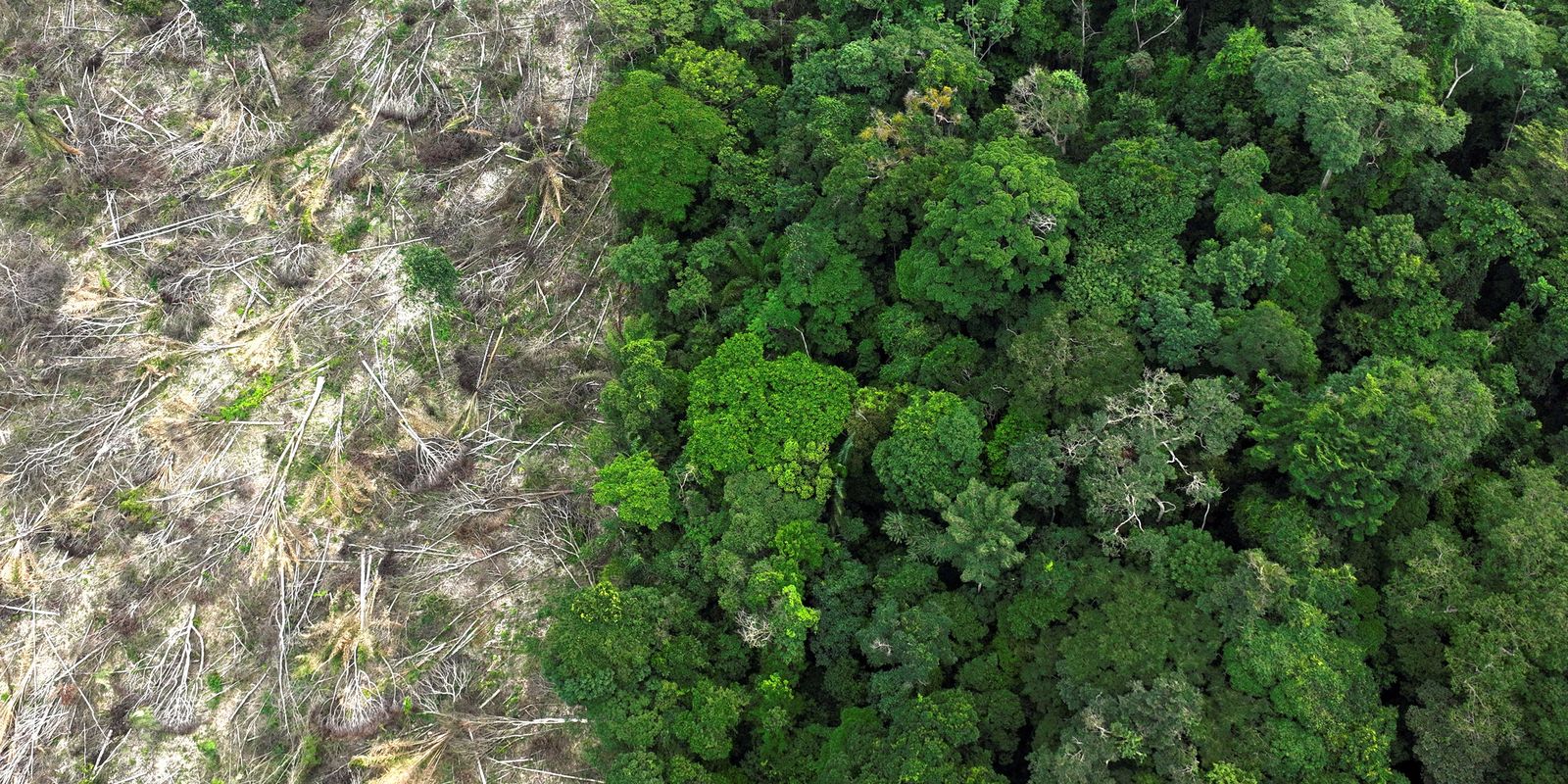
The way the human being has occupied the Amazon in the last 40 years has accelerated the threat to the ability of the largest tropical forest in the world to contribute to the balance of the planet. An analysis of data from the Mapbiomas historical series on soil use, released on Monday (15), reveals that between 1985 and 2024, the biome lost 52 million hectares of native vegetation area.
The area that was converted to human use in the period represents 13% of the territory occupied by the biome and is equivalent to the size of some countries, such as France, for example. Added to what had already been affected earlier, the Amazon in 2024 had already lost 18.7% of native vegetation, of which 15.3% were occupied by human activities.
“The Brazilian Amazon is approaching the 20% to 25% range provided for by science as the possible point of no return of the biome, from which the forest can no longer support itself,” warns Mapbiomas researcher Bruno Ferreira.
According to the researchers, the speed of soil coverage conversion in the last 40 years draws attention, when 83% of total native vegetation has occurred.. During this period, green coverage gave way to various activities such as livestock, agriculture, forestry of exotic species and mining.
Pastures, for example, occupied 12.3 million hectares in 1985 in the Amazon. By 2024, this type of land use was already present at 56.1 million hectares of the biome. Agriculture has advanced even more, occupying an area 44 times larger than 40 years ago. From 180,000 hectares at the beginning of the historical series, he jumped to 7.9 million hectares in 2024.
Proportionally, the presence of forestry in the biome has increased even more – 110 times, jumping from 3,200 hectares to 352 thousand hectares in the period of the historical series. Mining also follows the upward curve, with a jump from 26,000 hectares to 444 thousand hectares in the same four decades.
Soy moratorium
Another fact that draws attention is the presence of soybean crop as the main type of culture in the biome, representing 74.4% of the entire area occupied by Amazonian agriculture, with a total of 5.9 million hectares in 2024.
In the analysis of the historical series, the researchers focused on the evolution of soybean crop in the region from the perspective of the soy moratorium, a commercial agreement that prohibits the purchase of cultivated cultivated in deforested areas in the biome after 2008.
Most of soybean occupation in the Amazon occurred after the deadline of the trade agreement, when 4.3 million hectares were used by this type of culture. According to the analysis, despite the growth of this land use, most of 3.8 million hectares of crop, grew over an area previously converted to pasture or other modality of agriculture.
From 2008 to 2024, the conversion of forest formation directly into soybean crop was 769 thousand hectares.
Dry
According to the study, these activities occupied the space, especially forest, the most suppressed vegetation. Throughout the period, there were 49.1 million hectares, almost 95% of the total of what was removed from native vegetation.
“We can already notice some of the impacts of this loss of forest cover, as in the humid areas of the biome. The coverage and land use maps in the Amazon show that it is drier,” says Bruno Ferreira.
The analysis of the researchers points to retraction of 2.6 million hectares of water covered surfaces in the Amazon, between 1985 and 2024. They are forests and flooding fields, Apicuns and drier mangroves, intensified in the last decade, when the eight of the ten driest years of the biome were recorded.
Regeneration
In 2024, in the Amazon Green Coverage remnant account, 2% is of secondary vegetation. The percentage accounts for 6.9 million hectares in the previously converted area biome, but it was not deforested again and entered the process of regeneration.
This type of vegetation was less affected by deforestation over the past year, when 88% of deforestation in the biome occurred in first and 12% vegetation represented green coverage suppression in regeneration.














