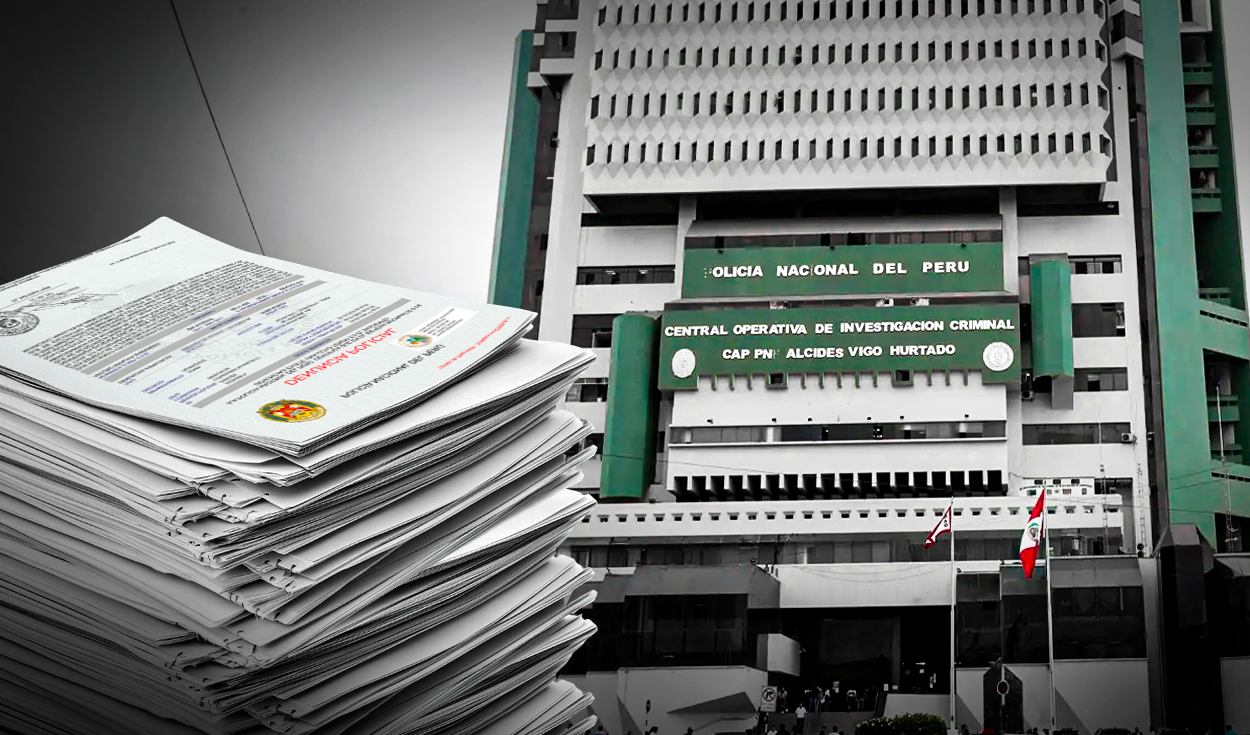
The PNP Announce impunity. Through the Directive Resolution No. 009-2025-DIRTIC-PNP-SEC, the complaints registered with the National Police They will become considered reserved. This means that no citizen will be able to access them, even not even being protected in the Transparency Law. According to statistics from the National Observatory of Citizen Security, the situation is alarming: only in 2025 572,763 complaints have been filed before the police institution, which will be out of the reach of journalists, civil organizations and citizens interested in meeting them in detail.
The resolution, being of an administrative nature, also has retroactive effect. In practice, this implies that the complaints filed before their promulgation will also be subject to the reservation. In other words, both previous and after this provision will be classified as secret information.
It is not only citizen complaints against third parties. The National Police It will also restrict access to thousands of complaints made against them. This was warned by the analyst and data engineer Juan Carbajal, who prepared a database with information from the single center of complaints and the National Citizen Security Observatory itself. According to this registration, until August of this year 2849 cases between complaints and complaints directed against the police institution are counted.
You can see: Congress approves that Dina Boluarte Trip ee.uu.: President will leave Peru on the same day of the marches
The resolution that officially made secretism in the PNP
The resolution allows the complaints filed against active members of the National Police Do not be public access through transparency orders over the next five years. In this way, journalists, NGO members, academics and citizens interested in knowing the status of the complaints filed before and against the institution will remain without the possibility of accessing this information.
Article 1 of the Directive resolution It establishes that all the information linked to complaints, either in the system of police complaints or in the registration system of criminal investigation complaints, will be classified as reserved for a period of five years. This provision reaches the records regardless of the support on which they are and is based on the arguments developed in the considered part of the document.
According to the National Police of PeruThe reserve seeks to guarantee the effectiveness of investigations and preserve citizen security, in addition to protecting fundamental rights such as the dignity and integrity of people. However, when applied in a general way over the entire database, it restricts access even to cases that do not represent risk for the course of the investigations. In practice, the decision could limit the right of victims to inform and reduce citizen control mechanisms about the management of their complaints.
You can see: Congress presents a motion of censure against Juan José Santiváñez after revelation of audios
The resolution argues that confidentiality is essential for PNP to fulfill its function of preventing, investigating and combating crime, in addition to safeguarding legal assets such as national security, citizen security and democratic stability. In line with this, the Documentary Reception Unit of the Directorate of Information and Communications Technology will be responsible for registering and guarding the declared data reserved. However, the risk is that this measure, instead of strengthening confidence in the institution, ends up reinforcing the perception of opacity and weakening accountability to citizens.
The measure has not been exempt from criticism. The lawyer Carlos RiveraMember of the Institute of Legal Defense (IDL), questioned the resolution: “It seems to me that it is an arbitrary act of the police and that it could even be unconstitutional. (…) Considering that here there are legal and even constitutional interests, it is not enough that the institution declares by itself that certain information will be reserved or secret. That lacks legal support, because what is being classified as reserved are the complaints, not the investigations, therefore the investigations. Easily questioned in legal terms.
National Human Rights Coordinator opposes the measure: “Transparency strengthens our democracy”
The decision made by the National Police It is already beginning to be observed by institutions that ensure the protection of freedoms and rights, such as National Human Rights Coordinator (CCNNDDHH). Tania ParionaExecutive Secretary of this institution, he declared to the Republic that the resolution of the PNP attentive against national democracy.
“The Transparency Law It is a fundamental norm. I think it is important to continue defending the right to transparency as an essential element both in state institutions and citizens. Transparency strengthens our democratic system. Who insists on hiding information acts contrary to a democratic system. To deny that access restricts any possibility of carrying out delicate investigations, ”he said.
Pariona added that it does not rule out to submit an appeal against this decision made by the police institution: “We are evaluating what to do, because we have even seen that some authorities have supported this measure. We believe that it is essential to defend the right to transparency and that it is not violated. The resolution affects serious facts that may have serious consequences, such as cases of sexual violence. Let’s think of denunciations of trafficking in persons for sexual exploitation or sexual aggressions. It would prevent identifying aggressor profiles, ”he said.