At the same time, Washington will formalize the aid of up to $20 billion that it is willing to provide to Argentina, during a visit by President Javier Milei to the White House on Tuesday.
Argentina also has an open help line with the IMF, and could be one of the leading countries at this meeting.
Latin America and the Caribbean maintain a low profile in the current environment of global turbulence, according to the first forecasts of the WB and statements by the head of the Fund, Kristalina Georgieva.
The region will grow 2.3% this year, compared to 2.2% in 2024, according to the WB.
The IMF will deliver its forecasts on Tuesday, as part of its annual report on the state of the world economy (WEO).
Resilient economy
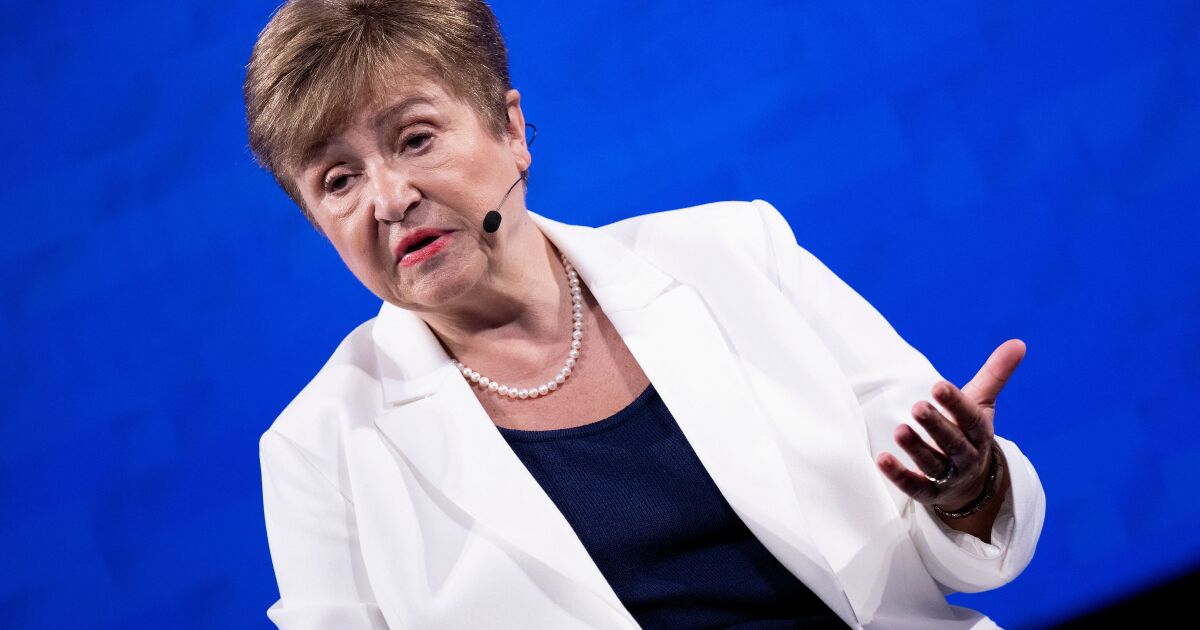
On Wednesday, Georgieva used her traditional keynote speech to warn about the persistent risks facing the global economy, pointing to uncertainty over tariffs, five years after the Covid-19 pandemic paralyzed the economy.
According to Georgieva, the WEO report should highlight an economy that has “globally withstood acute stresses” and is “better than expected but worse than would be needed.”
Above all, although the world economy has managed to resist so far, this “resistance has not yet been fully tested,” warned the IMF leader, pointing out numerous warning signs.
Georgieva particularly fears the possibility of a “violent correction” in the prices of companies linked to the development of artificial intelligence (AI), whose “capitalization seems to be heading towards the levels seen 25 years ago”, during the internet bubble.
The executive director of the Fund also invited Latin America to “aspire for more” and take advantage of the changes in the world economy, while pointing out Argentina as a model of economic adjustment.
Latin America must “take advantage of the reorganization of global supply chains,” he indicated.
“It is no longer possible to tolerate” what he described as “slowness” in “capturing what is coming.”
Of the two largest economies in the region, Brazil is losing steam (2.4% compared to 3.4% in 2024) and Mexico is barely growing (+0.5%), according to the WB.
“This reflects, in part, an external environment that offers limited support, characterized by a cooling of the global economy, falling commodity prices and greater uncertainty,” the WB explained in its report.
Beijing and Washington: high tension
Washington and Beijing seem ready for a new trade confrontation.
On Thursday, the world’s second largest economy announced that it will implement new controls on the export of rare earths, as well as on the machines and technologies necessary for their refinement and transformation.
These raw materials are especially sought after in the digital and renewable energy industries, but also in defense, and Beijing controls an essential part of the value chain for almost all rare minerals.
Trump described the decision as “extremely aggressive”, before threatening China with imposing a 100% tariff on its products, an additional tax that would be added to the rates, of at least 30%, already applied since last May.
“In no way should China be allowed to hold the world ‘captive,’ but it appears that has been their project for some time,” Trump said, assuring that “many other countermeasures are being seriously considered.”
However, he softened his tone on Sunday, saying he wanted to “help China, not hurt it” and that “everything is going to be fine” despite “a bad time” for Chinese President Xi Jinping.