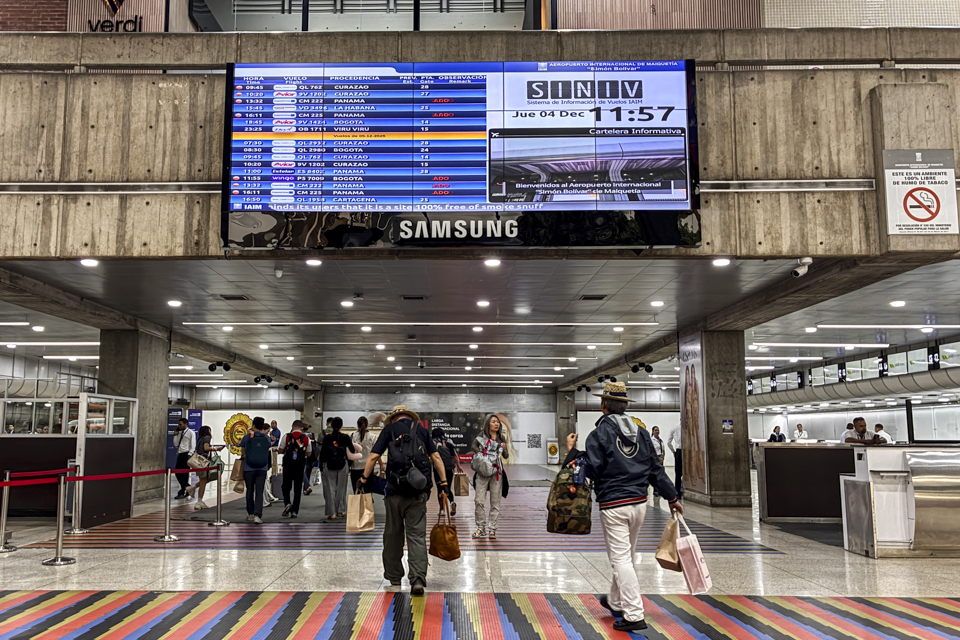
The cancellation of international flights emptied the Maiquetía airport and ignited fear among its workers, who speak in whispers and avoid responding for fear of reprisals. Between deserted businesses, vigilant guards and reduced shifts, the most important terminal in the country stopped sounding like an airport to remain silent and tense.
“If they hear you talking a little too much, it’s a problem,” said an airport worker to SuchWhich and it is almost an x-ray of what happens behind closed doors: In Maiquetía, talking about the current context seems to be a risk.
Silence has become the dominant sound at the Simón Bolívar International Airport in Maiquetía, accompanied by fear, as if there was danger there. On Thursday, December 4, just when Copa, Wingo and Satena airlines also announced the cancellation of flights to and from Venezuela due to “intermittencies in a navigation signal” reported by pilots, the country’s most important terminal was emptier.
In the hallways, where previously there were many rolling suitcases, boarding announcements or the commotion of travelers, a tense stillness was perceived. The small shops were empty, some didn’t even have a salesperson. In others, employees spent time staring at the phone, waiting for a customer who never arrived.
The baggage packers sat, waiting for activity to arrive. One of them described the situation in a few words: “Look around you and you know there is no work,” and he added, in a lower voice: «I can’t talk much and you don’t ask much either, the airport is dangerous». He didn’t say anything else.
Censorship was installed in the corridors of the Maiquetía airport. That fear of talking about the situation and situations of daily life, which exists in other spaces, is also felt in the terminal, which forces workers and passengers to measure every word.
The cafes were without buyers, the shops e-sims Without tourists, the tourism agencies are empty. In the few restaurants at the fair, fewer than 10 diners occupied some tables. The message was the same: “We can’t talk.” They said it under their breath, aware of the permanent presence of officials from the National Guard, Immigration and the Bolivarian National Intelligence Service (Sebin), who toured and monitored the space.
Two taxi drivers, at the airport gate, commented, marked by nerves, that they were prohibited from talking about what is happening in Maiquetía: “We only know that the flights are suspended, nothing more,” said one of them.

The other driver, with a New Testament in his hands, asked if he was being recorded and stated that he did not want to get in trouble.
Both agree that it is enough to look at the terminal to understand that the work has fallen.
Less flights, less work, less money
A worker, who asked to protect his identity for security reasons, said that the suspension of flights has disrupted everything: “The cancellation of flights has affected a lot, a lot in several terms,” he confessed.
He explained that their work hours were reduced, that the shifts have fewer staff and that transportation workers were left unemployed. “They canceled transportation for staff,” he said. That same worker explained that with fewer flights, they do not need extended hours: “We enter late and leave early because there are no sales, there are no passengers.”
«Before we entered at 4–5 in the morning and left at 10 or 11 at night. Now we come in at 6:00 am and at 2:00 pm we are doing nothing. Even at 4:00 pm we are already leaving,” he summarized.

This worker expressed concern about his payments in the middle of December: «There has been no movement and sometimes we spend a day doing absolutely nothing. The airport is empty, There are times when no one is seen in the hallways.«.
The warning of silence was not left out of his words. “You can’t talk too harshly because if they hear you talking a little too much, then it’s a problem.”
Some days there are barely four flights in the entire terminal, he said. “Rumors are heard,” he insisted, but without delving into details.
What affected this worker the most is that with the cancellation of international flights they also suspended a bonus in dollars and now they are paid in bolivars at the rate of the Central Bank of Venezuela (BCV). “That affects us a lot because it gives us less to buy.”

*Read also: INAC expects Copa and Wingo to resume their flights in 48 hours
An airport that breathes tension
The tension and uncertainty were perceived in the atmosphere of the Simón Bolívar International Airport of Maiquetía. The workers wait and almost no one speaks.
The stay in the terminal is done in a kind of constant surveillance and as if there were the instruction, tacit or explicit, that one cannot speak.
The liveliest scene on Thursday was provided by more than a dozen Chinese passengers who posed smiling in front of the mural of Simón Bolívar, while shouting: “Venezuela!” Passengers bound for Havana also stood out, with large luggage full of food, toys and merchandise perhaps impossible to obtain in Cuba.

Maiquetía no longer sounds like an airport, it sounds like fear.
*Journalism in Venezuela is carried out in a hostile environment for the press with dozens of legal instruments in place to punish the word, especially the laws “against hate”, “against fascism” and “against the blockade.” This content was written taking into consideration the threats and limits that, consequently, have been imposed on the dissemination of information from within the country.
Post Views: 64