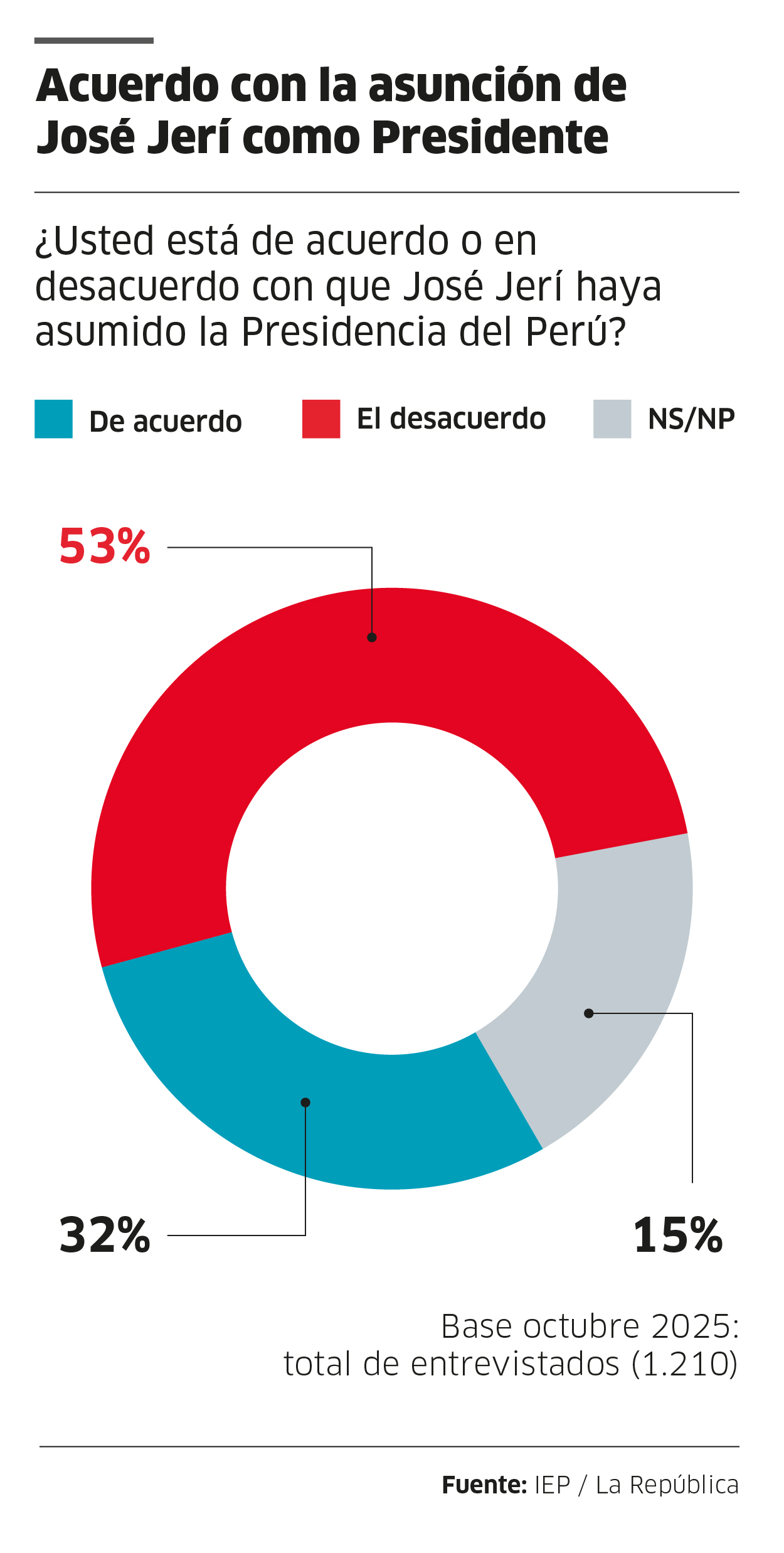
According to the Opinion Report of the Institute of Peruvian Studies (IEP), corresponding to October, 53% of those surveyed disapprove that Congress has appointed José Jerí as president, while only 32% support his assumption of office.
Behind these figures there is a feeling of exhaustion, since the majority does not expect that their permanence or eventual departure will imply a real change that will solve the country’s problems. The predominant idea is that the Congress continues to govern, and that any figure who assumes the presidency will respond only to that power.
The survey was conducted after the vacancy of Dina Boluartedismissed amid historic citizen rejection. According to the study, 81% approve of Boluarte’s vacancybut that initial satisfaction quickly disappears given the perception that those who held her in office continue to run the country. That is to say, citizens celebrated the departure of an unpopular president, but without greater hopes of regeneration in politics.
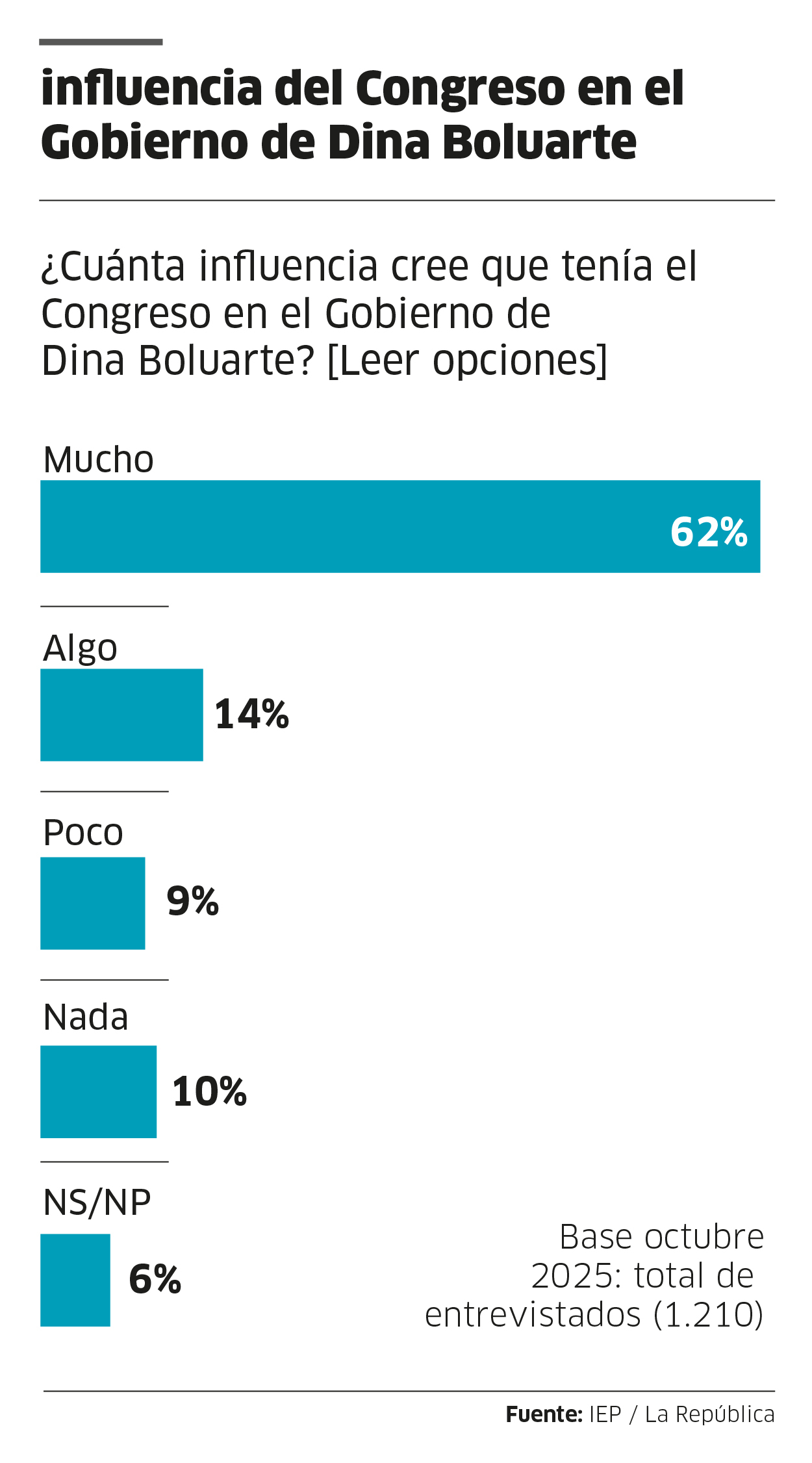
In that sense, the 49% believe that Congress will have a lot of influence on Jerí’s governmentand the 62% think that they already had it during Boluarte. In fact, three out of four Peruvians (74%) They consider that Parliament supported the former president until her vacancy, which reinforces the perception of an alliance between the Legislative and the Executive, beyond the faces.
YOU CAN SEE: Municipality of Surco will denounce Congresswoman María Acuña for constant attacks against council workers
Only 18% feel represented by José Jerí
Despite regional and age differences, the pattern is similar: people do not trust that the new president represents change. Only the 18% feel ‘very or somewhat represented’ by Jeríwhile 89% affirm that the Congress represents him little or nothing. In other words, the country is going through a stage of government without effective representation. The Executive does not generate hope, and the Legislative is seen as a bloc that acts for its own interests.
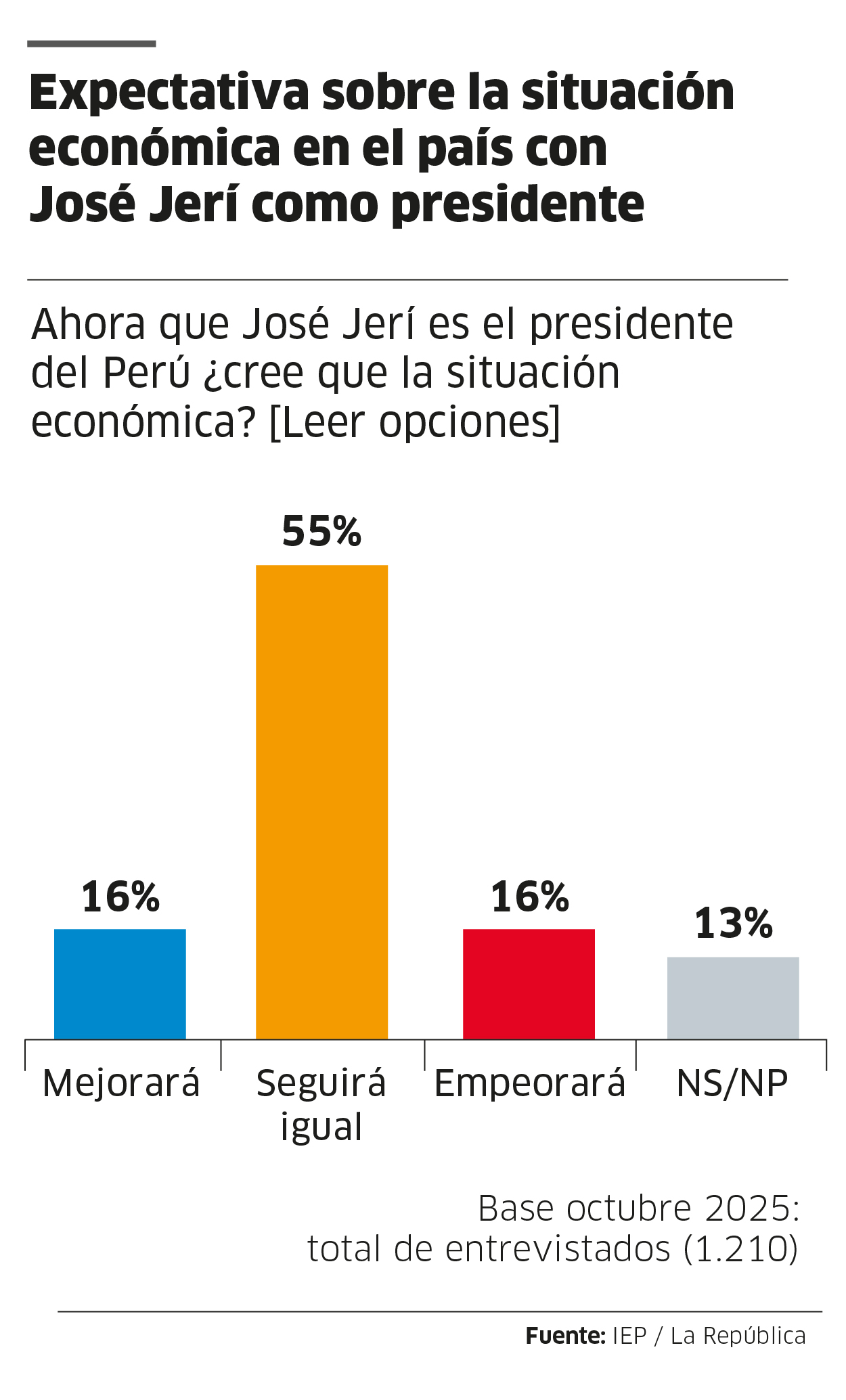
Expectations about the future Jerí in Palacio are equally pessimistic. The majority considers that ‘everything will remain the same’, but there are nuances: among those who still maintain some expectation, hope is concentrated in issues of citizen security (27%), more than in politics (22%) or the economy (16%). This order projects the priorities of Peruvians; That is, they do not demand political reforms as the most important thing, but rather changes in order to survive in the midst of crime.
The economic and political context aggravates this pessimism. The initial gestures of Jeri in terms of security, like the visit to the prisons imitating Nayib Bukele or the provision of the state of emergency, have not caught on. The difference between the president’s speech and what happens on the streets remains wide.
When analyzing social segments, the disapproval towards Jerí is stronger in the popular sectors and in rural Peru, where it is perceived more clearly the control of Congress over the Executive. In Metropolitan Lima, although the rejection is also majority, a higher level of indifference is observed: a resigned acceptance that “with Jerí or without Jerí, nothing will change.”
YOU CAN SEE: Six months before the 2026 elections: Generation Z also feels hesitant to cast their vote
In conclusion, the IEP data shows us a scenario of continuity. The change of president has not generated enthusiasm or expectation. Dina Boluarte’s vacancy was celebrated as a momentary relief, but not as the beginning of real change. Citizens perceive that power remains concentrated in Congress, and that the president in charge Jerí acts more as a figure chosen for the interests of Parliament than as a leader with political autonomy.
Between sadness and pessimism
According to the analysis of the head of Opinion Studies at IEP, Patricia Zárate, the fact that such an unpopular president has been vacated by Congress is applauded by 81% of the citizens, however, those who kept her in power continue to govern and that is clearly perceived by public opinion.
Although 32% agree that José Jerí has assumed the presidency and 37% believe that he should remain in office, there is an important sector that would have wanted another person in office or that there would have been more radical changes. The perspective about what is to come in Jerí’s government is not very auspicious, the majority believes that everything will remain the same, however, among those who expect some aspects to improve there is a greater expectation of improving security (27%) than politics (22%) or the economy (16%). The gestures that the current president has made regarding citizen security have had a limited impact so far, only 18% feel very or somewhat represented by him.
For most people, the role of the current Congress is clear, both with Boluarte and the current president. 74% believe that Congress supported the former president until the vacancy and 62% that Congress had a lot of influence in her government, while 49% believe that it will have a lot of influence on Jerí’s Government.
It is understandable that this political situation produces sadness, pessimism and anger, because in reality nothing will substantially change. Between this unrest and the perception that this Congress, which citizens do not feel represents them – 89% say it represents little or nothing – continues to govern, it is not surprising that the mobilizations called by young people have continued, despite Boluarte’s vacancy, and that they have high support from those surveyed (64%). They have been like a breath of hope in a situation that does not seem easy to get out of.