A booklet for women to identify that they are victims of online sexual harassment Final Research Product By 23 -year -old Arienny Carina Ramos Souza, a degree in Biological Sciences at the Federal Institute of Pará. During the academic investigation process, she came to the conclusion that black and low -income women are the main victims of this type of crime. 
What she did not imagine is that the work would be recognized by the 30th Young Scientists Award, last Wednesday (12). She and other researchers recognized by the National Council for Scientific and Technological Development (CNPq), in partnership with the Roberto Marinho Foundation, recall that the studied objects originated in community ideals for social transformation and service to the community.
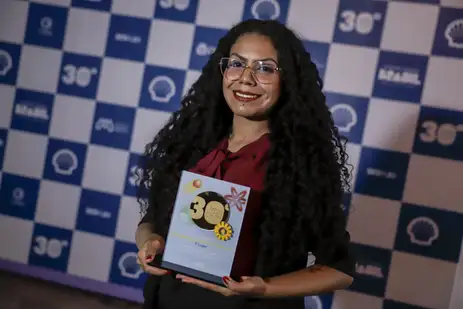
Brasilia, 14/02/2025 – Arienny Souza created a booklet for women victims of sexual harassment on the internet. Photo: Joédson Alves/Agência Brasil
Upon receiving the prize, researchers recalled their own humble origins, hours for hours, and what curiosity means to create and innovate for the common good. This is the case of Arienny, first placed in the “Higher Education Student” category.
She was guided by Professor Breno Alencar. When she took the stage to receive the award from Minister Luciana Santos, Science, Technology and Innovation, Arienny pointed out that she was the first person in the family to reach higher education.
“It is a very great emotion, given my origin, and mainly due to being from public school throughout my basic education,” he said.
The work was born from nonconformity after cases of harassment practiced by teachers against students.
Agroecological
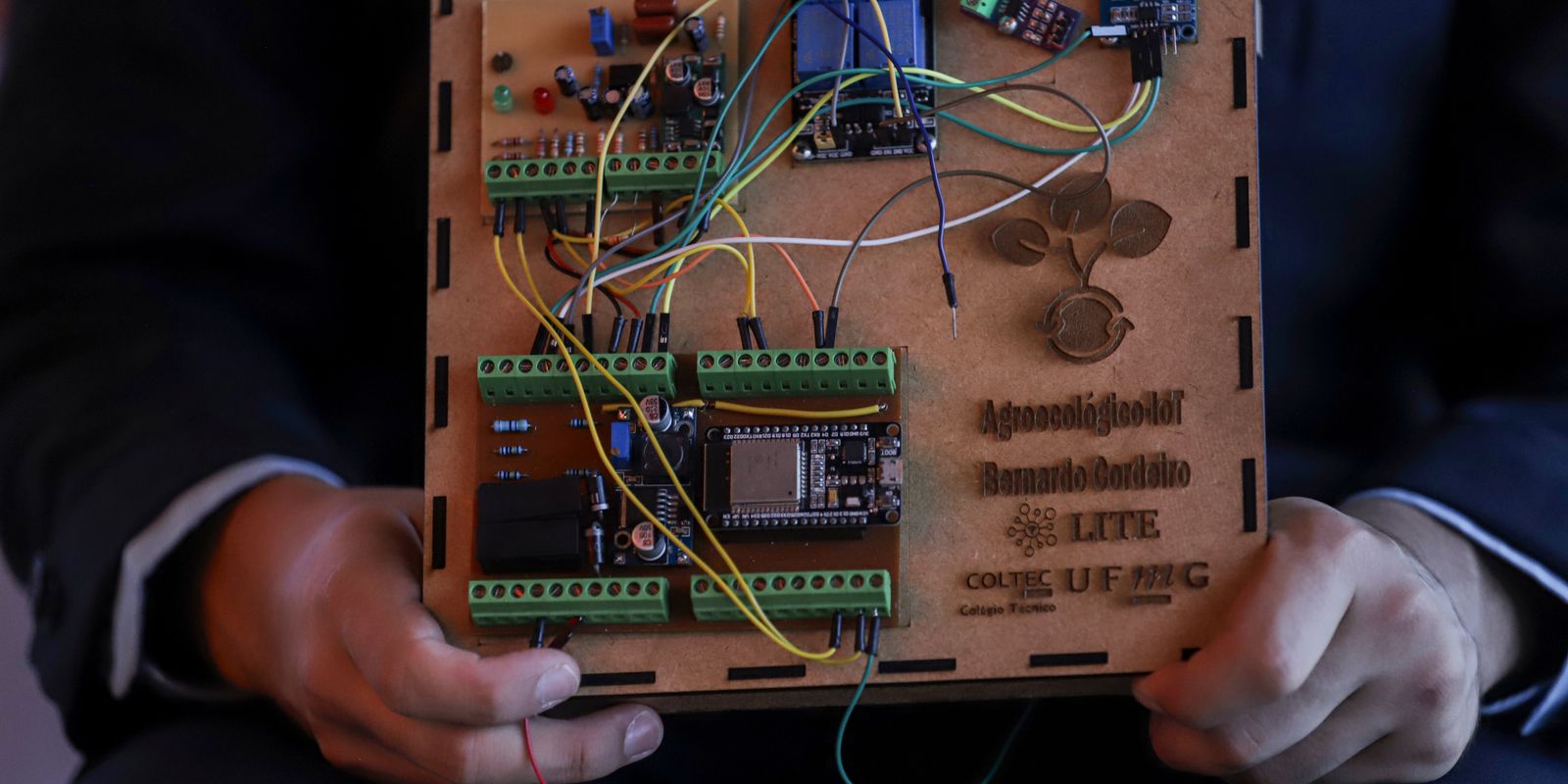
Another young award -winning scientist was Bernardo Souza Cordeiro, 19, also from a public institution, which ended the electronics course at the Technical College of the Federal University of Minas Gerais (UFMG). Guided by Professor Adriano Borges, he was first placed in the “high school student” category when developing a device for the production of a agricultural agricultural defensive.
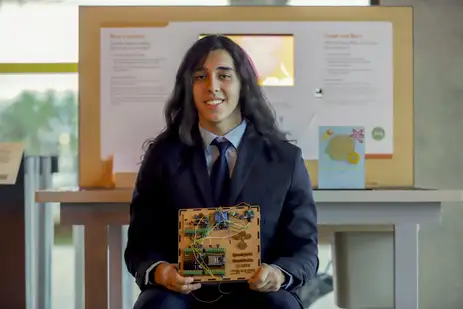
Brasilia, 14/02/2025 – Student Bernardo Souza created a device for the production of agroecological defensive. Photo: Joédson Alves/Agência Brasil
The opportunity came to work with an IoT agroecological project (English for ‘Internet of Things’) with a component to make it possible to replace pesticides.
“We wanted it to be a cheap alternative. This defensive only needs salt and salt in an electrochemical process, ”he explains.
He explains that hypochlorous acid, which has antimicrobial properties, is obtained by an electrochemical process that uses electricity. The developed prototype was part of the boy’s ideals of wanting to collaborate with small farmers.
Another reason for recent celebration is that it was approved, at the last National High School Exam (Enem), in the UFMG Control and Automation Engineering course. He was also the first in the family to join a federal university.
“My parents are very proud. My father could not complete the fifth year and my mother took a technical nursing course. ” Parents do not understand electronics, but they understand the boy’s happiness well. The smiles multiplied.
Sensors
Of multiplication and smiles, PhD in Physics Wenderson Rodrigues also knows. Student at the Federal University of Viçosa, the 30 -year -old boy raised Sensors and equipment for public health, food safety and climate monitoring In a survey that was awarded as first placed in the category for masters and doctors. He was guided by Professor Joaquim Mendes.
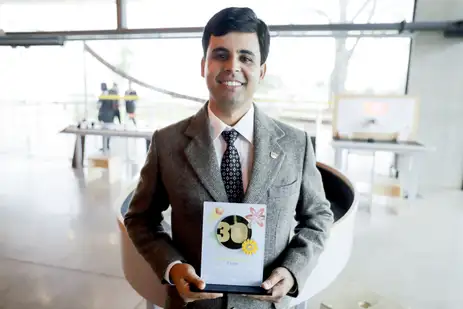
Brasília, 14/02/2025 – UFV student Wenderson Rodrigues was first placed in the master category and doctor at the 30th Youth Scientists Award. Photo: Joédson Alves/Agência Brasil
Rodrigues recalled that he was interested in the subject since high school. He said the work consisted of developing four devices. Among them, there is a detection device that shows on a screen whether or not the patient is with the virus.
“This is an application in the area of public health,” he said.
Another result of his research was in the area of food security with the development of a sterilization chamber based on mercury ampoules discarded public elimination. He contextualized that, with the replacement of mercury lamps with LED lamps, those that were discarded can generate environmental pollution.
“We decided to successfully reuse these lamps to sterilize objects and foods contaminated with bacteria.”
Still in this combo of innovations, the boy has created equipment, based on alternative materials and low -price sensors, with the potential to contribute to providing accurate local meteorological data for small producers working with family farming. “The idea was to democratize access to weather information.”
Professor Joaquim Mendes, who accompanies the prodigy scientist since scientific initiation.
“He is a very committed student and has a great differential because he can work in more than one problem at the same time.”
The teacher says that the student’s work should be even more valued by the financial difficulties that the family has crossed. “He managed to get out of a humble condition and arrived far away. We will hear a lot about Wenderson, ”he said.
Science Against Negationism
The president of the National Council for Scientific and Technological Development (CNPq), Ricardo Galvão, valued the trajectory and stories of award -winning researchers. He stated that it is essential to encourage these young people in their work.
“We have to consider these young people as headlights for others to develop. They are headlights for people to believe that they can do science and technology and be recognized for it. ”
The award contemplated the winners with computers, CNPq bags and cash values, ranging from $ 12,000 to $ 40,000.
>> Check here All winners of this edition
Minister Luciana Santos regretted that the award ceased to exist during the past government and called “nefarious” scientific negationism.
“We increasingly need to differ and the popularization of science in order to face obscurantism. We need to overcome obscurantism with scientific production. ”
Lenses
Thought in science inspires young people like 18 -year -old Maysa dos Santos, who researched at the Federal Institute of Pará (IFPA) at the Altamira campus, in a study with her teacher Laís Castro, one Light microscope alternative for high school in the Xingu region, in Pará.
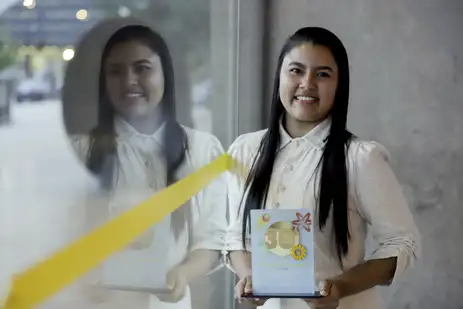
Brasilia, 14/02/2025 – Awarded at the 30th Young Scientist Award, student Maysa dos Santos developed an alternative microscope for Xingu Schools (PA). Photo: Joédson Alves/Agência Brasil
She was third in the category for high school students. In view of being aware that only 38.8% of high schools have a microscope space for biology classes, she created through a 3D printer. The idea was to create equipment to be a viable low cost alternative.
The student wore lenses taken from 3D glasses of virtual reality, wires and turns on/button. She didn’t even know. But he came to see reality in detail and the lenses have already made her world much bigger.