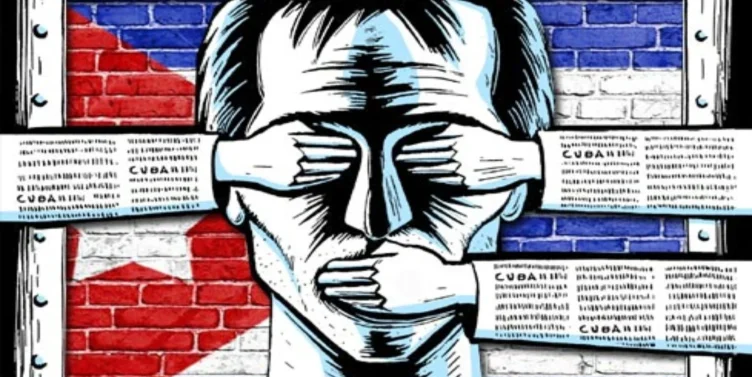
The report details a scenario of systematic harassment in which expressing critical opinions or practicing independent journalism continues to be a high-risk activity in Cuba.
MADRID, Spain.- The Cuban Institute for Freedom of Expression and the Press (ICLEP) record 65 violations of freedom of expression and the press in Cuba during the month of October, a figure lower than the 89 documented in September. However, the organization warns that this decline does not represent a real improvement in the conditions for exercising fundamental rights on the island, but rather a tactical variation of the repressive apparatus.
In its report “Cuba: fear prevails, repression persists”, ICLEP points out that 83.1% of the incidents were directed against the freedom of expression of citizens, activists, artists and political prisoners who expressed critical opinions outside the official discourse. The remaining 16.9% directly affected press freedom, confirming that independent journalists and media continue to be priority targets of state control.
The organization maintains that the numerical decrease compared to September should not be interpreted as a relief, because the “architecture of surveillance, coercion and punishment” remains intact. According to the analysis, in periods of greater international exposure or political tension, the Cuban Government modulates the intensity of its repressive actions, but does not alter its structural functioning.
ICLEP emphasizes that these violations do not occur in isolation. The impact extends to related rights such as due process, freedom of movement, political participation, the integrity of journalists and the right to peaceful assembly. The report describes an ecosystem in which repression not only limits the work of the press, but also the ability of citizens to express themselves without fear.
For independent media, the document highlights three central risks: the high exposure to retaliation even in basic investigative tasks, the intimidating effect on those who produce or disseminate information, and the need to document each case to counter the official narrative and preserve a verifiable record of abuses.
Despite the numerical reduction in October, ICLEP concludes that repression continues to be a structural element of the Cuban system, supported by surveillance and punishment mechanisms that seek to silence critical voices and limit the circulation of information not aligned with the State.
Last August, when the ICLEP documented 79 violations of freedom of expression and press in Cuba, warned that the current year was heading to close with more than 1,000 violations of freedom of expression and press.
Cuba registered a total of 232 alerts of violence against the press in 2024, a drop of 53.2% compared to 2023 that does not indicate an improvement in the information environment, but rather the result of the forced exodus of journalists, fear and self-censorship within the country, according to the Cuba chapter of the report. Journalism, violence and persecution (shadow report on press freedom in Latin America in 2024, prepared by the Voces del Sur network.