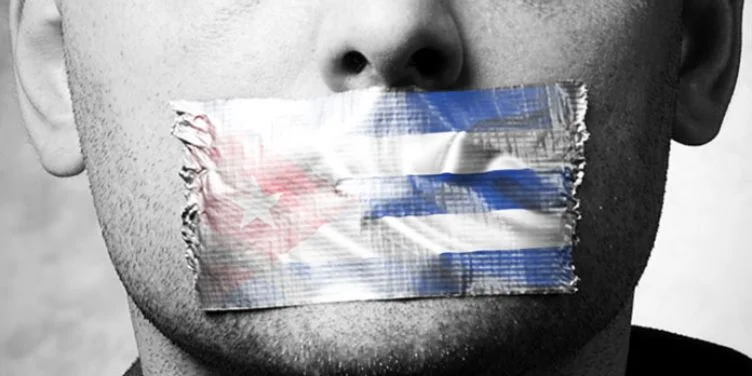
“In the Socialist Cuba, speaking freely or informing independently continues to be an act of risk,” the organization concluded.
Miami, United States. – The Cuban Institute for Freedom of Expression and Press (ICLEP) documented 79 violations of freedom of expression and press in Cuba during August of this year, a decrease of 61.1% against the record of 203 cases registered in July. Despite the fall, the report warns that the reduction “does not constitute a opening signal”, but a “tactical modulation” consistent with patterns of previous years, and reaffirms that repression “persists as a state policy.”
The report opens with a sharp characterization of the context: “In the Socialist Cuba, speaking freely or informing independently continues to be an act of risk.” In the opinion of the ICLEP, the aggressions, arrests and threats function as tools to “prevent public debate, restrict access to truthful information and limit citizen participation”.
Of the 79 events, 61 (77.2%) affected freedom of expression and 18 (22.8%) freedom of the press. In the intermennsual comparison, the Institute indicates a sustained escalation between March and July (from 96 to 203 cases) and an “abrupt decrease” in August, although with levels still higher than those of the beginning of the year. The accumulated from January to August amounts to 909 violations (monthly average of 113.6), so the year “is heading to close with more than 1,000 violations.”
The change of repressive method is another central finding. In August, the “attacks, threats and psychological aggressions” (27 cases), above arbitrary arrests (21). There were also 16 acts of “abusive use of state power”, ten “restrictions in digital space” and five physical aggressions; No new prisoners were recorded. According to the report, the objective is to “infuse fear, demobilize and socially isolate” critical voices.
The territorial distribution confirms to Havana as an epicenter (30 cases), followed by Artemis (9) and Matanzas (8). Pinar del Río and Guantanamo added six each; Santiago de Cuba registered four; Villa Clara and Camagüey, three per province; and Granma and Sancti Spíritus, two each. No facts were reported in Mayabeque, Cienfuegos, Ciego de Ávila, Las Tunas, Holguín or on the island of Youth. ICLEP also documented six violations committed abroad against Cuban communicators and activists.
Regarding perpetrators, the ICLEP attributes 100% of the facts to state institutions under the command of the Communist Party: State Security (35), National Revolutionary Police (14), Penitentiary System (10), Judicial System (4) and the state monopoly Etecsa (4). The document emphasizes that repression does not derive from “individual excesses”, but from a “planned institutional model.”
The victims profile summarizes a transverse fan: 12 journalists and a media director; 11 prisoners and two political expressions; nine activists and eight opponents; In addition to four citizens. In gender key, 35 men (74.5%) and 12 women (25.5%). According to the ICLEP, the regime operates in “three fronts”: to quell the press, dismantle the civic tissue and prolong the punishment within the prisons.
August concentrated operations on symbolic dates. On August 5, by The 31st anniversary of the MaleconazoState security and PNR deployed police fences without a court order, imposed movement restrictions, applied internet cuts and carried out arrests. Opposite venues and writers also besieged, in a logic of “preventive repression” against potential expressions of discontent.
The report details aggressions inside and outside Cuba against journalists. The independent reporter Orlidia Barceló Pérez It was administratively arrested at Viru Viru airport (Bolivia)despite carrying an official visa; The consul of Cuba in that country refused to assist her claiming “not talking with exiles.” In parallel, the exiled Cuban journalist José Luis so Estrada denounced threats and insults of the Cuba ambassador to Belgium, who called him “mercenary” and attributed crimes of the Cuban Criminal Code. A ICLEP reporter in Villa Clara was guarded and warned by civil repressors not to go out with his phone “Neither today nor tomorrow.”
The writer and journalist Jorge Fernández was “more than six hours” arrested on August 18 for trying a peaceful protest against the monument to José Martí in Havana. Denounced who was handcuffed strongly – “which caused a bleeding wound on the wrist” – and that did not return their identity card. The ICLEP also includes the case of the Moroccan journalist Amine Ayoub, retained more than 30 hours at the Havana airport, interrogated by Israeli stamps in his passport and finally deported, after a treatment he described as humiliating and arbitrary.
The criminalization of dissent advanced in court. On August 5, the trial in Guanajay took place against opponents Daniel Alfaro Frías, José Antonio Pompa López and Lázaro Mendoza García for “Illicit Associations, Meetings and Manifestations” and “Propaganda against the Constitutional Order”; The Prosecutor’s Office requested sentences of 10, 8 and 6 years in prison. In Sancti Spíritus, Fantu’s militant Amaury Díaz García faced an eight -year tax request for a poster with the phrases “without current” and “below communism” that never spread publicly. According to testimonies collected by the ICLEP, in Guanajay “the defense presented the absence of evidence” and the accusation rested in testimonies of repressors who called the defendants of “counterrevolutionaries.”
The penitentiary chapter includes new punishments. In Bladato (Santiago de Cuba), the political prisoner and Frometa Allen denied a visit “until he wanted to win,” according to the head of the internal order; Then he was beaten, dragged and taken to a disciplinary council for denouncing prison conditions. In Matanzas, the 11J Sissi Abascal prisoner was reprimanded after her mother’s complaints; An officer identified as Yuri recorded her without consent and a MININT doctor refused to deliver the medical history, in a context of supplies. The report adds that, since August 21, relatives were unaware of the whereabouts of Luis Manuel Otero Alcántara, who did not make his usual calls on the 26th and 28th.
The ICLEP identifies violated related rights: freedom, integrity and personal security; freedom of movement and meeting; due process; and manifestation of beliefs, which “demonstrates that repression on the island is not limited to informative control” and is projected towards a “comprehensive system” of physical, psychological, judicial, digital and prison coercion.
In its conclusions, the Institute maintains that repression in Cuba is “planned, structural and sustained state policy”, focusing on Havana but extended to the rest of the country and beyond national borders. The August decrease “does not alter the essence of the control system”, but confirms a higher “repressive floor” than in previous years.