Prolonged blackouts and almost paralyzed public transport made a resistance test for students and their parents.
Havana, Cuba. – Every morning, the son of Marlén Ordoñez Sáez had to face the same dilemma: walk up to five kilometers – because there was no bun – to sit in a classroom after having slept little and without having breakfast most of the time. “This was the worst year of the three in the pre -university. Luckily it was the last one; I thought it did not graduate,” says the mother.
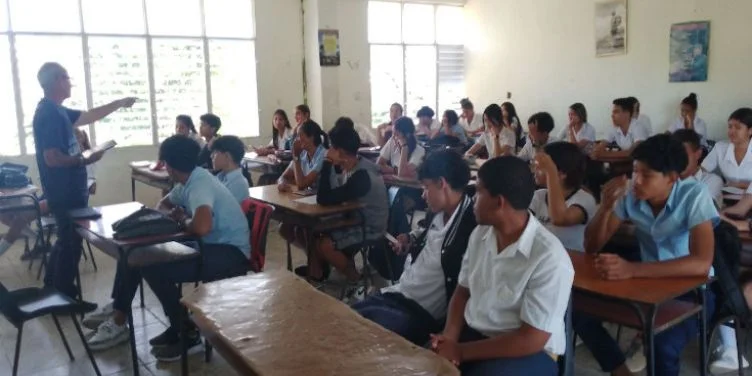
What the family lived was no exception. During the 2024-2025 school year, thousands of students in Cuba faced a cocktail of adversities that undermined educational quality. Prolonged blackoutsalmost paralyzed public transport and growing economic difficulties in homes made the school year a resistance test for students and their parents.
Imaray Suárez Rojas had to suffer in her daughter’s waking every morning she had to attend her school, a basic high school in Centro Habana. The interviewee says that “she wanted to study, but she couldn’t anymore.” “There were days without water, without being able to sleep through the blackout, without bread for breakfast or snack because it was said that there was no flour in the country,” he adds.
According to an official of the Ministry of Education (MINED), consulted by Cubanet On condition of protecting their identity for fear of losing their job, one of the main problems of the course was low school attendance, largely caused by the impossibility of students to sleep properly due to heat and mosquito bites during nights without electricity.
“The parents did not send them to school even though we insisted a lot,” he said.
In addition, he added that the blackouts complicated daily tasks such as washing or ironing school uniforms. The lack of proper costumes led to numerous students to be absent, without a practical solution, since for years the sale of uniforms fails to cover national demand.
To this was added the transport crisis, which caused the pre -university students and technical schools to become less accessible. Although the young people left in advance, the lack of buses condemned them to be late or miss. “For some specialties, there is nothing more or two schools per province,” said the official.
The situation forced the centers to make their internal standards more flexible so as not to penalize the students and withdraw the right to examine, due to the “unjustified” absences.
Less quality in teaching
The school year started on September 2, 2024, but did it by dragging old wounds. The teacher deficit, far from resolving, was deepened even more. The crisis not only hit the students: the teachers, who also suffer the blackouts, the lack of transport and an asphyxiating economy, expressed their discontent for low wages and adverse working conditions.
“Many teachers asked for liberation when a better paid job appeared. Others simply tired. Education has become a very hostile, ungrateful medium,” he told Cubanet The consulted official, who also explained that primary schools raffled better from the escape of teachers unlike the higher levels of education.
“No school could guarantee a teacher for each subject,” he added. The lack of staff forced to maintain multi -employment, a measure that allows teachers to work in two places, even in different centers, and collect a double salary. But in practice, this initiative reduced the preparation time of teachers and the classes that should be given.
Julio Román Cáceres is one of the professors who abandoned the classrooms, in early 2025. When leaving teaching, he confesses that he felt relief, but also blames after dedicating 12 years to the teaching staff, during which he taught classes in bad conditions: classrooms with leaks and without teaching materials, for a salary that barely reached him for the passage.
“Above the problems and deficiencies, education is a fraud, it is based on inflating balloons so that they do not reduce the salary of the year due to an evaluation that in the end does not depend on you. Nobody cares to teach. Abuse within the same sector, and the need, they are killing the vocation. It is no accident that the classrooms are increasingly empty,” said the exprofesor.
The students paid the disaster
Despite receiving few classes, there were no warm cloths: the students presented themselves to exams that were made with the same rigor.
Italy Gómez Álvarez, a student of Pedagogy in English, stressed that she and her classmates “sailed” between the lack of professors of certain subjects and the incomplete plans of others, which were “the best covers.”
“The teachers were disconnected, there were more than the students. When they stopped in front of the classroom, it was to give a talk, a tooth of anything, so that time left. The class stayed in the air. When the tests arrived, nobody knew anything,” Gomez said.
According to Mayra Salina Pulido, this year she left more expensive than ever sending her son to study: so that she arrived in time to school, where she was formed as a medium computer technician, she had to pay hundreds of pesos every morning to private carriers.
“In the middle of the morning I called me and they had not yet taught. Sometimes the day was going and they did nothing. The thing is very bad to throw the money, so I started sending him twice a week,” said the woman.
The school never claimed for the absences, justified with the difficulties to transport. “I waited until the final tests; if they didn’t approve it, I was going to burn Troy. He didn’t learn anything, but they had a degree,” the interviewee ended.